
Read time ca. 6 minutes
The blue whale has 1,000 times the number of cells that a human has, and a human has 1,000 times the number of cells that a mouse has. Since every cell has a small chance of mutating into cancer when it divides, the mathematics is not favorable to large organisms; thus, they should be prone to getting cancer more often when compared to small entities. This is why it should be noted that the whales and elephants would be full of tumors long before they become adults, while the mice would never live long enough to get any. Nevertheless, in reality, the exact opposite happens. Laboratory mice suffer high rates of cancer during their short two- to three-year lifespans, whereas whales and elephants routinely live for decades with remarkably low cancer rates.
This is something that was investigated, and in the end it was coined as the Peto’s Paradox, which was actually pointed out for the first time in the 1970s by the British epidemiologist Sir Richard Peto. Logically speaking, the risk of developing cancer increases exponentially when both cell numbers and time of cell divisions increase. However, in reality, body size and lifespan have nothing to do with how prevalent cancer is across different species. This paradox was named after Sir Richard, as he brought attention to scientists to investigate this further.
The Origins of Peto’s Paradox:
When Richard Peto presented his findings in 1977 by comparing cancer incidence in mice and human beings, the inadequacy of the model used to explain the process of tumor formation became quite apparent. It is based on the assumption that cancer results from a random event, basically something that could be considered a lottery. At each instance of cell division, the DNA replication system is susceptible to making errors, and every error made brings it a step closer to becoming cancerous. Since there are many more human cells than those in mice, which divide over a much longer period of time (70-80 years vs. 2-3 years), it follows that the probability of developing cancer is vastly greater in humans; therefore, humans ought to face an overwhelmingly higher lifetime risk of cancer.
But the epidemiological records across different species revealed that the lifetime death rate from cancer was quite constant regardless of their huge body size differences. Comparative studies by veterinary doctors and evolutionary biologists also verified the observations made by Peto across all animal species. Whether it be small animals like shrews or giant mammals like marine mammals, even those with orders-of-magnitude differences in number of cells, had similar or even lower cancer death rates. The Paradox showed that cancer is not just a mathematical certainty depending on body size but an active biological feature that evolved.
Evolution’s Anti-Cancer Arms Race:
With the evolution of prehistoric mammals, which became large and slow-reproducing animals, there was a dead end, or in other words, they hit an evolutionary wall. You could not develop into a creature weighing several tons and have to wait 20 years to reproduce if cellular mutations were constantly causing death in your youth. This would mean that the cancer would reach you before you had the chance to reproduce, thus giving your species the death penalty and the inability to continue evolving. Hence, nature made large animals evolve better protection from mutations, and it did so in various ways.
Elephant Tumor Suppressors and the LIF6 Zombie Gene:
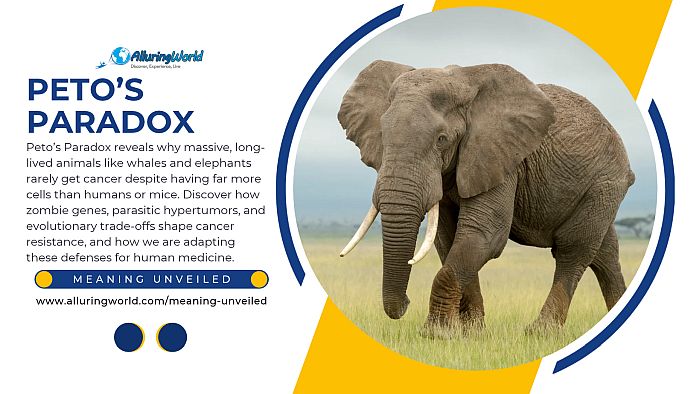
The elephants largely depend upon an explosive response to their own destruction. The human genome has just one pair of TP53, also known as the “guardian of the genome” due to its ability to detect DNA damage and stop cells from dividing. The African elephant and the Asian elephant, on the other hand, have 20 copies of TP53.
Working alongside those extra copies is a resurrected pseudogene known as LIF6, which geneticists nicknamed the “zombie gene.” Millions of years ago, LIF6 was a broken, non-functional stretch of DNA in elephant ancestors. Somewhere along their evolutionary path to gigantism, it switched back on, so when TP53 detects even minor DNA damage in an elephant cell, LIF6 rushes to the cell’s mitochondria and punches holes in them, thus forcing the damaged cell to commit suicide immediately. Rather than trying to repair risky cells the way human bodies often do, elephants wipe them out before they have a chance to turn malignant.
Whale Metabolism and Hypertumors:
Whales have a completely different strategy to deal with cancer; however, physics has something to say here. For example, the bowhead whale may survive more than 200 years and weigh more than 75 metric tons (82.7 short tons) without developing tumors. Together with additional genes responsible for repairing DNA, such as ERCC1 and PCNA, whales probably use hypertumors.
In order for the tumor to be fatal to a multi-ton whale, the tumor must be very large, weighing several kilograms (several pounds). At such a size, the tumor becomes unstable and so large that the cancerous cells in the tumor itself evolve to take over its blood supply. The cancer essentially creates its own parasitic cancer. This competing “cheater” cancer takes away all the oxygen and nutrients from the tumor, thus making it collapse before it can cause any harm to the whale. Additionally, the larger cetaceans have much slower resting metabolic rates and slower cell division rates per gram of tissue than small rodents, reducing the oxidative stress and replication errors that spark mutations in the first place.
ADVERTISEMENT
Other Surprising Outliers in the Animal Kingdom:
Even as the whale and elephant embody the paradigmatic examples of Peto’s Paradox, scientific studies have uncovered evidence showing that there is a range of species much smaller than their giant counterparts that still have unusual anti-cancer capabilities. Another great example of other animals that beat cancer is the naked mole rat. This is a digging rodent weighing only 35 grams (1.2 ounces), but it has a life expectancy of 30 years and hardly gets cancer. These animals secrete hyaluronic acid through their cells that is extremely sticky, which helps trigger early contact inhibition so cells stop dividing once they crowd and touch one another. These exceptions help in distinguishing the defense mechanisms based solely on huge body size and those based on long lifespan.
Why Small Animals Play a Different Game:
If these defenses work so well, why didn’t mice or humans evolve 20 copies of TP53 too? This is because evolution has to weigh and balance the cost of survival with the cost of reproduction. Continuous induction of apoptosis in damaged cells results in depletion of stem cell populations and hastens the aging process. Laboratory tests conducted on genetically modified mice with highly active TP53 proteins showed that these mice were extremely resistant to cancer formation; however, they aged prematurely and suffered from organ atrophy and died early from tissue degeneration.
For a mouse avoiding predation in nature, survival past two years does not matter at all, as it must focus on developing rapidly and reproducing within months. Cancer resistance would only delay its development and waste the energy needed for quick reproduction. We, the humans, are somewhere in between, sufficiently protected to reproduce and raise our children but still susceptible once we get older and enter the stage when natural selection no longer affects our genetics. Once an organism passes its prime reproductive period, natural selection does not have much influence on late-onset diseases.
Bringing Giant Defenses to Human Medicine:
Peto’s Paradox is no longer seen as just an interesting biological phenomenon; scientists want to convert these biological workarounds into clinically useful treatment therapies. Some scientific groups have successfully used synthetic forms of the elephant TP53 proteins on human cancer cells in the lab that cause the death of tumor cells instantly and without affecting normal surrounding cells. Using nanoparticles containing functional TP53 variants from elephants, researchers would be able to deliver increased cellular surveillance to the human cancer cells without prematurely aging the body.
Others are studying bowhead whale DNA-repair proteins to see if they can protect human cells from radiation and age-related genetic decay. Early laboratory trials transferring bowhead whale repair proteins into human cells have already shown measurable improvements in double-strand DNA break repair, a critical bottleneck in both cancer prevention and healthy aging.
Conclusion:
Peto’s Paradox reveals that cancer is much more complicated than just a numbers game determined by the number of cells and their lifespan. Over the course of millions of years of evolution, large and long-living creatures have developed various biological mechanisms, such as the highly sensitive TP53 and LIF6 self-destruction system in elephants or the efficient DNA repair system in whales.
Nature has already conducted millions of years’ worth of clinical trials to figure out how to keep huge, long-living bodies tumor-free. By uncovering the secrets behind how whales starve their tumors and how elephants remove harmful cells at first sight, oncologists are finding ways to prevent cancer that evolution has never managed to develop in humans. With all this ongoing research, maybe someday soon we will be able to say that we beat cancer, and we can have our loved ones who suffer from it stay alive and well.