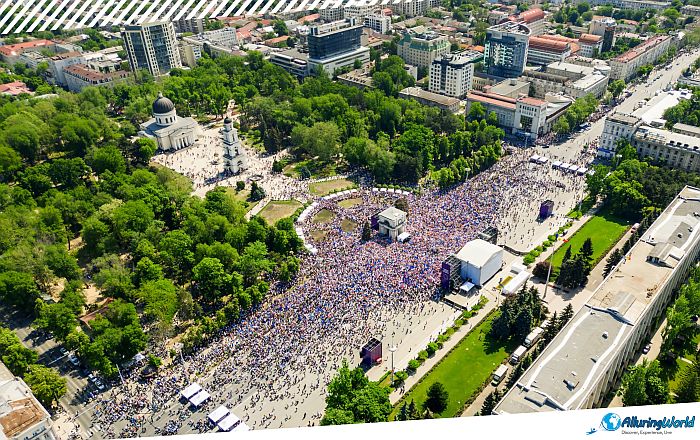
The Nativity Cathedral of Chișinău, locally referred to as Catedrala Nașterii Domnului, is the main Eastern Orthodox cathedral that serves as the main religious object of the Moldovan Orthodox Church, located in the absolute geographical and civic heart of Chișinău, the capital city of the Republic of Moldova. The cathedral is far more than a masterpiece of religious architecture since it serves as the enduring spiritual anchor of Moldova, a silent witness to geopolitical shifts, and a beacon of cultural preservation. Surrounded by the lush, shade-dappled pathways of Cathedral Park (Parcul Catedralei) and aligned with the majestic Triumphal Arch, the cathedral complex frames the central boulevard of Ștefan cel Mare.
If you are a tourist, a historian, or simply a spiritually minded person traveling to Chișinău, then you have a unique opportunity in this monument complex to delve deep into the heart and soul of Eastern Europe. It is quite important that you know the history of its creation, demolition, and eventual glorious resurrection to be able to understand the Moldovan Christian identity. The history of the Nativity Cathedral cannot be separated from the 19th century, especially from the era after the signing of the Treaty of Bucharest in 1812, which led to the incorporation of the region of Bessarabia into the Russian Empire. Although Metropolitan Gavril Bănulescu-Bodoni envisioned the sanctuary, the foundation stone was laid in 1830, nine years after his death, under the direction of Prince Mikhail Semyonovich Vorontsov, Governor-General of the region, to establish a central seat for the Orthodox Diocese of Bessarabia.
Commissioned to bring this vision to life was the renowned Russian architect Avraam Melnikov, who based the project on a twin blueprint similar to his design for the Transfiguration Cathedral in Bolhrad. Design work commenced under strict Imperial Neo-Classical guidelines, a style popular throughout Europe and Russia during the 1830s. Melnikov designed an ensemble where every dimension was governed by symmetry, balance, and spatial harmony. Construction began in 1830 and concluded in 1836, when the cathedral was consecrated as the mother church of the Moldovan Orthodox faith.
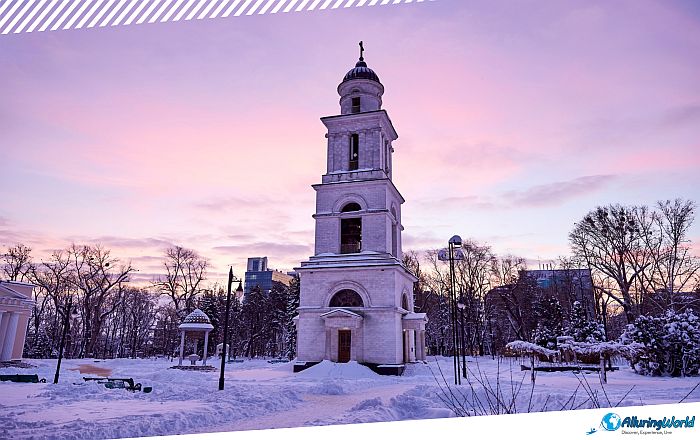
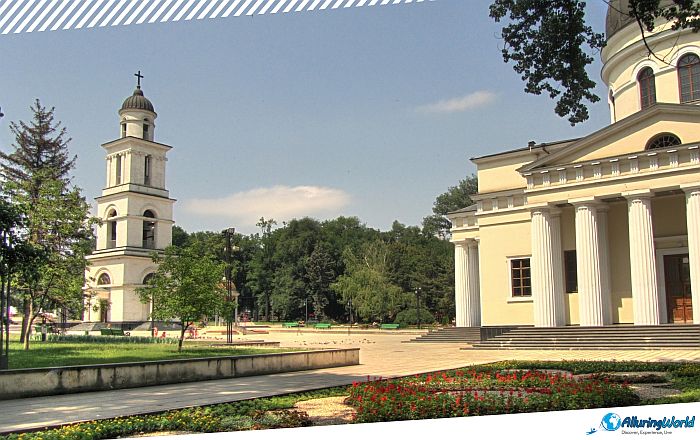
The spatial planning of Melnikov was much broader than the physical boundaries of the main church structure. His design allowed for the placement of the cathedral, the four-level bell tower close to it, and the nearby triumphal gate along a particular architectural axis. Thus, this impressive urban planning project successfully merged the sacred building into the civic plan of developing Chișinău town. The design of the Nativity Cathedral showcases an intricate blend of Neo-Classical precision and Byzantine dimensions of Russian tradition. In a long shot, the complex presents a striking visual silhouette: the reconstructed bell tower reaches a height of about 42 meters (138 feet) above ground level, while the cathedral’s central dome, restored during the late 1990s with a protective zinc shell, rises to 25 meters (82 feet), its surface contrasting sharply with the verdant surroundings.
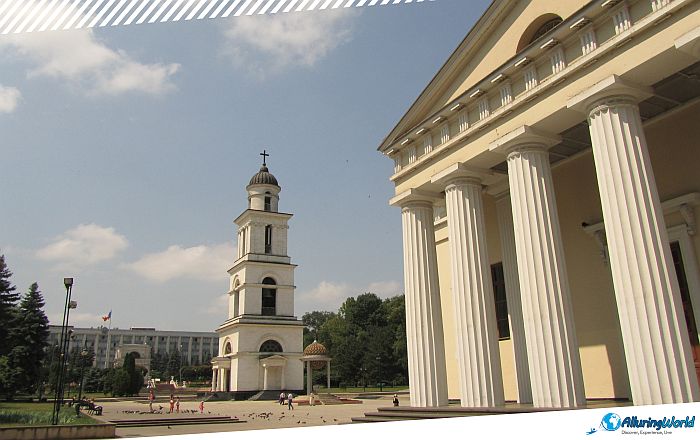
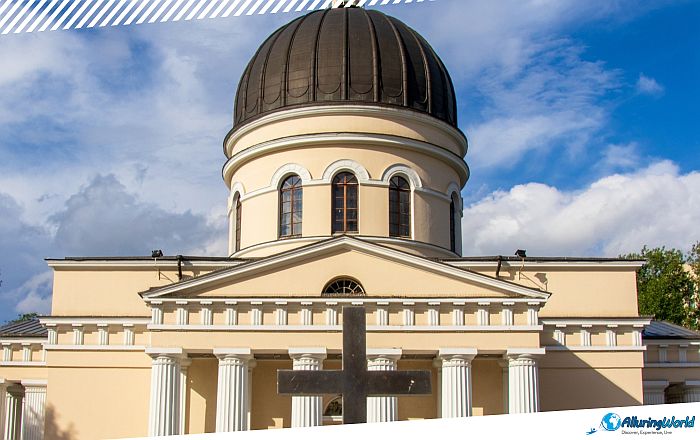
The main body of the cathedral is built on a symmetrical cross-shaped plan, featuring crisp white exterior walls anchored by four imposing porticos. Each entrance is supported by six massive Doric columns supporting classical pediments, lending the structure a sense of permanent strength and dignity. The central dome rests on a large cylindrical drum punctuated by high arched windows that channel natural sunlight directly into the nave below. Once entering through the large wooden doors, you will leave behind the outside world and enter a welcoming space that is filled with yellow tones and religious paintings. The walls on the inside are covered with beautiful Orthodox frescoes of scenes from the Gospel and of the holy saints. The magnificent iconostasis, which is a carved wooden wall covered with gold foil and hand-painted icons, creates a barrier between the nave and the altar and acts both as an art piece and a religious focal point.
The 20th century was a very difficult period for the Nativity Cathedral. During World War II, the city of Chișinău was subjected to intense bombing during the military actions that took place in Eastern Europe. In 1941, the bombings inflicted serious damage to the cathedral’s interior, damaging the original decorations and causing a fire to break out in the wooden roof. Although basic repairs were initiated in the years immediately following the war, a far more systematic campaign against the cathedral began under the militant atheism of Soviet rule. During the 1960s, state authorities officially stripped the cathedral of its sacred status, and the church was closed to religious practice. Its sacred interior furnishings were removed, and the building was repurposed as an official exhibition center for the Ministry of Culture, hosting state art displays.
ADVERTISEMENT
The worst disaster befell the cathedral in December 1962, when the Soviet authorities demolished the historical bell tower overnight, under the cover of darkness. The debris was removed, and a concrete fountain was built on the foundation of the tower as a way of removing it from public memory. In the eyes of the Moldovan people, for almost three decades, the cathedral complex without a tower became an embodiment of oppression, and a desire to rebuild it so that the Nativity Cathedral of Chișinău would regain its former glory. The dissolution of the Soviet Union and Moldova declaring independence in 1991 resulted in a cultural renaissance for the small nation in Eastern Europe. The renovation of the historic city center of Chișinău and the renovation of damaged sites during those times were seen as a matter of national pride. The most pressing of the tasks was the reconstruction of the Nativity Cathedral complex.
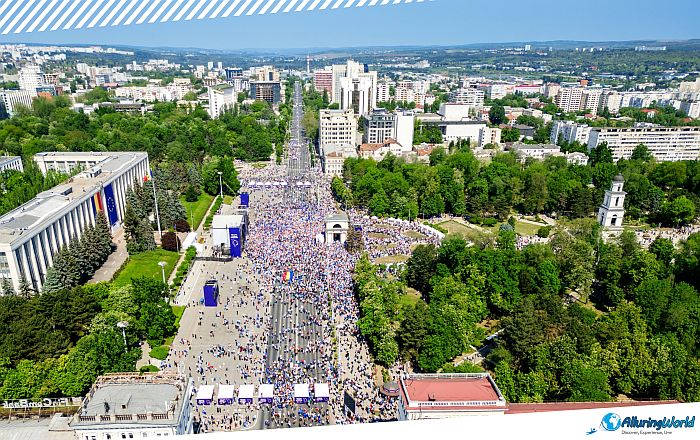
By the mid-1990s, local government officials and church clergy undertook a major architectural restoration program. The architects depended on historical plans of the 19th century and old photos that existed from the past in their effort to maintain accuracy. Restoration of the bell tower began directly over its original historic foundation, requiring the removal of the Soviet-era structure. As part of the overall 1990s park renovation, a new decorative fountain was positioned nearby in front of the rebuilt tower along the central plaza.
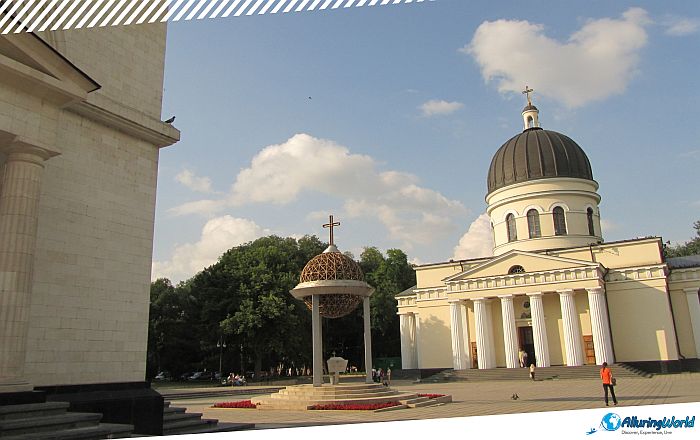
The newly constructed four-tiered bell tower received its consecration in 1997, thus bringing back the spatial symmetry that had been conceived by Avraam Melnikov over one hundred years ago. This event was a landmark moment for the contemporary history of Moldova, and especially for the Moldovan people. The renovated structure today houses a new set of bronze bells, created through classical methods, and their melodies can now be heard on a daily basis in the capital city. In subsequent renovation processes, the interior frescoes were restored, the copper roof repaired, and exterior lighting installed. Highlighting its cultural importance, the National Bank of Moldova issued a special silver commemorative coin featuring the cathedral ensemble to mark its 180th anniversary.
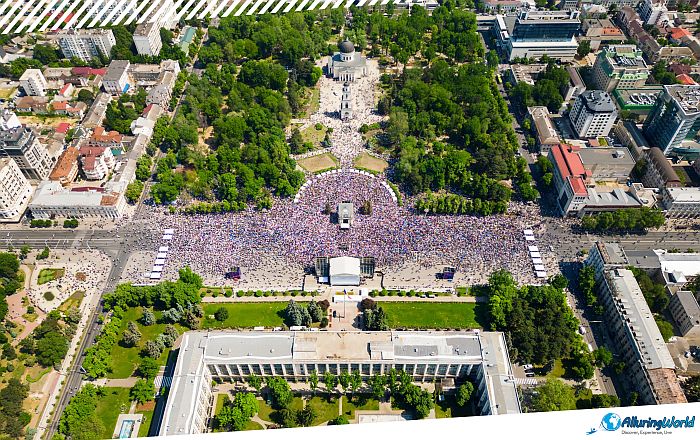
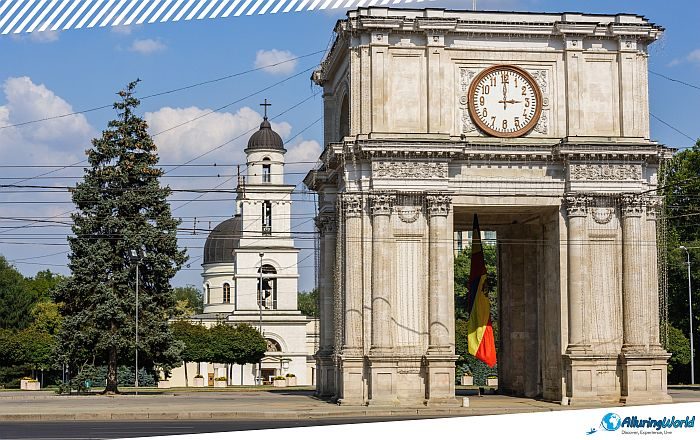
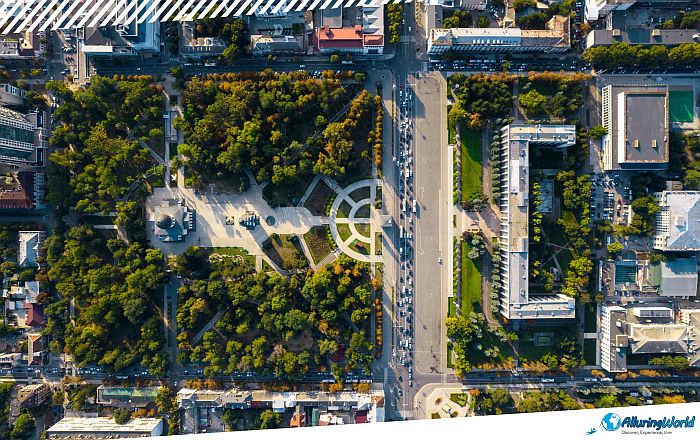
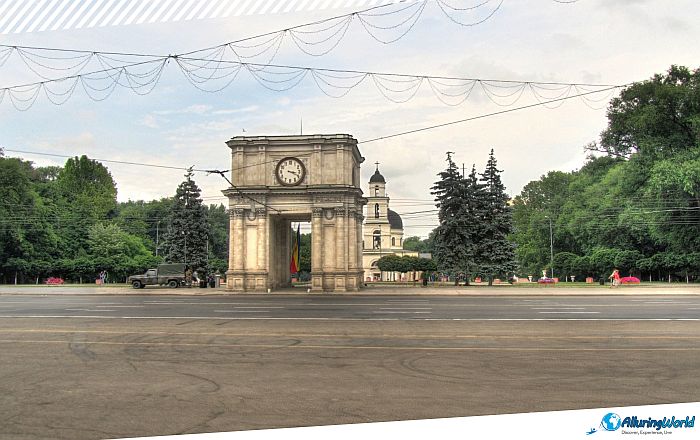
A visit to Chișinău’s Nativity Cathedral can never be considered complete without visiting the civic space around it. This cathedral finds itself in the Cathedral Park (Parcul Catedralei), which is essentially an urban garden that was created as an urban retreat. Walkways in straight lines with well-established lime and maple trees sprouting from them spread out of the central sanctuary. Opposite the cathedral, on the other side of the central square and positioned perfectly in line with its main entrance, is the Triumphal Arch (Arcul de Triumf), otherwise known as the Holy Gates (Porțile Sfinte), a structure designed by architect Luca Zaușkevici and completed in 1841. The square Corinthian-style arch was built to house an enormous 6,400-kilogram (14,110-pound) bell cast from captured Ottoman cannons in Izmail, which proved too massive to fit into the cathedral’s original bell tower.
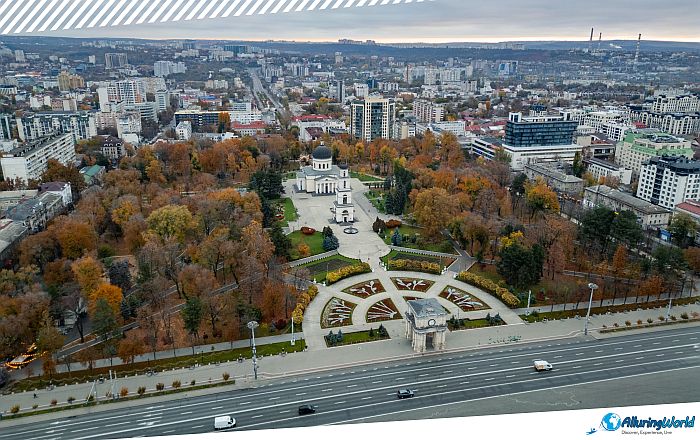
Visitor Insight: When you are standing under the Triumphal Arch at sunset, you are offered the finest photographic perspective of the cathedral, hence framing its central entrance and restored bell tower perfectly against the evening sky. When you visit the Nativity Cathedral, you will notice that it is quite simple due to its central location in downtown Chișinău. Because the site remains an active house of worship for the local community, keeping a few essential practical details in mind ensures a respectful experience. Important details you should be aware of are:
- Location: Bulevardul Ștefan cel Mare și Sfânt 138, Central District, Chișinău.
- Operating Hours: The cathedral opens daily from 07:00 to 19:00, with morning liturgy typically commencing at 08:00.
- Admission: Entry to both Cathedral Park and the cathedral sanctuary is completely free.
- Dress attire: Modest dress is expected; shoulders and knees should be covered when entering the main sanctuary. Women are traditionally expected to cover their heads with a scarf, while men should remove headwear prior to crossing the threshold.
- Photography: Taking photos inside the cathedral during active religious services is strictly prohibited to respect worshippers, but otherwise you are free to take pictures.
In summary, the Nativity Cathedral of Chișinău stands as a thriving living museum of remarkable architectural beauty and a monument to the resilience of the Moldovan nation. From its first construction with influences from Russian Neoclassicism to its restoration after independence, the cathedral is a manifestation of the resilience of the Moldovan people and their perseverance in religious freedom. Be it for viewing Melnikov’s masterpiece, hearing the sound of the bell towers after their restoration, or sitting in the shadow of the trees in Cathedral Park, the Nativity Cathedral is a must-see while visiting Eastern Europe, and especially Moldova’s capital city.