
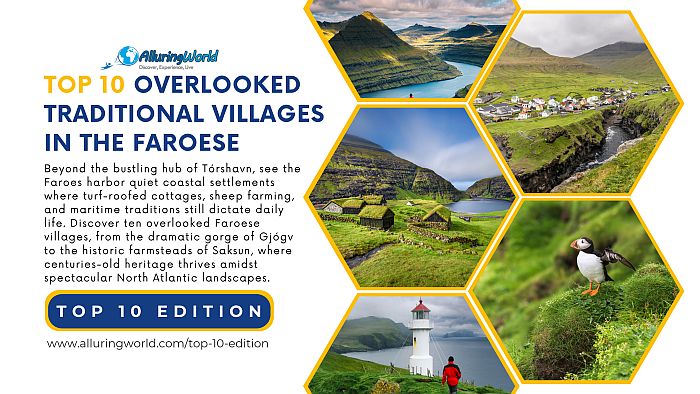
The Faroe Islands are an isolated chain of islands in the North Atlantic that feature impressive rock formations, green mountains, deep fjords, and long-lasting traditions that make them some of the most unique cultural regions of Europe. Although many tourists travel to the capital city of Tórshavn, the amazing Vágar Island, the popular village of Saksun, and the beautiful region of Gjógv, other places remain quietly preserved, offering a world of small villages where fishing, sheep farming, boat building, and Faroese traditions continue to shape everyday life. Faroese villages have evolved throughout history based on the strengths and weaknesses posed by the location on the islands. With unpredictable oceans and towering mountains surrounding them, the people learned to rely on fishing, bird hunting, sheep husbandry, and the strong kinship ties that existed among people.
Traditional Faroese villages are known for their black wooden houses with grass roofs, colorful homes, small harbors, stone walls, traditional boat sheds, and landscapes where sheep often outnumber people. The communities living on these islands continue to preserve customs such as the Faroese chain dance, traditional wool production, rowing competitions, local fishing practices, and seasonal celebrations, thus making them an interesting part that you should see. Because each island has its own character, the northern villages are often surrounded by dramatic mountains and narrow fjords, while the western settlements face the powerful Atlantic Ocean. In addition, smaller island communities preserve traditions that were shaped by isolation and self-sufficiency. While modern infrastructure has made it possible for some villages to connect through tunnels, ferries, and roads, there are still many villages that retain their traditional identity. These places will give you an opportunity to slow down and immerse yourself in the unique blend of community, nature, and heritage. These are ten overlooked villages where you can get a taste of traditional Faroese culture.
1. Gjógv, Eysturoy Island: A Village Built Around Nature and the Sea
Situated on the northeastern coast of Eysturoy Island, Gjógv is one of the most beautiful and historic villages in the Faroe Islands. The name of the village is derived from a natural gorge that creates a harbor for pulling boats inland. Over many years, this unique feature provided the villagers with means of sustaining their fishing culture. The people of the village depended upon fishing, sheep farming, and some agricultural activities; however, the steep mountains around the area made agriculture difficult. The grass-roofed houses, colorful buildings, and narrow streets speak to how the village has adapted to its harsh surroundings over the decades. Even though Gjógv has become a popular destination for tourists nowadays, it has managed to maintain its traditional atmosphere because the village is still a place where you can witness some of the traditional ways of the Faroese people as well as listen to the tales and myths associated with the landscape.
- Highlight: The dramatic natural gorge and sea-filled boat basin that gives the village its name.
- Best For: Coastal photography, hiking, and exploring traditional maritime history.
2. Saksun, Streymoy Island: A Remote Village of Pastoral Traditions
Hidden at the end of a narrow valley on Streymoy Island, Saksun is one of the most atmospheric villages in the Faroe Islands. Surrounded by mountains, waterfalls, and a tidal lagoon, the village appears almost untouched by time. Historically, residents depended mainly on sheep farming and agriculture rather than fishing. This remoteness of location led to the development of a self-sufficient way of life involving livestock farming using only what nature had to offer around them in the area. There are some old blackhouses with turf/grass roofs, a church dating back in time, and some stone walls reflecting the old architecture of the village. The natural surroundings have always been the key factor in the locals’ lives, and they have coped with the harsh weather conditions and lack of fields to cultivate.
- Highlight: The historic Dúvugarðar farm museum and the stunning amphitheater of surrounding waterfalls and tidal lagoon.
- Best For: Pastoral landscape photography, quiet walks, and rural history.
3. Kirkjubøur, Streymoy Island: A Village of Faroese History and Heritage
Situated on the southern coast of Streymoy Island, Kirkjubøur is one of the most historically significant villages in the Faroe Islands. For many years, it has been the cultural and religious hub of the archipelago due to the architecture that can be found there. Some of the historic sites include the ruins of Saint Magnus Cathedral, locally referred to as Múrurin, and one of the oldest inhabited wooden houses in the world, Kirkjubøargarður. Beyond its historical importance, Kirkjubøur has long been connected with farming traditions. Generations of residents have practiced sheep farming and agriculture on the surrounding coastal land. Overall, it embodies the strong bond that exists between Faroese identity, religion, agriculture, and traditional construction, giving tourists insight into the roots of the culture of the Faroe Islands.
- Highlight: The ancient timber farmhouse of Kirkjubøargarður and the medieval ruins of Magnus Cathedral.
- Best For: Medieval history, architectural heritage, and cultural exploration.
4. Tjørnuvík, Streymoy Island: A Village Between Mountains and Ocean
Situated on the northern tip of the island of Streymoy, Tjørnuvík is a village embraced by towering mountains and open waters of the Atlantic. Its emergence is associated with fishing and farming, and the people living here rely on the ocean and the earth to maintain their lives. Local grass-covered houses and stunning seascapes remind us that the village has a longstanding connection with nature. Sheep raising was historically crucial to the villagers, along with fishing providing necessary resources to sustain life there, but overall, the remoteness of the place helped to preserve numerous features of traditional Faroese villages.
- Highlight: The iconic view looking out toward the legendary sea stacks known as Risin and Kellingin (the Giant and the Witch).
- Best For: Surfing, dramatic coastal views, and remote village atmosphere.
5. Haldórsvík, Streymoy Island: A Village of Fishing and Farming Traditions
Located in a sheltered bay of the island of Streymoy, the village of Haldórsvík is an old-fashioned Faroese settlement that lies amid mountains and verdant valleys. Typical for many villages of the Faroe Islands, Haldórsvík emerged as a result of the interaction of agriculture and fishing. Villagers used to make use of small vessels, practiced shepherding, and made attempts to cultivate farmland in this area. The local village church, as well as houses, reveals the long-term relationship of villagers with the surrounding nature, but overall, the traditions of this place, such as the Faroese language, have played and still play an important role in the life of Haldórsvík.
- Highlight: The unique octagonal village church built right on the edge of the crashing waves.
- Best For: Unique ecclesiastical architecture, quiet exploration, and fjord scenery.
ADVERTISEMENT
6. Mykines, Mykines Island: A Village of Seafarers and Bird Hunters
Situated in one of the westernmost islands in the Faroe Islands, Mykines is one of the most remote and unique communities in the archipelago. For years, inhabitants made their living from fishing, sheep farming, and seabird catching. The steep cliffs of the island serve as home to thousands of seabirds, whose catching played a crucial role in island traditions. As a result of its remote location, a spirit of self-reliance and cooperation within the community developed in Mykines. Grass-roofed homes, narrow alleys, and a small port are evidence that this little village is in tune with the environment around it. Even though the village today is small, it continues to be an inspiring symbol of Faroese survival and adaptation, providing visitors with unique insight into an island lifestyle.
- Highlight: The bustling puffin colonies and the footbridge stretching across to the islet of Mykineshólmur.
- Best For: Birdwatching, rugged island hiking, and wildlife photography.
7. Funningur, Eysturoy Island: A Village Beneath the Highest Mountain
Funningur is located on Eysturoy Island amidst steep mountains and is one of the oldest villages in the Faroes. As per Faroese culture, the village is among the first few that were established in the Faroes. The village evolved around two main occupations, namely fishing and sheep raising, which suited their landscape surrounded by steep mountains. The traditional buildings, old church, and winding paths make it easy to notice the ancient character of the village. The steep mountains that surround the village have always been an influential part of village life, providing pastures but also making it remote at the same time.
- Highlight: The historic wooden timber church with its grass roof nestled against the towering slope of Slættaratindur.
- Best For: Mountain backdrop photography, ancient history, and scenic valley drives.
8. Húsavík, Sandoy Island: A Village of Farming and Island Heritage
Húsavík is a village on Sandoy Island, and it is a quiet village characterized by its agricultural history and traditional environment. While other villages situated on the coast were mostly characterized by their fishing industry, Húsavík developed with a strong agricultural foundation. The people living in this village have been raising cattle and sheep and are still engaging in agriculture on small pieces of land. Many of the houses in this village are traditional houses with green surroundings as well as quiet roads that characterize the rural areas, but overall, Sandoy Island still retains much of its Faroese culture due to its rural nature.
- Highlight: The medieval stone ruins known as Sjógv, associated with the legendary Viking-era chieftain’s wife Guðrunríð.
- Best For: Slow travel, agricultural heritage, and Viking-era lore.
9. Norðradalur, Streymoy Island: A Hidden Valley Village
Situated in a remote valley of Streymoy Island, Norðradalur is one of the smallest and most tranquil villages in the Faroe Islands. The village is enclosed by impressive mountains and the scenery of the surrounding islands. In the past, inhabitants relied on sheep farming and subsistence agriculture. Due to difficult topography, it was necessary for farmers to adapt and make use of all areas of grassland, so the traditional buildings, open landscape, and lack of any urbanization make it possible for visitors to feel connected with the history of the place.
- Highlight: The sweeping panoramic mountain road descending toward the sea with uninterrupted views of Koltur Island.
- Best For: Solitude, dramatic winding road drives, and sunset viewpoints.
10. Elduvík, Eysturoy Island: A Village of Traditional Coastal Life
Situated along the eastern shore of Eysturoy, Elduvík is a small village that is surrounded by mountains and the ocean. Elduvík has traditionally relied on the local practice of fishing and farming, and its inhabitants have always obtained their food and money through harvesting the ocean and raising sheep on its hills. Traditional houses, a tiny harbor, and a peaceful environment characterize the village and show the difficulties and picturesque nature of life in the Faroe Islands. Local traditions and storytelling are an integral part of the village culture.
- Highlight: The peaceful river flowing right through the center of the village past old multi-colored and turf-roofed cottages.
- Best For: Authentic coastal village life, gentle streamside walks, and peaceful isolation.
Planning Your Journey to Rural Faroe Islands
Visiting the Faroe Islands’ traditional villages is an exciting alternative to Europe’s busy cities. Here you can directly encounter living history, nature, and hospitality, something that cannot be experienced in other parts of Europe or the world. To have a great travel experience in these historical areas, it is recommended to consider some practical tips that would help you explore these places much better:
- Getting Around: Although bigger hubs such as Tórshavn, Klaksvík, and Runavík have public bus connections that are infrequent, it is advised that you rent a car when traveling to far-flung villages such as Saksun and Gjógv, because this way you will be able to see more, as you can stop and experience different sections of the trip.
- Best Time to Visit: Late spring through early autumn (May to September) offers optimal weather for countryside hiking, outdoor heritage explorations, and long daylight hours for village sightseeing.
- Local Culinary Must-Try: Be sure to sample skærpekjøt (traditional wind-dried fermented mutton) and fresh Atlantic seafood at local village eateries and traditional guest houses.
All in all, there is much more that you can experience when discovering Faroese villages that usually do not get much attention. Here you will find a culture built on the basis of isolation from others, living in contact with nature, and developing over a long period of time because of adaptation to conditions of the North Atlantic. It has to be noted that the people have managed to keep various traditions concerning fishing, raising sheep, crafting, folklore, and respecting nature.
All listed places here show that Faroese heritage is not limited to museums and historically important places in the bigger settlements. Faroese heritage can also include turf-roofed houses, fishing boats, village fests, crafting, local folklore, and communities maintaining connections with the sea and mountains. Thus, if you look for an authentic visit beyond popular places, it will be a worthwhile trip to explore some of the villages of the Faroe Islands.