
Read time ca. 7 minutes
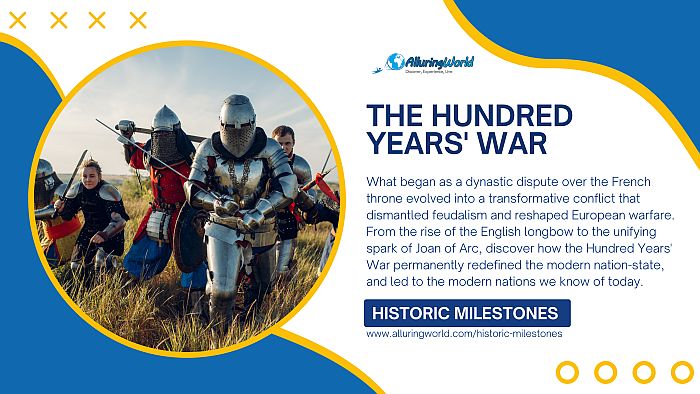
While the name Hundred Years’ War would suggest a war that lasted for 100 years, in reality it was not one continuous war but rather an extended period of wars, truces, and renewed warfare between England and France. The war took place between 1337 and 1453, and it changed the face of warfare and nationhood in Europe at that time. A war that started as a succession issue turned into a war that created early notions of nationhood and forever changed the political geography of Western Europe.
This lengthy conflict took place during an era of great turmoil, characterized by famine, plague, and unrest, but in this context, the war fostered further innovations in warfare, undermined feudalism, and consolidated power. At the end of the conflict, the nature of medieval warfare, politics, and community was changed forever, and it turned the world into a more sophisticated and scarier reality.
Origins of the Conflict: Dynastic Claims and Feudal Tensions
The origins of the Hundred Years’ War were in the intricate network of dynastic and feudal relations. Since King Charles IV of France left no male heirs after he passed away, King Edward III of England asserted his right to inherit the French throne on behalf of his mother, Isabella of France. Nevertheless, the French nobility did not like to have an English king, so they opposed this, thus relying on traditional laws of succession favoring the Valois branch of the family.
Apart from the royal bloodline, there were other issues that added to the tension that led to the numerous wars and conflicts. The English monarchs had claims to some French territory, including Aquitaine, in which the king of England was a feudal lord while being a sovereign ruler at the same time. This created a lot of mistrust between the two, but to top it all, the economic rivalry was another cause of hostility since money is always something extra for which people will start fighting.
Early Phases and English Ascendancy:
At the beginning of the war, the English side was more favorable due to the fact that it was due to the quality of their leaders and the new military technology England had developed up to that point. The English army consisted of well-disciplined foot soldiers who used longbows, which could pierce through armor from afar, thus giving them the advantage over other European armies.
The Battles of Crécy and Poitiers were great examples of how successful combined arms can fight against feudal cavalry attacks. This defeat of the French knights destroyed the myth of knight invincibility and revealed the flaws of French military organization. The successes of the English weakened the political and economic stability of France, causing internal strife and reduced royal control.
The Longbow and the Transformation of Warfare:
The Hundred Years’ War was a milestone in the history of military affairs. With the end of the age of heavy cavalry came the age of an emphasis on infantry tactics and teamwork, thus forcing the European armies to think differently from what had been fought until then. That is why the English longbow was first introduced; it became the symbol of such times, especially when the common soldier could influence the course of events and could turn the battles in their favor.
These trends were responsible for destroying the social prestige of the warrior nobility and shifting the perspective of invincibility of the supreme knights. Overall, the conduct of warfare became more professional, as mercenaries replaced feudal levies, but the warfare itself changed, therefore becoming less about individual heroism and more about planning and discipline.
French Recovery and Strategic Adaptation:
Even though France lost some early battles, it started to adapt to this new way of fighting wars. Under the leadership of kings like Charles V, the French decided to use defensive tactics that did not involve engaging in major battles but instead concentrated on regaining their land using sieges.
These administrative reforms helped the French monarchy to gain more control, allowing it to tax and raise troops more effectively. As the French army learned from its past mistakes, in the coming battles that they were fighting, interestingly, they combined infantry, artillery, and fortifications. Eventually, the entire country recovered its stability and gained confidence to continue fighting despite the many years of war.
Civil Strife and the War Within:
Intragroup rivalries were also a factor in the Hundred Years’ War, especially in France. Various groups fought for control of different parts of France, thereby reducing unity within the nation and creating chances for further English interference. There were even some civil wars that took place at various times.
On the other hand, England also had its own problems. Years of war had drained England’s treasury and caused unrest between the king and the nobles. The internal problems that England was facing underlined the enormous price of being at war for so long, so the regular people could not withstand the heavy taxation and times of uncertainty.
Joan of Arc and the Revival of French Morale:
One of the most famous individuals to appear during the latter part of the conflict was Joan of Arc. She was a peasant girl who believed she was guided by God, and her presence to fight against the English boosted the morale of the French she interacted with. Her story was told throughout the nation, thus inspiring more people to join the cause and fight for France.
With Joan’s leadership in the major battles where she fought, she managed to re-establish the soldiers’ confidence and turned the tide in favor of her side. Even though she was later captured by Burgundian forces who sold her to the English, she was in the end killed by the English after being condemned by a pro-English church court and burned at the stake; her legacy survived her lifetime. Today, Joan of Arc has become one of the biggest symbols of national solidarity and defiance in France and worldwide.
ADVERTISEMENT
Gunpowder and the Decline of Medieval Fortifications:
As the war continued, the use of gunpowder weapons became more important. While cannons and guns were first introduced in China during the 12th and 13th centuries (during the Song and Yuan dynasties), evolving out of earlier gunpowder weapons like the fire lance, they spread westward to Europe, where they were adapted for large-scale siege warfare. It is important to note that cannons and guns changed siege warfare by making traditional fortifications outdated, since the cannons could significantly damage the fortifications and the enemy could capture the fort, which might have been considered unconquerable before. Furthermore, the artillery enabled military forces to break through the walls that were previously deemed invulnerable and to kill their enemy from a long distance.
This progression in technology helped consolidate the power that was already there. Only the monarchs could have access to the artillery because it was expensive and required maintenance, but the inclusion of gunpowder was an important step in the development of early modern warfare.
The End of the Conflict and French Victory:
The last period of the Hundred Years’ War was marked by the success of the French side, even though in the beginning it seemed like France would lose the war. The English were deprived of their resources, and internal problems prevented them from continuing to fight abroad. One after another, the English possessions were slowly regained by the French. The last and decisive Battle of Castillon on 17 July 1453, supported by the preceding victories at the Battle of Formigny (1450) and the Siege of Orléans / Battle of Patay (1429), allowed the French to regain their former territories and land, and start building their French nation.
The war was effectively over in 1453, and England lost all its French territories, except for the port of Calais. Still, England was left with very little influence on the continent. France became a united country, politically stronger, while England was forced to look inward, moving into a period of internal conflict which in the end would result in a transition from feudalism to monarchy.
Nationhood and the Birth of Collective Identity:
Probably the most important legacy of the Hundred Years’ War was that of the development of national consciousness, and probably this is the turning point when we started having a more conscious identification with nations, rather than local leaders. The long war period helped develop a feeling of identity amongst people who had been concerned mainly with their local lords or areas, and instead of presenting themselves as people of a certain area, this shifted, and it moved towards identifying more as the country where people lived.
Allegiance came to be defined by language, symbols, and collective memory. Overall, the war was conducive to the adoption of vernacular languages for administration and literature, thus cementing the cultural unity. This was, in the end, classified as the early formation of the modern nation-states.
Economic and Social Consequences:
Since the war caused destruction throughout the rural landscape and left the people to start from the very beginning, as everything they had built would have been destroyed, the consequences of this almost never-ending conflict were far-reaching. The villages were destroyed, agricultural lands deserted, and commerce hampered, so the nations had to rebuild the entire system all over again. Taxes were imposed on peasants and towns, which caused social unrest.
However, at the same time, there were long-term changes that could be seen. Labor shortages strengthened the workers’ bargaining position, and central taxation increased the powers of the monarchy; thus, the monarchy gained more power. Such developments transformed medieval society; for example, both the English and French systems were a feudal-based, thus leading to the eventual weakening of the feudal system and leading to the greater power of the monarchs.
Conclusion: A War That Shaped the Future
In summary, the Hundred Years’ War was more than just a war; it was an agent of change for Europe. Overall, this changed how wars were fought; it reduced the power of feudalism and local leaders, but increased centralization of states, and it somehow helped to develop the nationalism which will continue to be strengthened throughout the centuries.
Its legacy can still be seen in the structures, boundaries, and identities that came after it, and even today there are nations that are still struggling with the nationalism of other nations. Comprehensively, the Hundred Years’ War, by changing the definitions of power, loyalty, and warfare, was the point at which Europe moved from the medieval period into the modern era, which began shaping the entire continent.