
Read time ca. 12 minutes
World War I, which took place from 1914 to 1918, is considered one of the most revolutionary and destructive wars in modern times. Before the start of World War II, the war was known as the Great War due to the massive changes it brought about to both Europe and the whole world in general. Starting as a crisis within the Balkans region, the war soon became an international conflict that involved many countries, huge numbers of troops, and immense destruction. At the end of the war, long-established empires were brought down, and a whole new era of diplomacy began, something that was not seen previously in history.
Unlike previous wars, World War I introduced industrialized warfare on an enormous scale. Advances in military technology, including machine guns, heavy artillery, poison gas, tanks, submarines, and military aviation, combined with outdated battlefield tactics, produced casualties unlike anything the world had previously witnessed. Entire generations were affected by the conflict, and its political consequences would help shape the course of the 20th century, with consequences that would be felt even today.
The significance of World War I is still historic since it marked a change in global politics, the speed of technology development, alliances, and the way that countries conduct diplomacy and wars. This war continues to affect international relations between countries today, the military strategies that leaders make, and the war affects history studies even almost a hundred years after the armistice ended it.
Europe Before the War: A Continent of Rivalries
In the late 19th century and early 20th century, there were many technological, economic, and industrial developments in Europe, so the countries were trying to outrun each other with the power they possessed. Along with all these developments came an increased competition among the great powers of the continent, which included Britain, France, Germany, Austria-Hungary, Russia, and Italy.
Nationalism was one of the most important forces of that period that was growing stronger within the empires and “conquered” nations. Ethnic minorities were trying to obtain more freedom, or even independence, and the states themselves paid more attention to their military power. Such a situation led to increasing rivalry between the states, and thus they had to strengthen their armies in case of possible war.
Imperial competition only served to exacerbate these tensions further and bring further intolerance between the people. Europeans were competing for colonies in Africa, Asia, and the Middle East, which led to diplomatic conflicts that often caused stress in international affairs, although there was always some solution that was agreed upon between the European powers. While most conflicts were solved without any bloodshed, suspicion between nations continued to be present. Overall, the turn of the 20th century saw Europe transform into a continent where political alliances, military planning, and nationalistic ambitions resulted in a progressively unstable international scenario, and what would unfold in the years that followed would scare everyone, especially the historians who would be afraid that history would repeat itself again.
The Alliance System and Rising Tensions:
Military alliances were some of the main characteristics of Europe before the war broke out. The objective of forming these alliances was to secure themselves by having each country come to the aid of another in case they faced an attack; however, the effect was that the crisis turned into a global war of unimaginable consequences.
The members of the Triple Alliance included Germany, Austria-Hungary, and Italy, but Italy eventually defected to the opposing side. In reaction to this grouping, France, Russia, and Britain formed the Triple Entente, resulting in the formation of two rival camps that greatly increased the chances for war and, in a way, were forced by themselves to go to war.
At the same time, states made huge investments in upgrading their militaries and started preparing their soldiers for an eventual conflict. There was a naval arms race between Germany and Britain, as they were building bigger battleships, as well as growing continental armies through conscription and better mobilization plans.
There have been numerous diplomatic crises which were recurrent not only in Morocco but also in the Balkans as well as other regions, and would test these alliances. Even though on many occasions war could be averted, the suspicion never ceased to exist, and it grew amongst Europe’s great powers. By 1914, many governments believed that conflict was becoming increasingly likely, and detailed military plans had already been prepared for large-scale mobilization.
The Assassination That Sparked the War:
The direct cause of World War I happened on 28 June 1914, with the assassination of Archduke Franz Ferdinand, who was heir to the Austro-Hungarian Empire. He was shot by Gavrilo Princip, a Bosnian Serb revolutionary who wanted South Slavs to be unified and free from the rule of the Austro-Hungarian Empire.
Despite the fact that just a handful of individuals committed the conspiracy of the assassination, the political ramifications of this whole event were very serious. Austria-Hungary believed that Serbia was guilty of fomenting nationalism against its multinational empire, and did not consider that perhaps it had been the culprit for the state the empire was in. With German backing, Austria-Hungary sent an ultimatum to Serbia with terms that undermined the independence of the country, but while Serbia agreed to some of the demands, there were other issues which still lingered.
On 28 July 1914, Austria-Hungary declared war on Serbia, but as they were part of the Triple Alliance, as a consequence of this system, the armies of the other states were mobilized soon enough. Soon after, other European powers started meddling with the war declarations, and then Russia began to support Serbia; Germany declared war on Russia and France; Britain joined the fray as a result of Germany’s attack on neutral Belgium. Even though at that time everyone was expecting the war to happen, the political dispute in the end had very quickly escalated into full-blown war.
ADVERTISEMENT
The Early Campaigns and the Western Front:
The German military plan relied upon what was known as the “Schlieffen Plan.” This involved defeating the French Army quickly before turning eastwards against the Russians, so the German troops moved into Belgium and towards Northern France. Nevertheless, their offensive was stopped by the First Battle of the Marne in September 1914. Both sides tried to outmaneuver each other, leading to the development of a trench system that extended from the English Channel to Switzerland.
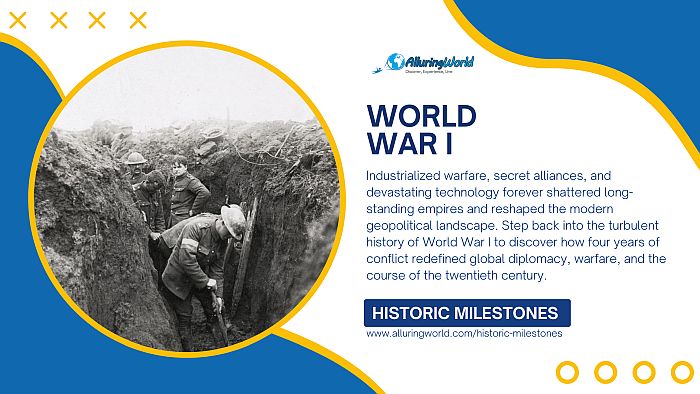
Soon enough, the Western Front became dominated by trench warfare wherein opposing armies entrenched themselves in highly protected defense systems that were separated by small tracts of destroyed land called “No Man’s Land.”
The trenches were safe from both artillery fire and machine guns, but when we see today how the soldiers lived every day in them, we can notice that they were not easy because soldiers had to deal with mud, flooding, diseases, vermin, lack of proper sanitation facilities, and stress caused by frequent fighting. Overall, the Western Front became one of the defining symbols of World War I and illustrated the devastating consequences of industrialized warfare. These historic trenches can be seen even today, throughout the whole of Western Europe.
The Eastern Front and Wider European Conflict:
Whereas most of the attention is usually focused on the Western Front, the Eastern Front was geographically more extensive, involving large military campaigns. The Russian forces managed to invade East Prussia but were defeated during the Battles of Tannenberg and the Masurian Lakes. Nevertheless, the battles continued in Eastern Europe between Germany, Austria-Hungary, and Russia with the same intensity as on the Western Front.
Unlike the relatively static trench systems in the West, the Eastern Front did not have that many trenches, and this part of Europe witnessed greater movement, with armies advancing and retreating over hundreds of kilometers. Meanwhile, additional fronts emerged in the Balkans, Italy, the Middle East, and the Caucasus. Throughout this whole mayhem, the Ottoman Empire actually tried to join the Triple Entente at first, but this alliance rejected them, leading the Ottomans to sign a secret alliance with Germany in August 1914. While at the beginning Italy was on the side of the Triple Alliance, as they were connected with the defensive agreement between the three powers, they entered the war in 1915 on the side of the Triple Entente after changing alliances, as they were promised territorial gains in the Adriatic and Alpine regions via the Treaty of London (April 1915). As more countries entered the conflict, World War I evolved into a truly global struggle involving military operations across Europe, Africa, Asia, and the world’s oceans.
Technological Innovation and Industrial Warfare:
Many new inventions were brought about during World War I, which completely revolutionized the conduct of warfare. The invention of machine guns made it exceedingly expensive to conduct infantry attacks due to the massive defensive firepower offered by these guns. The most significant part of the casualties was caused by heavy artillery, as it could bombard enemy targets from long distances. The use of poison gases like chlorine, phosgene, and mustard gas brought a frightening new element to warfare, something that was not seen before. Despite attempts at protection, chemical warfare created fear as well as health issues.
Apart from that, tanks were introduced in 1916 in an effort to counter trench warfare by traversing rough terrain while ensuring protection for advancing troops with their armor. Despite their mechanical problems, which were quite common, especially when the weather was excruciatingly terrible, the tanks in the end marked the dawn of armored warfare.
Overall, the European powers did not stop there, and they started introducing more and more aircraft to the war effort, as the air war grew in importance. Originally utilized mainly for reconnaissance purposes, the aircraft soon found itself in dogfights and bomb runs as well, thus establishing the basis for air forces, which would prove even more resourceful during World War II. To top it all, submarines revolutionized naval warfare in their own right, as well, through the dangers posed to both commercial ships and warships, having a major impact on international trade and strategy. While history had previously seen great naval battles with ships on top of the water, submarines were a novelty that was even scarier than their counterparts, as they could hide and do greater damage.
Life on the Home Front:
In general, the impact on the civilian population was as profound as on military soldiers. Entire economies were mobilized in support of the war effort, transforming industries into the manufacturing of weaponry, ammunition, and military gear. In addition, agriculture was organized for the benefit of civilians and the army, so rationing was something that became everyday for the people who lived in the warring countries.
Women entered the male-dominated industries of factories, transport, agriculture, and even governmental administrative positions as millions of men were away serving their countries during wartime. Women’s participation greatly increased women’s position in the world and helped advance the movement for equality in politics and the economy.
The governments applied rationing, censorship, and mass propaganda in order to keep the support of their citizens. The citizens were urged to save their resources, buy war bonds, and participate in the country’s production. Nevertheless, the long-lasting war resulted in economic difficulties, hunger, inflation, and fatigue among the people.
The United States Enters the War:
Although the United States initially remained neutral, several developments gradually shifted public and political opinion. Germany’s unrestricted submarine warfare threatened neutral shipping and resulted in the sinking of vessels carrying American passengers and cargo. At the same time, economic ties between the United States and Allied nations strengthened considerably.
The publication of the Zimmermann Telegram in 1917 further heightened the already existing tension. In the intercepted message, Germany suggested to Mexico an alliance between them in case the United States went to war against Germany. As a result of this, in April 1917, the United States declared war on Germany and joined the Allied Powers. American industrial production, financial resources, and the arrival of fresh military forces significantly strengthened the Allied position during the final stages of the conflict.
ADVERTISEMENT
The Russian Revolution and the Changing Balance:
Still, one of the most significant political developments during World War I occurred in Russia. Years of military setbacks, economic hardship, and political instability contributed to the Russian Revolution of 1917. The imperial government collapsed, and later that year the Bolsheviks seized power.
The new government sought to pull out of the war, and hence signed the Treaty of Brest-Litovsk with Germany in 1918. This treaty was important in that it pulled Russia out of the war, allowing Germany to mobilize more troops to the Western Front. Nevertheless, despite the reinforcements, Germany had difficulties coping with Allied offensives supported by America.
The Final Offensives and the Armistice:
In the spring of 1918, Germany initiated a series of offensives to secure victory before the Americans made their presence felt in Europe, so they increased their activity on the Western Front. The advances made initially secured some gains; however, due to various problems such as high casualties, logistical issues, and stiff resistance from the Allies, the advance ceased.
The Allies then launched coordinated counterattacks known collectively as the Hundred Days Offensive, which proved to be a successful part of World War I that helped turn the war effort towards the Allied Powers. Superior workforce, improved tactics, tanks, aircraft, and sustained industrial production steadily forced German forces to retreat.
As military conditions deteriorated, political unrest spread throughout Germany and Austria-Hungary. Several Central Powers sought armistice agreements, and long-standing empires began collapsing. In the end, due to the enormous pressure, on 11 November 1918, an armistice came into effect, ending four years of devastating warfare on the Western Front.
The Treaty of Versailles and the New World Order:
Even though the war was over, negotiations for a peace agreement were much more difficult. In 1919, the Treaty of Versailles forced Germany to suffer from huge territorial losses, military restrictions, and reparations, something the German people had to live with in the following decade. Furthermore, the League of Nations – the predecessor to today’s United Nations- was an international body meant to help prevent future wars, and this treaty created it.
At the same time, the collapse of the Austro-Hungarian, Ottoman, German, and Russian Empires brought into being many new independent nations in both Europe and the Middle East, so the entire continent changed drastically once again. Borders changed dramatically in accordance with the new situation, though not always peacefully. Many historians argue that unresolved grievances resulting from the peace settlement contributed to the conditions that eventually led to World War II.
The Lasting Legacy of World War I:
World War I changed the course of world history forever. It stimulated technology, revolutionized the diplomatic policies of nations, and revealed the devastating power that could be unleashed through industrial warfare. There was a notable evolution of military doctrine as countries learned from trench warfare, mechanization, aviation, and combined-arms warfare.
Socially, the impact of the war included changes in gender roles, labor movements, and political reforms in many nations. Rebuilding the nation was economically difficult as it required huge investments, but at the same time it changed the world’s financial structure.
The war also brought about innovative ways of cooperation between nations, humanitarian aid, and collective security, which have been instrumental in molding world politics to date. The memories of the millions who fought and the ramifications of one of humanity’s greatest wars are preserved through memorials, museums, literature, and historical studies, and today’s and future generations bear witness to the devastation such wars can bring to humanity. They serve as a great reminder to make sure politicians and leaders find a solution that would not erupt in a great conflict, which will have devastating consequences for the generations to come.
Conclusion:
In summary, World War I took place between the years 1914 and 1918 and is considered one of the major historical milestones of the modern era. It evolved out of political rivalry, alliances, imperialism, and nationalism over several decades and revolutionized Europe and the international system. With the scale of the war, technological advancements, and enormous loss of life, this war changed the face of warfare and saw the disintegration of empires and the rise of new nations.
Beyond the war front, World War One was an experience that brought change to societies in terms of economic, political, scientific developments, and international diplomacy. It was an illustration of not only the incredible power but also the destructive impacts of industrial warfare. One hundred years after that eventful period, World War I continues to stand out as an important chapter in the history of today’s world. It is reflected in the structure of global organizations, the formation of national borders, advances in technology, and also the efforts by countries to resolve their differences through diplomacy.