
The art of architecture goes well beyond the brick, timber, and mortar that were used to create it. Architecture serves as a silent narrator of the dreams, fears, and quirkiness of the people, the architects who used their inspiration to leave behind their imagination and their great creation. Throughout history, people have found a way to add secret parts to their houses; for one reason, to avoid being persecuted, for another, to please their own ghosts, but most of all, to enjoy the element of mystery. Delving into the history of these historic houses will unveil the art of building, and it will also shed some light on the secret lives that were led inside their walls. Here are ten such mysterious houses around the world that you should know about.
1. The Winchester Mystery House, USA
This mansion in California may perhaps be considered the best-known case of architectural weirdness, as it is the work of Sarah Winchester, who had inherited money from her family’s manufacture of rifles. After the death of her husband and son, she allegedly felt the presence of the ghosts of people who had been killed using Winchester guns, and felt like they were after her. She thought that she would be able to confuse these restless entities, so the story is that she ordered the continuous construction of this interesting mansion that would last for nearly four decades. The house consists of confusing corridors, stairs going up to the ceiling, and other weird features, which overall do not follow the usual building standards.
2. Bran Castle, Romania
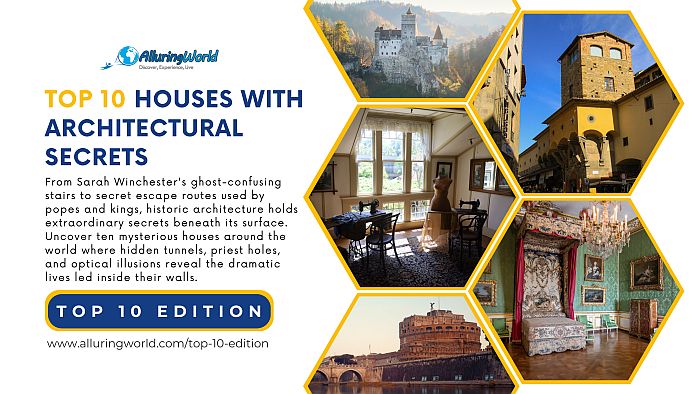
While usually associated with the stories about Dracula, the Bran Castle is an imposing castle that houses many architectural secrets, which are much more concrete than any myths. One such secret passage was uncovered behind the fireplace in the 1920s, and this passage allows the first and third floors to be connected. This passage was used by the officers in the castle as a means of escape in the event of a siege or any other kind of emergency, so it was crucial that it stay hidden from the general public. Such an architectural secret emphasizes the importance of maintaining secrecy in medieval castles, and puts Bran Castle into the unique structures that contain secrets discovered over time.
3. Harvington Hall, England
In the late 16th century, there was a lot of religious persecution in England; consequently, it became perilous for the Catholics to exercise their religion. To be able to practice their religion, Harvington Hall underwent several ingenious transformations to keep visiting priests safe by incorporating several “priest holes,” which were hidden spaces camouflaged within false walls or under floorboards. This ingenious structural transformation ensured that residents could conceal both people and holy objects during unforeseen attacks, and would allow people to practice their Catholic masses and other practices.
4. The Palace of Versailles, France
Though well known for its grandeur and the Hall of Mirrors, Versailles was also an example of a space where complete privacy was indeed a luxury that was not common at all. The monarchs who ruled France at that time and lived in this majestic structure would make use of the secret passages that existed inside the palace in order to have some time alone, away from the eyes of other courtiers. This helped them move around the vast halls in private, thus allowing the King and the Queen to have their own privacy inside a golden cage.
5. The Vasari Corridor, Italy
In Florence, the Medici family built an extensive covered passageway connecting their palatial residence in the Pitti Palace to the administration center at Palazzo Vecchio. Giorgio Vasari constructed the passageway and covered a distance greater than one kilometer while crossing above the city streets and through the Uffizi Gallery. This is a clear indication of the lengths that dominant clans went to in order to stay secure while keeping away from the commoners during times of civil unrest. During the construction in 1565, the Medici intended to demolish the medieval Mannelli Tower to maintain a straight path across the Ponte Vecchio, but the stubborn Mannelli family refused to sell or alter their property, forcing the architect Giorgio Vasari to wrap the passageway around the tower on heavy stone brackets. Considering the Medici did not want to go against the Mannelli family, as they were slightly more powerful, they had to agree to build the passage around the tower.
ADVERTISEMENT
6. Monticello, USA
Apart from being known for its neoclassical architecture, Monticello was one huge network of architectural illusions. In order to keep the labor activities of his slaves away from sight, Thomas Jefferson had underground corridors in the hillside, dumbwaiters that looked like fireplace mantels, and bedroom closets that featured stairs leading to upper rooms. All this was done by Jefferson’s “cleverness” to create an illusion for the outside world of an absolutely perfect house without disclosing what was going on inside his home.
7. The Olde Bell & The Mermaid Inn, England
In the seaside village of Rye, with its rich history, the architectural mystery that people can see connects different buildings in this charming English village. One of them is a mysterious tunnel that links the basement of The Olde Bell tavern with the Mermaid Inn. This underground passageway was used by the notorious Hawkhurst Gang back in the 1730s. They used the tunnel for carrying illegal products such as tobacco and brandy underneath the noses of local authorities, turning the very structure of the town into a tool for illicit activity.
8. The Passetto di Borgo, Vatican City
The Passetto di Borgo is a link between the Vatican’s papal apartments and the fortress of Castel Sant’Angelo. This fortified walkway provided an escape route for the popes whenever there was a war in the Papal state. Being approximately one kilometer long, the passageway enabled the popes to escape from the Vatican to the fortress whenever the city was invaded. Throughout the long history, there were two popes: Pope Alexander VI and Pope Clement VII, who, as a matter of fact, were saved by means of the passage. Pope Alexander VI used the hidden passage in 1494 to evade the invading armies of King Charles VIII of France, while Pope Clement VII famously used it in 1527 to escape the violent Sack of Rome by Charles V’s imperial troops, while his Swiss Guard fought off the attackers.
9. The Secret Annex, Netherlands
The back structure of an inconspicuous home in Amsterdam houses one of the most powerful secrets ever harbored in architecture. Hidden by a movable bookshelf, the Secret Annex entrance became a hiding place for the Frank family amid the Nazi occupation era. The Secret Annex is such a place that people are reminded of how, even at their worst, the metamorphosis of a room into a sanctuary becomes a representation of humanity, and they are using this as an inspiration to do good in the world.
10. The Monastery at Capel y Ffin, Wales
Created by Charles Buckeridge, this place includes architectural elements that narrate a story of ambitious ideas and ultimate destruction. In addition to beautiful arched leaded windows and elaborate stone work, the property has ruins of the church that appear to be a reminder of some past era. A combination of thoughtful design and natural growth makes this place feel like a place with live history, which gives spectators an opportunity to think about the transformation of a busy place of worship into an architectural enigma.
In conclusion, the attraction to these houses is due to the fact that man always wants to see what is under the surface. These houses can be built either to conceal a family, transport a king, or deceive a ghost, but for whatever the reason for construction is, they all remind us that a house is much more than just the façade. It is a vault of human experiences, which stores the urgency of the past in its floorboards and tunnels. When studying these houses, we can look at the design but also get involved in the history, and learn how we can improve the lives and do better in the world.