
Read time ca. 5 minutes
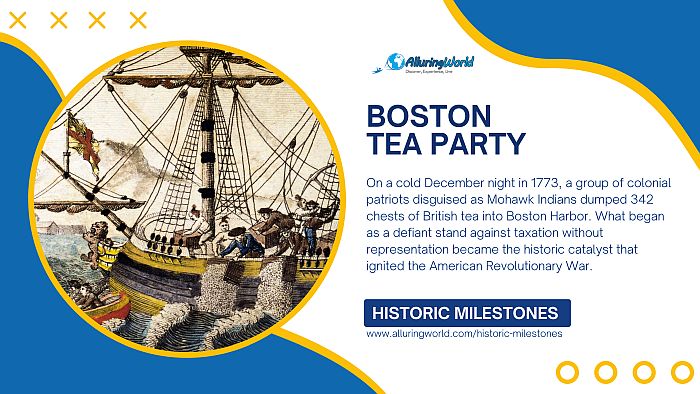
One of the greatest historic milestones in American history was when a number of American colonists took action against Britain’s taxing policy in Boston, Massachusetts, in an event that would be later known as the Boston Tea Party. On 16 December 1773, the American colonists boarded the ships that were anchored at the port of Boston, and in an action that would describe the entire event, they threw overboard 342 chests of tea into Boston Harbor. With this, the Boston Tea Party became one of the crucial incidents that led to the American Revolutionary War. Through this incident, the Americans not only showed their dissatisfaction with the British government but also displayed their readiness to revolt against the British authorities.
This protest did not take place out of the blue; rather, it was the outcome of several years of accumulated dissatisfaction from the people living in the British colony of the Americas. British authorities pursued various policies that sought to offset the expenses of the war against France and gain tighter control over their colonies. Such policies resulted in heavy taxation and strict trade regulations, which squeezed more financial means from the colonists, thus resulting in a great dissatisfaction. The Boston Tea Party emerged as one of the most important events that shaped the future course of action for Americans.
Historical Context: Colonial Grievances and British Policies
The American colonies during the 18th century had been used to a level of independence and autonomy, with their own colonial legislatures ruling them when it came to taxes, trading, and other internal matters. But due to a substantial national debt from the Seven Years’ War, the British authorities aimed to exert more control and collect more revenues by passing a number of laws, including the Sugar Act in 1764, the Stamp Act in 1765, and the Townshend Acts in 1767.
Such policies fueled a great deal of umbrage, thus giving birth to the idea of “no taxation without representation.” The colonists contended that since they did not have any elected representatives in the British Parliament, they could not be taxed by such a parliament. The form of resistance adopted by the colonists ranged from boycotts to petitions and even demonstrations. The Tea Act of 1773 was not considered a gesture of goodwill on behalf of the British government; rather, it was viewed as an act of forcing the colonists into submission.
Organizing the Protest: The Sons of Liberty
At the heart of the Boston Tea Party was the Sons of Liberty, which was a secret society of colonial patriots who resisted any form of oppression from the British and fought for American liberty. This group consisted of prominent leaders like Samuel Adams and Paul Revere, among others, who collaborated to sway public sentiment and rally against oppressive forces.
The Boston Tea Party was planned and executed as a politically conscious and calculated plan. The colonists intended to send out a political message without causing any unwarranted violence. The disguise worn by the participants consisted of being dressed up as Mohawk Indians, which symbolized their freedom from British rule and was an attempt at gaining their independence.
The Event: The Night of the Tea Party
In the evening of 16 December 1773, a large number of colonists gathered at Griffin’s Wharf in Boston, which had three ships of the British Empire carrying tea from the East India Company. At midnight, a group of members of the Sons of Liberty boarded these ships, opened the chests, and threw the tea into the sea. About 342 chests, worth hundreds of thousands of dollars today, were destroyed in this revolutionary act, marking the entire discontent as the Boston Tea Party that changed American history forever.
The mission was carried out in an orderly manner, without causing any injury to British forces, and showed the resolve of the colonists for a well-organized but powerful statement. The smashing and dumping of the tea into Boston Harbor was a symbolic act, serving as a threat not only against British economic interests but also as an assertion of the power of the colonists.
ADVERTISEMENT
British Reaction: Coercion and Escalation
The British government’s reaction to the Boston Tea Party involved a number of measures, which came to be referred to as the Coercive Acts, otherwise known as the Intolerable Acts, which were passed in 1774. These included closing Boston Harbor until the debts incurred as a result of the Boston Tea Party were paid, as well as taking away the right of Massachusetts to govern itself. Instead of quelling further unrest, it backfired on the British and led to the unification of the colonies against Britain.
The Coercive Acts showed how coercion could only be effective up to a certain point when it comes to governance because excessive force would only provoke people to rebel against their rulers. The colonial leadership portrayed the measures as a direct violation of basic human freedoms, further strengthening the belief that the policies of Britain had been oppressive to them.
Public Opinion and Colonial Solidarity:
The Boston Tea Party made an immense impression on the opinions of people in the colonies, and even a bigger impression across the world. The newspapers, pamphlets, and letters spread news about the incident, which was perceived as a manifestation of heroism and the fight against tyranny. The act of throwing tea into the bay was very symbolic and inspired colonial Americans to rebel against oppression.
The gathering also helped in fostering the formation of an American national identity, focusing on common complaints, principles, and objectives. The colonists started seeing themselves not only as citizens under the rule of the British monarchy but also as a separate political entity with rights and obligations.
Long-Term Impact and Legacy:
The Boston Tea Party remains an important seminal moment that led to American freedom. It showed how effective it was for activists to use protests symbolically to achieve results in politics and oppose the rule of Britain. This incident served to clarify the relationship between the actions of citizens and the reactions of the government.
The Boston Tea Party not only marks an event in the history of American politics, but it continues to resonate today as an example of resistance and the fight for justice. This is not so simple, and yet a great act of defiance and bravery demonstrates the capacity of common people to stand up to authorities and to demand their rights.
Conclusion:
To conclude all this, the Boston Tea Party was a very powerful act of rebellion against the taxes imposed by the British. By dumping tea into the Boston Harbor, the colonists were not only rebelling against the commercial interests of the British but also asserting their rights to govern themselves. This was one major turning point leading to the American Revolution.
The Boston Tea Party will live on in history as a living proof of the impact that mass mobilization and civic participation can have in today’s societies. The entire event demonstrates that organized protests, as far as they are based on common ideals and intentions, can change the tide of events and bring some change to societies. As an iconic and very important historic milestone in the fight for freedom and autonomy, the Boston Tea Party continues to serve as a beacon of bravery, ingenuity, and the age-old pursuit of justice.