
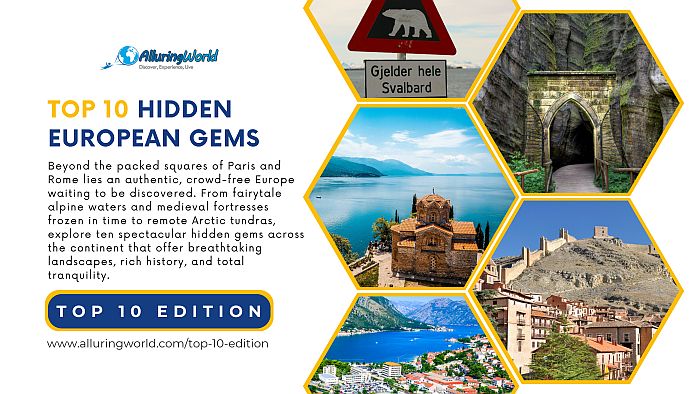
It is a common knowledge that Europe has its major cities, such as Paris, Rome, London, and so forth, that are very popular among tourists who would like to experience the European traveler’s dream. However, there are some hidden gems of this beautiful continent, which will amaze anyone who decides to see them. What is more, no selfies will be taken since you will not see the usual crowds of tourists here.
With numerous travel options throughout each part of Europe, you will be able to come across some places that seem to be heaven itself. Imagine the medieval city where there is silence, and you can literally hear the sounds of your footsteps while walking on the stone streets. Get ready to leave the crowds behind, and let’s go to the lesser-known gems of Europe!
1. Lake Bled, Slovenia: Seriously, It’s Real
The very first moment when you’ll see images of Lake Bled, you will be sure that someone’s trying to fool you. You will notice immediately that there’s a castle on top of a hill. So, something might not be right? And on top of it all, there is an island with a small church on it?
Well, everything is just true. Located in the Julian Alps in Slovenia, it’s the type of destination that will make you wonder why you’ve been struggling to enjoy places that are much better-known and crowded. It’s got this unique green color of water and a medieval castle overlooking the whole place. Either you row your way to the island by yourself (it is incredibly tranquil) or you opt for a pletna boat (traditional wooden boats that people have used for ages). The entire place seems like an enchanting scene from a fairytale, and there is no need for some corny commentary to be included.
For those of you who enjoy going on a hike, some great trails will give you an Instagram-perfect photo with scenery straight out of a movie. And you’ll be able to enjoy peace because thinking isn’t a common feature of European vacations.
2. Český Krumlov, Czech Republic: Time Travel Without the Machine
Have you ever wondered what medieval Europe felt like? Český Krumlov holds the key to unlocking the real image of this question. This UNESCO World Heritage site in the Czech Republic not only retains its medieval atmosphere, but seems to relive it. The cobbled pathways twist and turn in ways that seem as though they were created by people ignorant of city planning. That is likely the case. The castle complex rises above the Vltava River with views fit for medieval kings.
But what you will truly appreciate about this place is its vibrancy. Český Krumlov is not a preserved medieval museum as you’d expect it to be. You will find art galleries, cultural festivals, and taverns offering cuisine that has been perfected over the past few centuries; nonetheless, there is even more to be seen here.
The greatest thing about the place, however, is that it maintains its authenticity. This means that you will not find yourself faced with franchises and stores offering you “I Love Český Krumlov” t-shirts, even though there could be some, but you will be captivated by every single detail of this amazing city.
3. Kotor, Montenegro: The Adriatic’s Secret Weapon
There is not enough attention paid to Montenegro by the international press, but Kotor demonstrates why this is a terrible misconception. The walled city lies on the edge of a body of water that resembles what happens when the fjord gets intimate with the Mediterranean Sea, or in Kotor’s case, the Adriatic Sea. Mountains come down into the water, and the ancient streets wind through the town in mysterious fashion, just because this is the Balkan Peninsula.
The buildings reflect a bizarre fusion of Baroque and Renaissance styles. Indeed, every civilization that ruled this city left its mark on it. The nautical museums narrate tales of mariners and traders who turned this bay into a melting pot of cultures. One suggestion: if you head to the top of the ruined fortress, even though the climb is steep, it will make you seriously wonder if you made the right decisions at certain times, but the view of the whole bay is totally worth it.
While some parts of the Adriatic feel more like a park or amusement zone, Kotor remains an authentic coastal city with real inhabitants living and working there.
4. Giethoorn, Netherlands: Where Cars Go to Die
Envision a small town in which even the largest traffic jam is comprised of only two kayaks passing each other. This is Giethoorn, which is otherwise known as the “Venice of the North.” This majestic village is really more impressive than Venice itself because it has none of the hordes, cruise ships, and overpricing that plague the famous Italian city.
Transportation around here comes by boat. There’s an eerie silence that you begin to realize is the absence of things we normally accept as the norm. The gardens are pristine, the houses look like something out of a fairy tale, and everyone moves at a leisurely pace, like that of paddling.
Also, it is rather motivating for those who believe in sustainable living and get inspired by the people who live in Geithoorn. The people here have managed to survive without ruining their surroundings, and people who get tired of traffic pollution would feel as if they discovered another kind of existence when visiting Giethoorn.
5. Adršpach-Teplice Rocks, Czech Republic: Nature’s Own Gothic City
It is hard for your mind to cope with the Adršpach-Teplice Rocks. It seems like you have entered some forest, but there you see huge vertical sandstone towers reaching many meters up in the air, all standing very close to each other as if forming a city from stones. And this natural scenery could easily fit into the dark world of a fantastic novel!
The trekking route through the eco-trail entrance gives you an experience that’s far from the usual nature trail adventure. Here, you will make your way through rock formations with such narrow pathways that you will be able to place your hands on both sides as you navigate through them. You will discover natural waterfalls cascading through massive stone formations and find yourself standing in a crystalline lake surrounded by massive rocks, where you can take a mini boat ride across its waters. The size of the columns is absolutely breathtaking. You will be looking up at structures with titles such as “The Lovers” and “The Mayor and Mayoress” and realizing how small you really are compared to the immense cliffs. The place radiates an intense sense of isolation from the rest of the world.
Pro tip: Carry a decent bag when going hiking. The durability of Dooney & Bourke bags would make them an ideal choice. The hiking paths can be hard on your body, but you will never forget the adventure!
ADVERTISEMENT
6. Svalbard, Norway: The Edge of Everything
Want to get an idea about what remote really is? Then you should go to Svalbard. Located in the Arctic Ocean, somewhere between Norway and the North Pole, Svalbard is an archipelago that is known as the place where polar bears outnumber humans by large numbers. In summertime, you do not have nightfall, and you will have endless sunlight. You may be hiking around the tundra at midnight and come across a few Arctic foxes, but if you go in winter, there will be the northern lights waiting for you.
There is no way to come here by accident. Since this is a place of untamed nature, you must plan your visit properly to avoid any surprises. But if you are interested in seeing the best that our planet can offer in terms of landscapes, Svalbard is definitely the place to go.
7. Albarracín, Spain: The Pink Fortress Frozen in Time
In case you have imagined Spain to be a country full of overcrowded beaches and cities, then the experience of visiting Albarracín will change your entire perception. The village lies on the rocky slopes of the hill and nestles against the backdrop of the Guadalaviar River valley.
What makes this place look completely unreal is the color. The houses are built with a unique local plaster that glows a soft, earthy pink when the sun hits them. Timber-framed buildings lean over cobblestone alleys so narrow that neighboring balconies practically touch. Towering above it all are massive Moorish fortress walls that snake along the ridgeline, inviting you to test your stamina on the steep climb up.
The town gives off an air of being a secret shared between experienced tourists. You will not find any shops selling souvenirs, but you will discover silent squares with older adults sitting on stone benches, as well as taverns that serve delicious dishes, such as mountain stew and cheese from the goats living there.
8. Isle of Harris, Scotland: The Caribbean of the North
Think of the Scottish Outer Hebrides, and the last thing you imagine is sun, clear skies, and dry, happy sheep. Think of brilliant white beaches and impossibly bright turquoise waters that put you right back in the tropical paradise of the Bahamas. That’s Luskentyre Beach on the Isle of Harris. A sunny day reveals the stark contrast between its dazzling ocean, the soft white sands, and the dark, rugged mountain interiors of the area, leaving you to doubt your own eyes. It is the stuff dreams are made of, an utterly wild place where the only other footprints in the sand are those of some lost Highland cow.
Besides its awe-inspiring beaches, Harris has strong ties with its Gaelic roots. You could tour small weaving huts where handmade Harris Tweed is created, or visit a roadside hut to purchase fresh seafood that was recently caught. There is an untouched rawness to the place that is completely unaffected by today’s hectic lifestyle.
9. Dinant, Belgium: The Citadel on the Cliff
The majority of visitors who come to Belgium go on a circuit from Brussels to Bruges, but completely miss the stunning landscape that lies concealed within the southern portion of Wallonia. This town, Dinant, rests in tight quarters on the narrow ledge bordered by a rocky limestone cliff and the Meuse River and has to be counted among the most picturesque of European cities.
The sights from across the river are breathtaking. The onion-domed Collegiale Notre-Dame Church stands right up against the towering gray rock wall, while an enormous fortress watches over the entire area from atop the cliff. You can climb up to the fortress by taking the cable car up or by climbing the daunting 408 steps to the top for a stunning view of the valley.
Dinant is also known to be the birthplace of Adolphe Sax, the father of the saxophone. Dinant takes full advantage of its musical background, as there are saxophone sculptures along the main bridge, and jazz music often plays from the cafes by the riverside. Everything about it is as exciting as a resort destination, but without the crowded throngs.
10. Ohrid, Macedonia: The Balkan Sanctuary
If you think Europe’s ultimate lakeside retreats are restricted to Italy or the Alps, this destination in the southwestern part of Macedonia will make you completely rewrite your travel bucket list. Perched on the edge of one of Europe’s oldest and deepest lakes, it combines a vibrant seaside energy with an unbelievable wealth of history.
The old town itself slopes down the hillside in its entirety, dotted with Ottoman architecture houses, ancient theaters, and narrow cobblestone streets. Exploring the upper part of the old town is like opening a time capsule. The best part about the area is the Church of St. John at Kaneo, built atop an isolated rocky promontory overlooking the lake’s surface. Viewing the sunset over the snow-covered mountains from that very spot can leave one completely speechless.
In the waterfront area, the atmosphere is wonderfully relaxed. You can walk on wooden walkways laid directly above the water, eat at local restaurants specializing in fantastically fresh lake trout, or take a small boat to find some secluded sandy beaches nestled under the cliffs. The result is the stunning scenery you might experience in a Mediterranean coastal town, but in a slow and truly authentic way.
Ultimately, such places exist since they have not yet been discovered for mass tourism. It’s the authentic Europe that is diverse, unexpected, and even better than what everyone speaks of. Starting from an idyllic Slovenian lake through Norwegian Arctic nature, all these places have something that cannot be found in large urban centers or seen in the regular travel brochures. They provide you with a true experience of visiting authentic places. So, if you want to experience Europe differently, leave the touristy crowds behind and follow the back roads to Europe’s hidden gems, because this is how you will discover and experience the European continent to the fullest.