
Read time ca. 4 minutes
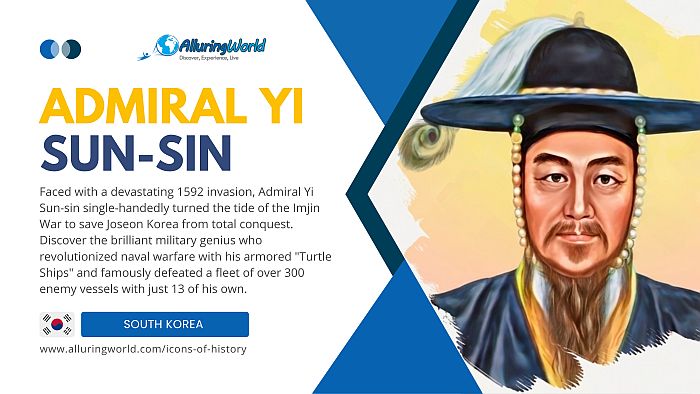
Admiral Yi Sun-sin, who was born on 28 April 1545 in Seoul during the reign of the Joseon Korea kingdom, which is known to be the last dynasty of the Korean nation, is regarded as one of the greatest naval heroes of modern-day South Korea, as well as in the world. Famous for his military genius, bravery, and patriotism towards his homeland, Admiral Yi Sun-sin made a significant contribution in protecting Korea from Japanese invasions during the latter part of the 16th century.
Early Life and Military Training:
Yi Sun-sin came from a family belonging to the yangban class, members of Korea’s aristocratic elite, which gave him an opportunity to receive a quality education and train as a soldier. Since childhood, he exhibited a keen interest in various aspects of warfare, archery, and martial arts. He became familiar with many of the skills that would later become essential to his career path. The teachings of Confucius played a prominent role in shaping his worldview.
Yi was promoted through the military service examinations in 1576, attaining the status of a junior-ranking officer, and in the early stages of his military career, he held different positions in various garrison locations. These positions allowed him to develop his skills in military operations, logistics, and tactics, so that he would be shaped into the military leader we know of today. Initially sidelined from important military command positions on account of court intrigues, Yi was finally acknowledged as a competent commander.
Rise to Prominence:
The ascendancy of Yi Sun-sin came at a very crucial time for Joseon Korea. In 1592, Japan, under the command of Toyotomi Hideyoshi, attacked Korea in what came to be known as the Imjin War. The Japanese army had received good training and was well armed; they quickly pushed into Korea. It was at this point that Yi Sun-sin got the post of commanding the naval force of Jeolla Province in Korea.
Realizing the significance of naval supremacy for the defense of his nation, Yi concentrated all his efforts on building the strength of his navy, developing improved ship designs, and training his sailors with utmost diligence. He knew that the control of the oceans was vital in stopping the Japanese from supplying themselves on land. This was the time when he started thinking and trying to put Joseon Korea as a power on the map, so that his people would be able to enjoy the benefits of this.
Innovations and the Turtle Ship:
One of the accomplishments by Yi Sun-sin is the creation and usage of the Geobukseon, also known as the “Turtle Ship.” This warship was armored and had iron spikes covering its deck, several ports where cannons were located, and a solid hull, all of which ensured that the vessel was impervious to attacks from enemy ships.
The strategic application of Yi’s use of the turtle ship, alongside his skill with naval tactics and knowledge of coastal topography, helped him to defeat much larger forces from Japan. He was capable of using technological advantage in combination with tactics and knowledge, which is not something many could do.
Major Battles and Victories:
During the Imjin War, Yi Sun-sin was responsible for numerous victories at sea for the Korean Navy despite being outnumbered and outgunned. His best-known battles took place during the Battle of Hansando in 1592, when he employed the “crane wing” tactic to surround and defeat the Japanese fleet, and during the Battle of Myeongnyang in 1597, where he used 13 ships to beat the Japanese fleet of 300 or more ships.
The triumphs, apart from severely damaging the Japanese, also ensured the security of essential supply lines, the safety of Koreans, and improved morale. The tactical genius, strict leadership, and inspiration that Yi possessed helped the Koreans in resisting the attacks for a long period of time.
ADVERTISEMENT
Leadership and Character:
However, the leadership style of Yi Sun-sin was not limited to the tactical skills he employed in battle. He is remembered for his discipline, ethics, and for always having regard for his subordinates. On several occasions, Yi Sun-sin has been seen sharing in the trials of his men.
Yi was resolute and undeterred by political intrigue, even after being temporarily removed from his position due to false charges. His resolve and quite stark resilience in surviving difficulties are indicative of his dedication to defending his nation and the tenacity of his morals, something that the Koreans appreciate and follow even today.
Death and Legacy:
Yi Sun-sin met his death on 16 December 1598 while fighting in the Battle of Noryang, the final, decisive naval battle of the seven-year Japanese invasions of Korea. Yi Sun-sin fought strongly until the very end, and his last thoughts were about his people and their safety. He made sure that the news of his death did not reach his soldiers for fear that they would panic. It is true that when a great man dies, his work remains.
Overall, Yi Sun-sin has had a huge impact on the Korean nation, so that it would be reshaped and developed into what we know today. He is regarded as one of the most brilliant figures of Korean military history due to his outstanding feats, brilliant strategies, and patriotic spirit. His statues and monuments pay homage to him throughout the country, while his life story is taught at military academies across the globe.
Conclusion:
In conclusion, the life of Admiral Yi Sun-sin highlights what you can see as courage, creativity, and patriotism. Under his guidance, the Korean Navy secured some astounding wins over highly powerful Japanese armies, safeguarding his nation through one of the most vulnerable times for his people. The tactics he employed, his integrity, and his vision of incorporating advanced technology, such as the Turtle Ship, set him apart as an icon in the military arena. Yi Sun-sin continues to be an inspiration as a resilient strategist and patriot who was dedicated to his country.