
Read time ca. 5 minutes
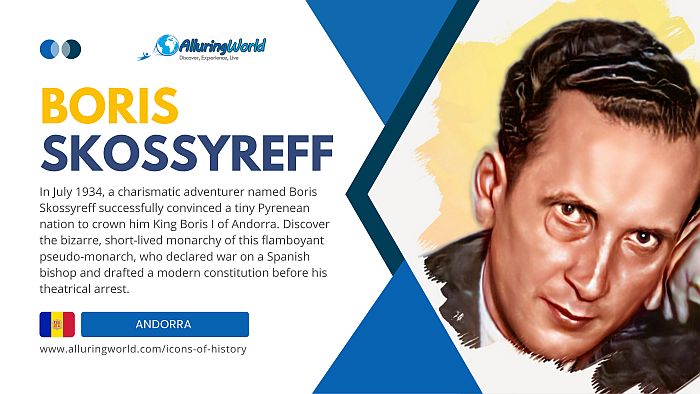
One of the most intriguing and enigmatic personalities in Andorran history is Boris Skossyreff, who was born in 1896 in Vilnius, which at the time was part of Russia. Skossyreff was a unique character, combining the qualities of an adventurer, politician, and pseudo-monarch. Although his attempt to conquer Andorran territory and become its ruler failed, his story still stands out as an interesting episode in the history of Europe’s smallest principality.
Early Life and Background:
Skossyreff was born in Lithuania, where his parents were members of the Baltic-German community, thus giving him a background immersed in the traditions of both the Russian Empire and the European aristocracy. While there are few details on his early educational background, one thing is certain: he had access to schooling, which provided him with knowledge in languages, diplomacy, and European history.
In addition to military experience gained during World War I and surviving the political tumult in revolutionary Russia, Skossyreff’s life experiences gave him an adventurous spirit as well as a confidence in his ability to play a role in politics at a far greater level than he had originally experienced. It was this life experience that allowed him to do things no other person had done until then, and he would remain as one of the most intriguing people in history.
The Road to Andorra:
During the 1920s, Boris Skossyreff set out on a trip across Europe, which had elements of adventure, individualism, and politics all intertwined. He traveled from Spain through France and finally into Andorra, which was a small place that truly intrigued him because of its unique and very special political system. During this period, Andorra was under the joint sovereignty of the French president and the Bishop of Urgell in Spain, and this is still in force today, hence why the Andorrans say that their nation is a Co-Principality.
However, Skossyreff saw Andorra as an opportunity. It was a tiny country with poor administration and no strong ruler, which meant that he could be the catalyst for change and lead the country as any strong leader would. Skossyreff was thinking about bringing changes, reforming the country, modernizing it, and giving Andorra the opportunity of becoming a recognized nation, although the plan he had was not something that would be thought of as a great one. Still, the Skossyreff story in Andorra continues.
The Self-Proclaimed King:
It was in 1934 when Boris Skossyreff made a surprising decision in proclaiming himself King Boris I of Andorra. This was a decision that was supported by the General Council of Andorra, which voted to support his proposed constitution and proclaimed him King of the Valleys of Andorra on 8 July 1934. According to Skossyreff, his primary objective in establishing his monarchy was the modernization of the country as well as economic and political security, as these were the main reasons he convinced the Council to appoint him as a leader. To do this, he prepared a constitution for Andorra which included the modernization of laws, the extension of citizens’ rights, and economic development. His plans, however, were met with suspicion from both the local government and other nations.
In an effort to back up his claims, Skossyreff used the tactics of charisma, diplomacy, and the limelight. The man befriended some powerful figures in Spain and France and portrayed himself as a visionary leader who would transform Andorra from a forgotten micronation to a thriving nation-state. However, Skossyreff’s attempts were not very successful since his claimed monarchy never gained recognition among the legitimate co-princes of Andorra, the President of France, and the Bishop of Urgell.
ADVERTISEMENT
Controversies and Challenges:
The attempted rule of the small micro-nation by Boris Skossyreff was controversial to say the least. The Andorrans saw Skossyreff as nothing more than an opportunist, and their distrust only increased because of his extravagant actions, especially the declaration of war against the Bishop of Urgell in Spain, since the Bishop criticized and opposed Skossyreff’s rule. It is clear that Boris Skossyreff was a thorn in the side of the Andorran political structure, and the bishopric and French officials acted quickly to address the issue.
His stint ended abruptly with him being jailed and thrown out of Andorra in 1934. This event showed that charisma and ambitions alone do not suffice as tactics since they cannot fight political and national structures. Despite him being ejected from Andorra, Skossyreff continued to be featured in European news publications in connection with the country, establishing his reputation as the eccentric aspiring monarch of Andorra, who started something great in the nation but was unable to finish it.
Later Life and Activities:
Following the banishment from Andorra, Boris Skossyreff went on to have a life full of excitement and politics. He wandered through parts of Europe, taking part in different adventures and establishing himself as a flamboyant politician. Later in life, he was to be imprisoned and observed, especially during the Second World War and its aftermath in Europe.
In the end, Skossyreff died in Spain in 1989 and was mostly overlooked by the annals of history, although he would be remembered in Andorra and by historians in the most peculiar way possible, as the ruler who had made an audacious claim to rule a tiny country.
Legacy and Historical Significance:
The legacy of Boris Skossyreff may be unusual, but it is interesting in relation to the country’s history. Even though he did not have the chance to obtain power in Andorra, the fact that he tried to do so was quite revealing for the problems associated with small-state governance. It is important to note that his theatrical announcement made Andorra appear briefly in the spotlight.
Skossyreff has been interpreted as an example of how politics operated in the early decades of the 20th century. Here, personal dreams and desires came up against the existing traditions. Skossyreff’s story is now part of Andorra’s history because it shows the power of the country and also its love for stories about adventure.
Conclusion:
To sum up, Boris Skossyreff can be regarded as one of the most eccentric personalities in the history of Andorra. His outrageous claim to be king, ambitious but at the same time unrealistic plans for modernizing his state, and eventual exile are evidence of the problems that leaders of such tiny countries can have. Despite the fact that his rule lasted for only several days and had no success, the fate of Boris Skossyreff is interesting to many people, and will always be remembered that convincing people can really make an impact on small states and the policies they try to implement to make life better for their own citizens. The story of Boris Skossyreff is just one of the few narratives that we keep in our history books nowadays.