
Read time ca. 5 minutes
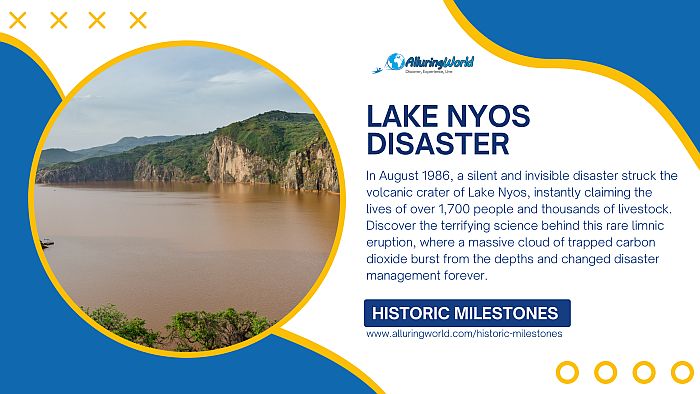
A devastating natural calamity occurred on 21 August 1986, within the villages around Lake Nyos, located in the Northwest Province of Cameroon. This is a case where both the native groups and the scientific community across the globe were shocked by the way in which death occurred due to the sudden release of carbon dioxide from the lake, which resulted in the deaths of about 1,700 people, as well as a large number of livestock animals in the nearby villages. The Lake Nyos disaster is one of the milestone cases that made a mark on the history of environmental science and disaster management.
Lake Nyos was a beautiful and serene lake that had been formed due to a volcanic eruption and was located among the green surroundings and fertile farmlands. But there was another aspect of this beautiful lake, and it contained lethal amounts of CO2 gases caused by volcanic eruptions. The shocking nature of this disaster took the whole world by surprise, and as a result, scientific research and international intervention were required.
Geological and Environmental Context:
Lake Nyos is located in a volcanic caldera at an elevation of about 1,800 m (5906 ft) above sea level. The unique geological features of Lake Nyos play a key role in comprehending the catastrophe, because it is a crater lake that exists in a volcanic depression, where it has immense depth and layers of water. Underneath its surface, volcanic eruptions constantly emitted CO2, which got trapped under the layers of water due to their density and temperature differences.
Lake Nyos is located in an area that forms part of the Cameroon Volcanic Line, a highly volcanic area. Although there was no history of volcanic activity in the Lake Nyos area for several centuries, there was still a constant release of carbon dioxide from a magma chamber under the lake. This danger was not visible to the local population since the carbon dioxide remained dissolved under the lake’s surface. The right combination of geology and chemistry made Lake Nyos ready for the environmental disaster.
The Disaster Unfolds:
The entire disaster unfolded in the early hours of 21 August 1986, when Lake Nyos had a limnic eruption that devastated the area. Limnic eruption means a sudden release of CO2 gases from the deep layers in the lake, and this eruption occurred due to some triggering factors such as a landslide, volcanic eruption, or even a change in temperatures that caused disturbance in the stratification process. As a result of this, the CO2 gas in Lake Nyos was released quickly to the surface in large quantities in the form of a gas cloud, killing everything around it by depriving it of oxygen.
The villagers were totally unprepared for such an event. Many had gone to sleep in their homes without realizing what the invisible CO2 cloud had done to them. Livestock, vegetation, and other forms of life were obliterated within a wide radius. Due to the rapid rate at which the CO2 cloud appeared, neither humans nor animals were able to get away; even those who tried could only manage to struggle for a few minutes before succumbing to its effects.
Immediate Consequences and Human Toll:
The cost of life from the Lake Nyos disaster was staggering. An estimated 1,700 people died, while thousands more had to be evacuated since the effects of the gas persisted for days around them. The survivors experienced profound psychological distress due to the complete destruction of their communities within minutes, and the economic hardships after the eruption were inevitable since the source of livelihood for the communities was significantly affected.
Nevertheless, not only did it pose a human threat, but the Lake Nyos disaster also revealed how vulnerable the communities were in terms of their closeness to such natural disasters. The community was unaware of the danger, had no previous information about it, had no knowledge of ways to prevent such disasters, nor any measures of safety from the dangers associated with the lake.
ADVERTISEMENT
Scientific Investigation and Understanding:
Lake Nyos’ tragedy led to quick interest in the scientific community worldwide. Scientists from Cameroon, the United States, France, and many other nations worked together to analyze the underlying factors and processes behind this unfortunate and inevitable event. Research showed that the lake had stored large amounts of CO2 for years, which was emitted by volcanic gases leaking out of the lava under the lake. The stratification of the water enabled the gas to stay in solution before being released abruptly.
This event also marked a turning point in limnology and volcanology, when the idea of a limnic eruption was introduced to the worldwide scientific community. Lake Nyos represented the first documented instance of a natural lake releasing gases at such dangerously high concentrations so suddenly and fatally. This helped to evaluate future threats posed by other volcanic lakes, including the eruption of Lake Monoun in Cameroon in 1984, which had undergone a much less destructive CO2 release.
Mitigation Efforts and Long-Term Response:
The degassing systems were established to avoid future disasters for Lake Nyos and similar lakes after the occurrence of this event. Through the installation of a system that allowed engineers to degas the water through a vertical pipe driven either by pumping or natural convection, the engineers could slowly reduce the amount of CO2 in the water to avoid future eruptions.
Under the direction of the Cameroon government, with the help of various international agencies, the surviving groups were moved to safer locations where early warning systems were put in place for any possible future limnic eruptions. Education campaigns were carried out to educate the locals on the dangers posed by Lake Nyos and how to prevent disasters from occurring, but after all, the Lake Nyos 1986 disaster made the lake a lesson in international cooperation for disaster prevention.
Global Significance and Lessons Learned:
Overall, the Lake Nyos disaster has been a significant achievement in the field of environmental studies due to the unpredictable nature of natural phenomena that poses an extremely dangerous threat to humans. This disaster showed the significance of interdisciplinarity in environmental issues, integrating knowledge from various fields like geology, chemistry, physics, and social sciences to solve environmental problems.
In addition, the disaster raised awareness about the problem of human vulnerability to natural hazards in general, especially in developing countries. There was an increased awareness of the need for cooperation on an international level regarding knowledge, expertise, technology, and other resources that could be used to avoid such tragedies in the future.
Conclusion:
To conclude, the Lake Nyos catastrophe on 21 August 1986 was an unfortunate incident that took the lives of more than 1,700 individuals and proved the danger that natural limnic eruptions can pose. This unfortunate event has been considered to be a momentous occasion in the field of environmental science since it led to awareness about the danger that is posed by volcanic lakes, and the need for proper scientific monitoring and disaster preparation.
By means of international cooperation, engineering, and careful monitoring, Lake Nyos stands as an example of how science and policy can be used to avoid potential disasters in the future. The lessons learned from the disaster have endured as a testament to the force of nature, the value of vigilance, and global awareness about the unpredictabilities of our world.