
Read time ca. 6 minutes
The sixth century ended with the Arabian Peninsula in a position to be an intersection point between various ancient civilizations, but it was politically and socially divided. Arabia did not have any religious or political unifying leadership since it was characterized by tribal loyalty, oral history, and trade interactions. Arabia was predominantly polytheistic in nature, although there were some Jewish and Christian settlements, especially along trade routes and oasis cities. This is the kind of society through which Muhammad ibn Abdullah passed during his birth around 570 in Mecca.
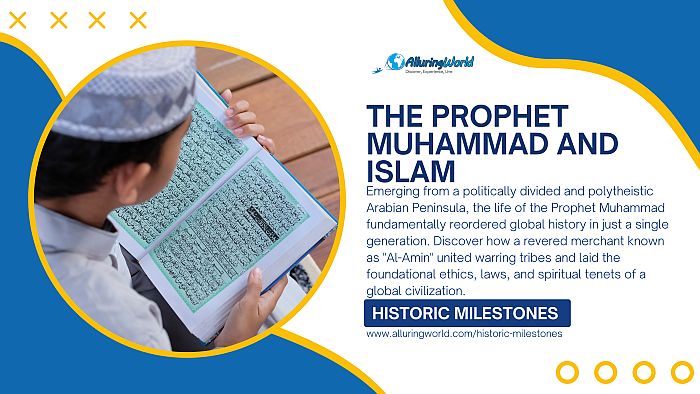
It may be said without hesitation that the life of Prophet Muhammad and the founding of Islam constitute one of the most important turning points in human history. It took just one generation for the religion of Islam not only to emerge but also to become a complete system of morals, social relations, and laws that revolutionized Arabia and eventually impacted an enormous part of Africa, Asia, and Europe.
Early Life in Mecca: Orphanhood, Integrity, and Trade
Muhammad belonged to the tribe of Quraysh, which was considered one of the most powerful clans in Mecca. However, Muhammad’s family was neither affluent nor politically powerful, and Muhammad’s father died before his birth. His mother died when Muhammad was a child, making him an orphan at a very young age. He was brought up under the care of his grandfather at first and then under his uncle, Abu Talib.
Since childhood, he was famous for his truthfulness, sincerity, and calm disposition, which made people call him Al-Amin, or “the reliable one.” At a young age, Muhammad was a merchant, moving around with various caravans that linked Mecca with the rest of the Arab world’s business network. This allowed him to come into contact with various ethnic groups, religions, and social organizations, all of which influenced his perception of human civilization and ethics.
Muhammad got married to Khadijah bint Khuwaylid at the age of about 25. She was an older lady who had already established herself as a successful entrepreneur and trader. The union between them was filled with love, harmony, and stability, and Khadijah would later emerge as one of the most important people in the initial development of Islam.
The Spiritual Crisis and the First Revelation:
Though Muhammad appeared to be doing well in life externally, he found himself distressed by the prevailing social injustices in Meccan society. Loyalty to one’s tribe took precedence over ethics, and oppression of the poor and needy was common practice. In addition, polytheism, the belief in, or worship of, multiple gods or deities, often organized into a pantheon, prevailed among the people. To escape the chaos around him, Muhammad would go into retreat at Mount Hira.
It is said that in the year 610 AD, while on one such retreat, Muhammad had an experience that would forever change the course of history. As per Muslim beliefs, he was chosen by God to receive revelations through his angel, Gabriel, and was instructed to “Read” or “Recite.” This was a divine experience that left Muhammad in awe and confusion regarding his mission in life.
Khadijah comforted him and convinced him to accept this revealing experience. The revelations kept on coming for the next 23 years in such a way that an entire book was formed from them, called the Quran, which is considered the word of God by Muslims. The messages at first dealt with Monotheism, morality, charity to the poor, and the day of judgment.
Early Preaching and Opposition in Mecca:
Muhammad started his public preachings from Mecca, inviting people to believe in One God and to stop worshipping idols. His preachings posed an ideological threat to the existing social order and economic system that was in place during Muhammad’s time, where the elites from Mecca enjoyed privileges through their control of pilgrimage that revolved around the Kaaba and its idols. The concept of equal believers in God’s eyes questioned tribal hierarchy systems.
The opposition grew stronger, where Muhammad and his adherents suffered mockery, economic boycotts, and even violence. Some of the early converts were persecuted, while others fled to Abyssinia (present-day Ethiopia), where a Christian king offered them sanctuary. In spite of all these difficulties, the Muslim community expanded, attracting converts from diverse social strata.
Patience and moral courage characterized Muhammad’s leadership during this era, but he never responded violently to his oppression and persecution. Instead, he went on to preach peace and urged people to be patient, faithful, and morally upright. The difficult years contributed towards shaping the religious identity of Muslims at that time, and shaped the foundation of the global faith we know today.
ADVERTISEMENT
The Hijrah: A Turning Point in Islamic History:
The condition was already critical in Mecca by 622 CE, which made it impossible for Muhammad to stay there any longer. The leaders of Yathrib, later named Medina, proposed that Muhammad be made an arbitrator among the conflicting factions of people. Taking the opportunity, Muhammad moved out of Mecca with his followers in an incident termed Hijrah.
The Hijrah is one of the most important milestones in the history of Islam and acts as the origin of the Islamic calendar. In Medina, the Prophet Muhammad was able to transform from a man who faced persecution to a politician and a statesman. He also established a social compact, popularly known as the Constitution of Medina, detailing the obligations and entitlements of Muslims, Jews, and other tribes in the area.
This new era enabled Islam to become a complete system of life, including religion, social justice, government, and dispute settlement. The Muslims started forming themselves into an organized group known as the ummah.
Conflict, Consolidation, and Moral Authority:
The relations between the Muslims of Medina and the Quraysh of Mecca were still strained, causing several conflicts to arise in the form of armed struggle. Some important battles that took place during this time include Badr, Uhud, and the Battle of the Trench. These battles had more than just an importance in terms of military tactics; they also had moral and ethical implications for Islam as a religion.
Muhammad adopted an approach to conflict that was pragmatic yet idealistic. He stressed the need for discipline, consultation, and self-restraint, creating new moral limits to waging war, which had never been seen before in the region. Gradually, the nature of alliances changed, and the balance of power began to favor the Muslims.
Muhammad returned to Mecca in the year 630 CE, accompanied by a vast multitude of followers. The city of Mecca capitulated without much resistance. In one of the most significant acts of mercy performed by Muhammad, he granted an all-around pardon to his erstwhile opponents and commanded that all the idols within the Kaaba be cleared out, reinstating it as a place of monotheistic devotion.
The Final Years and the Prophet’s Legacy:
After the peaceful subjugation of Mecca, the growth of Islam occurred quickly across the entire region of the Arabian Peninsula. Delegations were sent from tribes to Medina, accepting the religion of Islam and pledging loyalty to Muhammad.
In his last sermon, Muhammad focused on equality, justice, and respect for life and property just before he died in the year 632 CE. He talked to his followers about their responsibilities and reaffirmed their values, as they are part of the religion that he established. Although Muhammad’s death marked the end of his prophethood, the religion that he made his legacy continued.
What remains important is that, before dying, Muhammad gave the world a unified Muslim community, a holy book, and an ethical code. It should be noted that the quick expansion of this religion after Muhammad’s death can be attributed to both political and ideological reasons.
Conclusion:
In conclusion, the life of Muhammad and the origins of Islam are one of the most momentous episodes in the history of the world. Muhammad went from his origins in Mecca to unite all of Arabia in a movement that would change religious belief, social structures, and ethical thinking around the globe. The religion of Islam was thus founded not just as a faith but as a civilization.
The time between 570 and 630 C.E., serving as a significant benchmark in history, highlights the manner in which concepts, with the inclusion of moral guidance and history itself, have the capacity to change the path of humanity. The significance of Muhammad’s life lives on through its effects on religion, law, culture, and identity throughout the world even today.