
Read time ca. 6 minutes
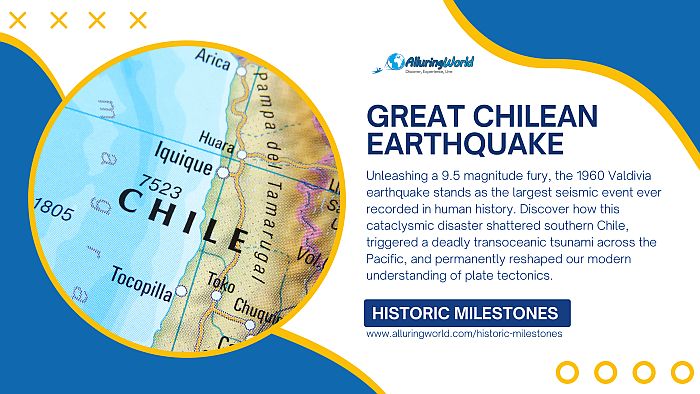
On 22 May 1960, Chile faced one of its worst natural disasters ever witnessed. It was called the Great Chilean Earthquake or the Valdivia Earthquake and holds the record for being the largest earthquake that was ever recorded by scientific instruments. With a moment magnitude scale of 9.5 on the Richter scale, within minutes, extensive regions in southern Chile faced destruction, and the repercussions of the quake spread to distant parts of the Pacific Ocean, causing tsunamis.
Not just a disaster of nature, but this earthquake became an important moment in history, which marked a new era of connection between the nation of Chile and its geography, as well as an entirely new way of looking at earthquakes around the world from a scientific point of view.
Chile and the Ring of Fire: A Country Shaped by Seismic Forces
The geographical setting of Chile has been characterized by constant geological strain. The country is situated on the Pacific Ring of Fire, which is the region along the western coast of South America, but extends on the other side of the Pacific on the Asian continent. Still, the region lies at the point of convergence between the Nazca Plate and the South American Plate.
Seismic events were not something new to Chile before the year 1960. Previously, various earthquakes had caused damage to properties in the country, and they created some resilience and adaptation among the population. Nevertheless, none of those events had come anywhere close to the one that was to hit near the region of Valdivia. This earthquake came as a shock to everyone and exposed the tremendous force stored underground.
This context is essential to understanding why the earthquake was not merely a national tragedy, but a global wake-up call that would force other nations to think over how they deal with earthquakes.
The Day the Ground Shattered: The Earthquake Unfolds
The first major earthquake hit in the afternoon, after being preceded by a number of foreshocks that had previously raised concerns and done some damage. Once the initial earthquake hit, it hit a fault zone that stretched for hundreds of kilometers off the coast of southern Chile. It caused severe and lengthy shaking, consequently lasting many minutes despite being built to handle lesser earthquakes.
Valdivia was one city that had been utterly destroyed. Structures crumbled, streets were torn apart, and parts of neighborhoods became uninhabitable. Rivers were diverted, landslides obstructed rivers, and parts of the ground sank and rose to varying heights. Some coastlines in affected regions experienced changes as well.
But the most unfortunate fact was that the human toll was immense. Many people died, and many others became homeless, dealing with the initial problem of being injured, hungry, and having no access to clean drinking water. But the unfortunate fact was that an earthquake was just the start of a chain reaction of disasters that followed.
The Tsunami That Crossed the Ocean:
One of the most important parts of the Great Chilean Earthquake involved the creation of a tsunami. Huge waves began to spread out from the point of origin throughout the Pacific Ocean, and these waves hit various coastlines in Chile only moments after the earthquake occurred.
After several hours, the tsunami hit distant shores as it moved through the Pacific. The Hawaiian islands witnessed substantial devastation caused by waves that flooded their shores, resulting in deaths. Despite Japan being on the other side of the Pacific, located thousands of kilometers away, it still suffered from the effects of the tsunami. These situations only prove further how earthquakes, while occurring in one part of the world, can still affect the entire planet.
The transoceanic tsunami transformed how governments and scientists viewed earthquake hazards, elevating tsunamis from regional threats to global risks.
ADVERTISEMENT
A Turning Point for Seismology and Plate Tectonics:
When the Great Chilean Earthquake occurred, the concept of plate tectonics had not yet gained wide recognition among scientists, so people did not fully understand how tectonic plates work. The magnitude of the Valdivia quake served as powerful proof of plate movements and the buildup of tension that is eventually released during an earthquake.
Data gained through the study of this earthquake provided a greater insight into the energy storage and release process in Earth’s crust. It revealed that the megathrust earthquake could fracture large fault zones, which earlier studies had underestimated.
Overall, the Great Chilean Earthquake served as a milestone case study in the field of seismology, and it hastened the widespread acceptance of the plate tectonic theory. It is this theory that brought together the understanding of earthquakes, volcanic eruptions, and mountain building, and made it possible for people to better understand the entire process of how earthquakes and tsunamis can form.
National Recovery and Institutional Change in Chile:
After the disaster, Chile was left to pick up the pieces with a great deal of work that needed to be done to recover from the devastation. The entire region had to be reconstructed in order to move forward, and many countries provided aid to help.
As years have gone by, the earthquake has been a source of major alterations in the building codes and city planning within Chile. The need to construct buildings that would withstand the extreme earthquake pressures became an unavoidable reality. Such changes have made Chile famous for its earthquake-resistant construction, and nowadays people feel safer when they know that the structures around them can save their lives during great disasters.
In addition to all this, the tragedy has affected public education and made it possible for people to get to know more information about what they need to do in case of an earthquake. Nowadays, preparations for earthquakes have been incorporated into community life, thus affecting how the community deals with any future catastrophes.
Global Impact: Redefining Disaster Preparedness
Nevertheless, the implications that the Great Chilean Earthquake brought, especially on an international scale, were immense. The earthquake brought home the realization that there were no means of early tsunami or earthquake warnings that could inform those close and far away from danger.
Such programs resulted in the creation of more advanced technologies for earthquake sensing and better ways of communication for early warning purposes. Hence, the earthquake played an important role in increasing global preparedness against natural disasters and reducing losses from future events.
To top it all, the Valdivia earthquake also influenced humanitarian response strategies that were not very developed at the time. This was an opportunity to emphasize the importance of rapid international cooperation and scientific data sharing in the face of natural catastrophes.
Environmental and Geographic Transformation:
Aside from the effects on humans and institutions, the quake left a permanent mark on the geographical landscape of southern Chile. The subsidence led to some of the coastal areas being sunk below sea level, thereby inundating their farmlands and wetlands with seawater.
There were higher levels of volcanic activity after the quake because of the interactions that existed between the tectonic stresses and volcanism. Scientists were able to gather more knowledge on how such activities occurred from the observations.
Inclusively, the environment itself became a living record of the earthquake’s force, as it reminds today the people of the planet’s capacity for sudden transformation without prior notice.
Conclusion:
To sum it all up, the Great Chilean Earthquake of 1960 is not only regarded as the biggest earthquake on record but also a critical turning point in shaping the history of Chile. Not only did this earthquake shape Chile’s future, but it also shaped the science and methodology that the entire world uses in disaster management today.
The historical event became a turning point when people understood how powerful nature is and how they should prepare, cooperate, and conduct research for the benefit of future generations. The consequences of the event led to more durable constructions, effective alarms, and knowledge about our planet.
Overall, the Great Chilean Earthquake brought into view both weakness and strength, which resulted in not only altering the future of Chile but also reshaping the way the world perceived seismic hazard.