
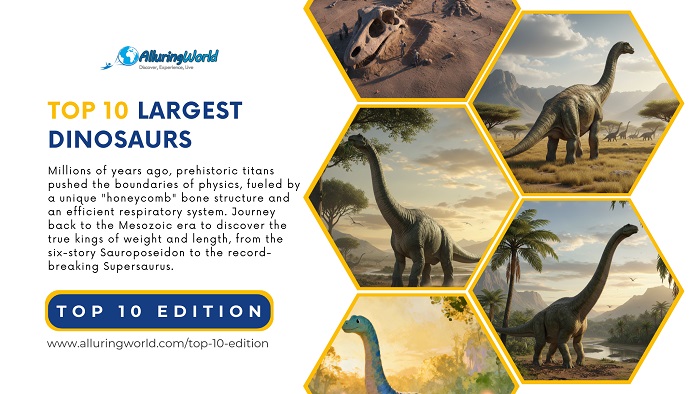
Giant land-dwellers millions of years ago claimed our world as their own, as they were leaving behind footprints with the size of hot tubs and skeletons that defy modern engineering today. These prehistoric titans represent the absolute peak of terrestrial biological growth. So that we can understand their scale, we must look back at a time when nature pushed the boundaries of physics. Looking back to the giants that ruled the Mesozoic era, and moving through the fossil records, we are able today to identify the true kings of weight and length.
How did these animals grow so large? In short, their success was built on hollowed-out “honeycomb” bones that reduced weight without sacrificing strength. There was an avian-like respiratory system, which allowed them to pump more oxygen efficiently through their massive bodies. At the same time, their small heads meant they didn’t have to waste energy chewing. What this did for them was to simply swallow the vegetation whole and let their massive stomachs act as fermentation vats. Still, below you will find the list of the 10 gigantic creatures that once roamed the Earth and were the most impressive creatures to be seen.
1. Argentinosaurus
Widely considered the ultimate heavyweight champion, this titanosaur lived during the Late Cretaceous in what is now South America. Its massive vertebrae and femur fossils suggest a creature weighing up to 100 metric tons. This giant is at the top of the list because scientists were able to confirm and verify that its mass is the most consistently verified among “super-giants.” If you imagine an animal as heavy as twelve African elephants combined, then you can see a giant that is moving with a grace that seems impossible for its bulk.
2. Maraapunisaurus
This giant creature was previously known as Amphicoelias fragillimus, but even today, this dinosaur remains a legendary enigma. Based on nineteenth-century sketches of a now-lost vertebra, there are some paleontologists who estimate it reached lengths of 58 m (190 ft). It is a little bit controversial to be on this list, since it lacks physical evidence, but the sheer scale of the documented bone fragment places it firmly at the top of the “longest” list, representing a specialized branch of rebbachisaurids that grew to extreme proportions.
3. Patagotitan
This giant is often called the “Patagonian Titan,” and this species gained worldwide fame when a nearly complete skeleton was unearthed in Argentina. Measuring approximately 37 m (121 ft) long, it provides the clearest look yet at the anatomy of a giant. This giant is part of the largest dinosaur list because of the reliability of its data, unlike many other contenders. Because we have enough of its skeleton, we can accurately calculate its 70-ton mass and awe-inspiring height.
4. Bruhathkayosaurus
This titan was discovered in India, and it is a contender for the heaviest ever to have been discovered because some early estimates suggest that it exceeded 150 tons. Nonetheless, due to the fragmentary nature of the found remains and their subsequent loss to environmental factors, the Bruhathkayosaurus usually ranks just below its South American cousins. Despite this fact, it still remains a fascinating “what-if” of paleontology, further hinting that even larger giants may have roamed the Eastern Hemisphere.
5. Sauroposeidon
The Sauroposeidon is known as the “Lizard Earthquake God.” This North American giant was likely the tallest of all dinosaurs because its neck alone was roughly 12 m (39 ft) long, allowing it to browse on treetops that other herbivores couldn’t reach. Founding its place on this list through its specialized height, this titanosaurus is standing as tall as a six-story building, which represents a unique evolutionary strategy for avoiding food competition.
ADVERTISEMENT
6. Supersaurus
This “Super Lizard” holds the record for the longest dinosaur verified by reasonably complete remains found in North America. Its body length stretched up to 42 m (138 ft) from its snout to its whip-like tail, and it was a marvel of structural balance. The Supersaurus found its place on this list because it represents the extreme end of the Diplodocid family, as this family was mainly focused on length and agility rather than the pure, stocky mass of the titanosaurs.
7. Dreadnoughtus
“Fears nothing” is the official translation for this giant, which is an appropriate moniker for an animal that reached 26 m (85 ft) in length and 60 tons in weight. It is scientifically significant because the specimen found was almost 70% complete, offering unprecedented insight into how these giants grew. Interesting fact, but the most famous specimen that was found was still growing at the time of its death, which suggests that these species could become even larger.
8. Puertasaurus
This is considered to be the contemporary of the Dreadnoughtus, which is known for having some of the broadest chest cavities in the dinosaur world. Its dorsal vertebrae are exceptionally wide, suggesting a massive ribcage designed to hold an enormous digestive system, and it finds its place on this list for the reason that its specialized torso width would imply a level of bulk and power that few other sauropods could match.
9. Turiasaurus
Representing Europe’s contribution to the giants, this Spanish sauropod was a massive surprise to researchers more accustomed to smaller island-dwelling species. Weighing over 50 tons, it proved that the “gigantism” trend was a global phenomenon. The Turiasaurus is part of this list because it is the largest dinosaur to be found to date in Europe, thus showcasing a unique lineage that evolved independently from the famous South American giants.
10. Futalognkosaurus
The Futalognkosaurus might be last on this list, but it is not the least. This “Giant Chief Lizard” is one of the most complete titanosaurs ever found, and it is considered to be among the most enormous dinosaurs because its hip structure measures nearly 3 m (10 ft) in width. Due to the large predators that lived in the same era as this lizard, it lived in a lush, river-rich environment because it served as a natural defense. The Futalognkosaurus still represents a prime example of the ecological dominance these long-necked herbivores maintained for millions of years.
In conclusion, while we still might uncover some other giant that once roamed the Earth, we are lucky to live in an era where they have been discovered. Interesting fact, as the Founding Fathers were not aware of the existence of dinosaurs, the luck we have today allows us to get a glimpse of the giant era, which serves as a testament to the versatility of life on Earth. From the sky-scraping neck of the Sauroposeidon to the crushing weight of the Argentinosaurus, these creatures transformed the landscape they walked upon. New fossils continue to emerge from the dirt of many continents, so we may one day find a titan that dwarfs even the legends on this list.