
Read time ca. 5 minutes
Within an incredibly short period of time, the two-digit number “67” has gone from being just another numerical figure to becoming one of the most famous sayings in youth culture and internet slang. As “six-seven” (said approximately as “siks sev-uhn”), it rings out in schools, on the playing field, and in the videos streaming online much faster than many adults would expect.
What stands out about the term is how quickly a simple pair of numbers turned into a shared inside joke. To understand how “67” gained so much popularity, it would be useful to consider its musical origins, the use of the sound by the algorithms to create a funny image, as well as its use in classrooms and sport.
Origins of the Term “67”
Contrary to classic slang that might require years to transition from the streets to daily conversations, the current obsession with “67” developed out of a specific chain of pop culture events that happened during the latter half of 2024 and the early part of 2025. The most definite beginning is found in the song by rapper Skrilla called “Doot Doot (6 7)” and is connected to Philadelphia’s 67th Street and/or the police code 10-67. Skrilla, the artist, claims that there was no definite dictionary definition given to the phrase, thus leaving room for the internet to project its own context onto the audio.
The song got much broader exposure on TikTok and Instagram as video editors started adding Skrilla’s song to highlight videos of basketball player LaMelo Ball, who is 6’7” (2.01 meters) tall. Videos that had comments about the player being 6’7” would suddenly switch to Skrilla’s music and fast basketball gameplay. The bait-and-switch was a classic and an effective way to ensure that the number entered sports meme culture.
Transitioning from niche social edits to popular playground slang was catalyzed by the popularity of a YouTube video showing an amateur basketball game organized by the Amateur Athletic Union. In the clip, a little boy, who became known as the “67 Kid,” could be seen raising his hands up and down while saying “6-7!” into the camera lens. Overtime Elite basketball player Taylen “TK” Kinney further spread the word with their basketball videos for kids.
Symbolic Interpretations:
Because the term “67” jumped very quickly across platforms, people read and added different layers to it depending on where they encountered it, so the term started getting new narratives:
- Absurdist Insider Humor: Usually, the term “67” is associated with the post-ironic, low-risk nature of absurdist humor that is often included in the category of “brainrot” internet humor. The joke here does not rely on some hidden philosophy, but instead derives from the randomness of screaming a number as if it were the main point of the joke. This move immediately signals shared internet literacy among peers while leaving outsiders guessing.
- Sports and Pop-Culture Reference: With regard to the sports spaces, the number is highly linked with the athlete height modifications, highlight reels, and celebratory gestures. Basketball and football players have even picked up the alternating, palm-up weighing-scales motion to celebrate big plays.
- Legacy and Subcultural Meanings: Apart from the viral meme, “67” had some other meaning in certain groups. In the United Kingdom, the group called 67 is the name of a revolutionary drill collective from Brixton Hill in South London. In contrast, in the telephone networks in North America, the number *67 serves as a code for blocking outgoing caller ID. There are also dates that have “6-7” numbers (for instance, June 6–7) and are referred to as a playful “6-7 weekend”.
ADVERTISEMENT
Usage in Contemporary Culture:
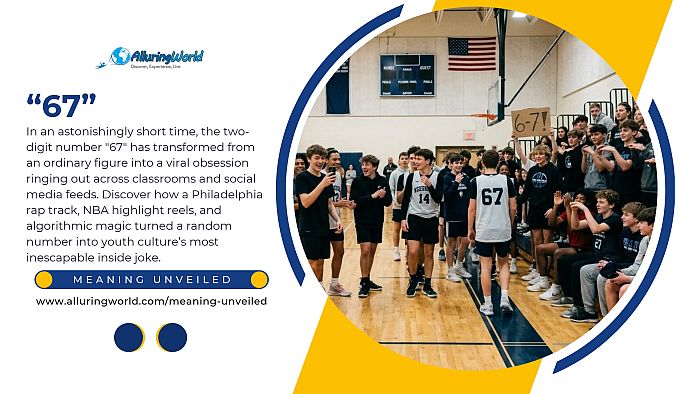
In daily life, “67” becomes less of a conventional vocabulary item with a single denotation and more of an immediate response reflex. In any situation where the numbers 6 and 7 appear automatically, whether the teacher asks the students to go to page 67, there is a mathematical solution of 67, there is an expense of 6.70 dollars, or there is a countdown of six and seven seconds, there will be someone who would exclaim, “Six-sevvuhnn!” paired with a two-hand gesture.
In the classroom setting, this reaction has made even the most commonplace class a minefield of unintentional humor. Something as simple as “120 minus 53” in a math problem, a page number, or simply asking how the class is going could cause the instant eruption of laughter and arm waving. It is not rebellion, but this should be seen as a harmless disruption, where the students catch a hint in the regular schoolwork and find fun in something mundane.
On the internet, short-form algorithms facilitate how the gag spreads further. The moment the format of the sound, the caption, or the visual meme becomes popular on TikTok, Instagram Reels, or YouTube Shorts, the algorithm will promote similar memes to millions of people within days. People use “67” in their captions, comments, edits, and even when hiding references to brands and pop culture, like Google searches and television shows, because they know that people who understand the short-form culture will immediately understand the reference. Since the joke is based on recognizing it, not explaining it, it crosses all boundaries and language barriers easily.
Regional and Historical Associations:
Although the “67” viral trend does not originate from a particular neighborhood but rather from global social networks, it follows in a tradition that has been with us since time immemorial. Numbers have traditionally held symbolic importance in popular culture, and this is clearly evident, from jersey numbers to area codes in popular music.
The uniqueness of “67” lies in its rapid dissociation from its original environment. A song lyric that was created within the context of a single Philadelphia street and rap culture, and a reference to the player’s height, were taken out of their original context; the term “67” was transformed by algorithms, and it was made into a collective joke in classrooms and on the Internet. Much like the old viral number joke, the “21” Vine meme, the numbers broke away from their original context and became a standalone gag.
The Broader Social Implications:
This whole phenomenon of “67” reveals quite a bit about the ways in which the newer generations form connections in rapidly changing virtual space. As the trends emerge within just days or even a week, the shared joke is often formed by easily recognized hints rather than complicated backstory. The simple number combined with a body sign becomes an easy way to indicate you are “in the joke.”
For the younger generations in the physical classroom, as well as the congested online feeds, being part of a viral joke such as “67” is a form of fun that acts as a social glue. In addition, it helps create a mild generational gap whereby the adults try to look for the underlying message while the children have fun because it is ambiguous. Overall, it turns an everyday digit into a shared ritual that belongs to the people using it.
Conclusion:
From the drill rap refrain to the edited basketball footage, “67” has evolved into an interesting example of internet slang. From Skrilla’s track and LaMelo Ball edits to schoolyard chants, the phrase’s appeal comes down to timing, repetition, and instant recognition rather than deep symbolism. Even though it doesn’t have a solid meaning, as a viral joke and cultural reference, “67” proves just how much life a simple two-digit number can acquire.