
Read time ca. 6 minutes
The Phoenix, also referred to as “Fenghuang” in Chinese civilization, is one of the most respected mythical animals in Chinese culture. While the phoenix in Western civilization is associated with fire and rebirth from the ashes, the Chinese phoenix stands for much more than this, and it includes harmony, virtues, and balance of the cosmos. The phoenix has significance in Chinese mythology as well as in alchemy and Taoism, where it symbolizes spiritual metamorphosis, immortality, and the interaction of forces making up the universe.
Historical Background of the Fenghuang:
This mythological bird can be traced back in Chinese mythology to the time of the Zhou dynasty (1046-256 BC), and it is also mentioned in classic literature that includes the Shan Hai Jing and the Book of Rites. The Fenghuang was traditionally connected with the Empress and was regarded as a companion of the dragon, which stood for the Emperor, so the two together symbolized the principle of yin-yang in Taoism.
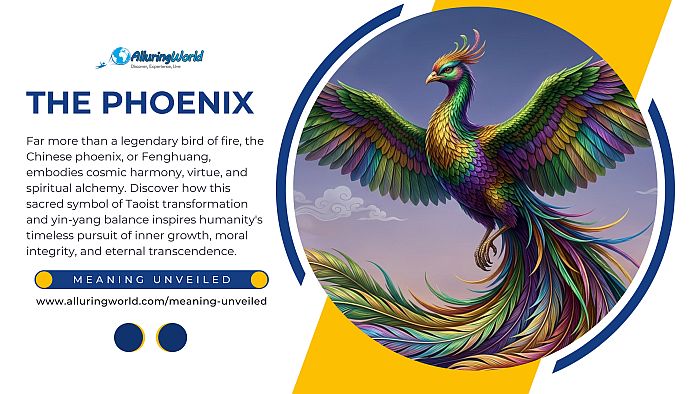
Fenghuang is represented in art and literature by having colorful feathers, and all these feathers are a combination of different bird features such as cock, a swallow, and a peacock. Its full appearance portrays power, elegance, and righteousness that tie it to both the terrestrial and divine worlds, which is why the Chinese people adore this mythical bird. Ultimately, the bird’s long-standing cultural presence reflects its deep connection to ethical and spiritual ideals, particularly those central to Taoist and alchemical traditions.
The Phoenix in Chinese Alchemy:
Chinese alchemy, which developed over many years in the complex area where science and spirituality were inextricably intertwined, often features the phoenix, symbolizing change and immortality. In the philosophy of Taoism, alchemy was not just a primitive endeavor involving physical processes and experiments with physical elements or looking for a substance that would provide a person with eternal life. On the contrary, Taoists viewed alchemy as a complex process both within and outside a human being, which aimed at transforming one’s existence. The goal of alchemy was to purify the body, uplift the spirit, and refine the soul.
In this case, the phoenix represents the elevated spirit that is born as a result of internal alchemical practices, which are known as nei dan or internal alchemy. The repetitive process of rebirth experienced by the phoenix is analogous to the Daoist doctrine of transformation achieved through personal cultivation. Similar to the phoenix’s rebirth, the alchemist tries to transform themself through purification of the mind and body.
The phoenix is also associated with the Wu Xing (Five Phases) in Chinese alchemy. These phases comprise wood, fire, earth, metal, and water and reflect the dynamic relations between different forces that exist in nature. The phoenix symbolizes the unity and harmonious interaction of these forces. Fiery feathers of the bird symbolize the force of fire.
The Taoist Perspective:
In Taoism, the phoenix stands as a significant symbol of cosmic harmony, equilibrium, and the very interaction of the principles of yin and yang. Although the phoenix represents the empress and her feminine energy while the dragon symbolizes the emperor and his masculine energy and forms a sacred pair to create a balanced duality of these two, the phoenix is an embodiment of cosmic balance on its own. This duality of dragon and phoenix reflects the basic idea of Taoism that the entire universe is run by the principle of complementary opposites, and only through absolute balance do they exist and create order in the universe.
The phoenix is also a symbol of spiritual resurrection and rebirth in the context of Taoism. It represents the concept that people can transcend the limitations of the physical world and become immortal through harmonization with the Tao, which is the basic principle of the universe. The cyclic nature of the phoenix reflects the importance of adaptability in Taoism.
ADVERTISEMENT
The Phoenix as a Symbol of Virtue and Moral Integrity:
Other than alchemy and cosmology, the phoenix is also a symbol of virtue, goodness, and righteousness. According to the classical philosophy of China, the arrival of the bird was considered a good omen, signaling that a virtuous ruler or a prosperous era had arrived. From the perspective of the Taoist belief system, the development of virtue is of paramount importance in the path of spiritual attainment.
The phoenix has always been utilized by artists and intellectuals to express ideas about ethics and self-improvement. The beauty, elegance, and nobility of the phoenix are more than aesthetic concepts since they indicate the harmony between the individual and the cosmos. Overall, through contemplation of the phoenix symbol or through its use by artists, one is made aware of the need for harmony between one’s actions and the universe.
Cultural and Artistic Depictions:
In Chinese art, architecture, and ceremonial traditions, the phoenix emerges as a recurring visual representation of its virtues and cosmic significance. The motif is a common feature in court paintings, imperial tapestries, and artwork in general, as it is an important symbolic representation of royal power and majesty, especially in artworks intended for use by the empress or commissioned for important ceremonies at court. Outside the imperial palace, the phoenix plays an important role in the iconography of the Taoist temples. In these sanctuaries, among other mythological creatures, the bird reiterates its significance in the larger scheme of things.
The representation of the phoenix is characterized by the bird’s bright and colorful feathers, where each color symbolizes the union of natural elements with spiritual elements in harmony. Represented in action among ethereal clouds or holy flames, the bird reflects the connection between it and the heavenly sphere as well as the process of the transformation that takes place in spiritual development. In such a way, the phoenix bird not only acts as an ornament but also becomes a powerful symbol and an inspiration to people who want to develop themselves spiritually.
The Phoenix and Immortality:
In the entwined philosophies of Chinese alchemy and Taoism, the phoenix plays a key role as an essential symbol in the quest for immortality. In contrast to the Western legend of the phoenix, where the phoenix revolves around the theme of death and physical resurrection from the ashes, the Chinese philosophy focuses on a continuous transformation and an eternal cycle. Unlike the resurrection concept, the Taoist alchemists see the phoenix as the ultimate symbol of the perfect spirit, the supreme being who has conquered physical mortality through discipline, righteous conduct, and harmonization with the Tao.
Immortality in this regard is not only physical but is also spiritual and cosmic. The phoenix symbolizes the possibility for humans to attain balance, harmony, and immortality with nature as well as the universe, which is a Taoist principle regarding life, death, and rebirth.
Modern Interpretations and Legacy:
Today, the phoenix has continued to serve as an important and relevant symbol within Chinese culture and modern Taoism. The consistent presence of this bird within modern literature and arts has enabled the continued relevance of its archaic symbolism of resiliency, transformation, and cosmic equilibrium. In modern-day Taoist practice, the phoenix is not just a mythical being anymore but serves as an example of how one can live and grow in the modern world.
The continued relevance of the phoenix indicates the universality of the significance of symbols that link human experiences to universal truths. The phoenix is a symbol in alchemy, Taoism, and art that reflects the interaction between the physical and spiritual aspects of life, provoking thoughts about growth and morality.
Conclusion:
Ultimately, as a representation in Chinese alchemy and Taoism, the phoenix (Fenghuang) holds a very special and deep place in Chinese history and culture. More than just a mythical creature, the phoenix is a constant symbol of change, immortality, and the perfect synthesis of cosmic forces that guide the Chinese people. Whether from classical literary origins to the modern-day practices in art and ceremony, the phoenix represents the highest ideal of morality and spiritual perfection.
Its cyclical process and vivid images teach us about our constant quest to cultivate ourselves and align with the universal truths that are present in the world. Through an examination of the symbolism associated with the phoenix, we can further understand Chinese mythology, as well as Taoism, and the human desire for rebirth, balance, and transcendence.