
Read time ca. 4 minutes
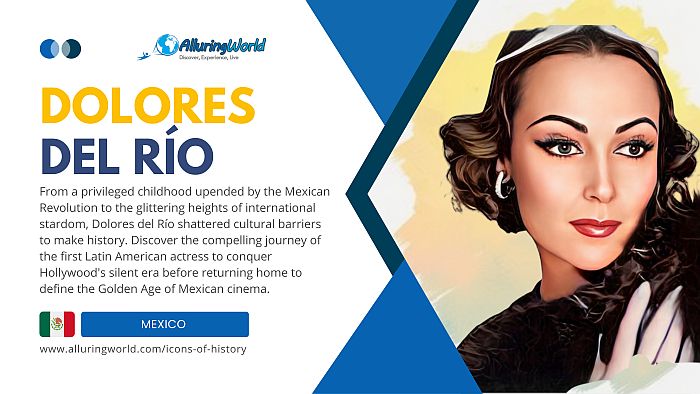
Dolores del Río, whose birth name was María de los Dolores Asúnsolo López-Negrete, was born on 3 August 1904 in Durango, Mexico. She is considered among the most famous actresses during the Golden Age of Mexican cinema and an icon for many Latin American actors who were making their mark in Hollywood during the prime time, better known as the Golden Age of Hollywood. Known for her grace and beauty, she represented her culture through her various roles in movies, theatre, and silent films, and left her mark on the cinema for generations to come.
Early Life and Education:
Del Río was born into a wealthy family in the state of Durango, but she lived through hard times. Due to the onset of the Mexican Revolution and the family’s displacement, Dolores developed her toughness and ability to be self-reliant. She was well educated, having gone through art studies that fostered her artistic talents and skills, although in her youth, Dolores developed an interest in drama and music as well. It was at this time that she took part in the theatre groups and honed the confidence that she needed to appear on the big screen.
In her younger days, she learned ballet and performance art skills, which helped her develop both expertise and the ability to appreciate the beauty of body movement. Her background in such a structured form of artistic expression would go on to lay the groundwork for her later film career.
Hollywood Career:
The Hollywood career of Dolores del Río started in the 1920s when Hollywood was experiencing unprecedented growth. During that time, silent films dominated the movie industry, and Del Río became one of the few Mexican actresses to make it big on the international scene. She relocated to Los Angeles, where she caught the attention of many due to her looks and talent.
In addition to appearing in several important silent pictures such as Resurrection (1927) and Ramona (1928), Del Río created several other memorable roles that further cemented her spot in the history of cinematography. The arrival of the new era of talkies did not discourage Del Río from succeeding in this environment, as she proved her linguistic versatility and innate acting talent despite the problems encountered by many former silent film actors.
Despite her success in Hollywood, Del Río was aware of the stereotypical and often limiting roles that were available and mostly given to Latin American actresses in the United States. Even though she was given certain types of roles, she mostly sought projects that would allow her to portray characters with dignity and depth, challenging industry norms and advancing the representation of Latin American women on the big screen.
ADVERTISEMENT
Return to Mexico and National Impact:
Del Río moved back to Mexico towards the end of the 1930s, and she soon became one of the most prominent artists in the newly blossoming Mexican film industry, as it was expected of her. At the same time, this period is considered the golden age of Mexican cinema, a period marked by significant artistry, national pride, and global recognition. One of the most important films in which she appeared was María Candelaria (1943), directed by Emilio Fernández and filmed by Gabriel Figueroa.
The roles played by Del Río in Mexican movies were characterized by the emphasis on social problems, indigenous culture, and historical events, thus promoting knowledge about the heritage of Mexico. The cooperation between Del Río and prominent directors such as Fernández, Figueroa, and others resulted in one of the most stunning and emotionally captivating movies of Latin America. Overall, she was able to capture the strength of Mexican women through her performance in the movies.
Theater, Philanthropy, and Cultural Influence:
In addition to her career in film, Dolores del Río took part in other activities unrelated to acting on film. These activities include participating in events related to theater and social affairs. She performed on stage, showcasing her range as an actress, but ultimately, her passion for the arts extended beyond just acting on film. In particular, she trained young actresses in order to develop Mexican theater and cinema.
To add to her numerous activities, she was using her power to promote social issues like women’s rights and humanitarianism, and she helped raise awareness through her work and the popularity of charitable endeavors. Her star status helped her become more involved in civic-minded activities, which showed how she was not just an attractive but also intelligent and caring individual.
Legacy:
Dolores del Río died on 11 April 1983, in Newport Beach, California. Throughout her entire career, she made a great contribution to Mexican and world cinematography and tried to make this world a better place for everyone. Dolores was the first Latin American actress to receive recognition in Hollywood, and her work elevated the image of Mexico in film. Moreover, she contributed significantly to the Golden Age of Mexican Cinema.
Her influence is not limited to just the films she acted in; the story and achievements of Dolores del Río are those of an artist who succeeded within a multiculturally challenging environment, whose life and success are ones of overcoming the constraints of the film industry and dedication towards significant representation.
Conclusion:
In conclusion, Dolores del Río was not just another Hollywood star; rather, she was a role model and an artist who overcame barriers between different cultures and paved the way for future Latin American artists. Due to her talents and devotion to art, Dolores became a source of pride for Mexico and the world, becoming an example of what a talented actress could achieve through cinema. Her name remains unforgettable among many generations of actors and directors in the cinematography sphere.