
Read time ca. 5 minutes
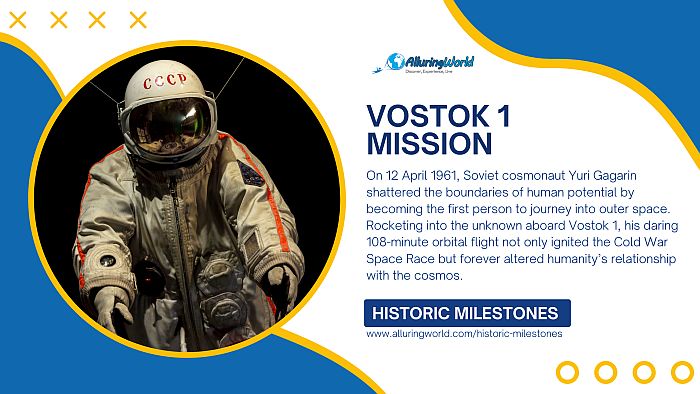
Yuri Gagarin was a Soviet cosmonaut who made history by becoming the first man in human history to travel into space, and with the spacecraft Vostok 1, he traveled around the planet on 12 April 1961. This amazing feat was a turning point in the Space Race, being an accomplishment not only of human creativity but also a landmark in scientific research throughout the world. This mission proved the capability of human beings to live and work in space, paving the way for further space missions.
Humanity’s first trip into outer space took place during the Cold War era, when both the USA and the USSR were competing fiercely in terms of technology, weaponry, and ideology. Apart from the fact that this flight was an important scientific event, the journey made by Gagarin also had a very significant political meaning since it proved the technical ability of the USSR to undertake such a project and increased national pride.
Historical Context: The Space Race and Soviet Ambitions
Gagarin’s space journey represented the fruition of many years of hard work by scientists from both superpowers. Post-World War II developments in rocket science and missiles were crucial to the agenda of both the military and science. Space frontiers were considered the final frontiers for proving the technological superiority of both the United States and the Soviet Union. In addition, the success of the Soviet Sputnik 1 satellite in orbit in 1957 indicated that the Soviets had a technological edge, thereby increasing their ambitions in sending a man into space.
In this framework, the flight of Gagarin became not only an important scientific achievement but also a political statement that was too important for the Soviets. Huge funds were spent on the training of cosmonauts, building safe ships, and providing security for each expedition. The Vostok program was a chain of logical and consecutive attempts to study the impact of space conditions on humans and space vehicles. In 1961, all these activities came to fruition and made it possible for the USSR to become the leader in space exploration.
Yuri Gagarin: Life and Preparation
Yuri Alekseyevich Gagarin was born in 1934 in the small village of Klushino near the Gzhatsk area in western Russia. Gagarin came from humble beginnings, but at a young age, he demonstrated talent in the areas of mechanical and aerospace engineering. In his service as a fighter pilot in the Soviet Air Force, Gagarin gained valuable experience flying jet aircraft.
Selection for Vostok cosmonauts was a very stringent process, and it involved testing the applicants for physical endurance, psychological stability, and technical proficiency. It is Gagarin’s stability in handling himself, his quick reflexes, and his adaptability that stood him out among other applicants as a candidate suited to the unique requirements of space travel. The training he underwent involved preparing him physically, mentally, and technically for any kind of eventuality. All of the tests that were given to him have been done impeccably, and he really deserved his place in the history books, being the first human in space.
The Vostok 1 Mission: Engineering and Execution
The Vostok 1 spacecraft, which Gagarin used to enter space, was a masterpiece of technology, and the spacecraft ensured that life was possible in such an extreme environment. Vostok 1 had life support equipment as well as communication systems, which were meant for monitoring the health condition of Gagarin and of the spacecraft itself.
On the very morning of 12 April 1961, at 9:07 AM, Gagarin blasted off from the Baikonur Cosmodrome aboard the Vostok-K rocket. Engineers worked hard on its development, and the human body had to cope with high loads, which were not experienced by other people previously. During the flight, Gagarin was exposed to extreme acceleration, vibrations, and the sensation of floating out of Earth’s gravitational field. However, Gagarin kept calm and conversed with the ground control staff about his sensations.
Vostok 1 made a single orbit around the Earth at velocities of more than 27,000 km/h (16,777 mph). During the 108-minute journey, Gagarin saw the curvature of Earth, registered phenomena in the atmosphere, environment, and space, and checked the spacecraft’s systems. Vostok 1 proved that people can survive and work in space.
ADVERTISEMENT
Re-entry and Global Reception:
As important as the takeoff from Earth was, equally important was the return to Earth, which had to be timed and engineered so that the landing would be smooth and successful. The heat shield on the spaceship protected Gagarin from the intense temperatures involved in re-entry into Earth’s atmosphere, and Gagarin separated from the capsule during the descent, parachuting down onto the land of the Saratov region.
The reaction to the launch of Gagarin across the world was amazing, and it was seen with ecstatic celebration in the Soviet Union, worldwide awe, but intense embarrassment and anxiety in the United States. In the USSR, Gagarin emerged as a hero, and as his feat won worldwide admiration and amazement, he became an inspiration for scientists, engineers, and the common person alike. Even though the overall journey of Gagarin to space was linked with politics, it transcended them, and it marked a milestone in human endeavor in realizing the dream of space exploration.
Scientific, Technological, and Cultural Impact:
The consequences of Gagarin’s journey turned out to be far-reaching in many aspects: science, technology, and culture. The flight was essential to the development of space projects in the USSR and the US, as well as to the development of rocket engineering, space life support systems, satellite engineering, and orbital mechanics. This success became the basis for further flights that involved such operations as flights into orbit for a prolonged period of time, exploration of the moon, and outer space.
From a cultural standpoint, the achievement of Gagarin was symbolic of the human desire for knowledge, courage, and crossing barriers that people had not dared to do before. The well-known phrase “Poyekhali!”, which means “Let’s go!”, is a metaphor for the spirit of adventure, and therefore, the flight of Gagarin in outer space has become an iconic cultural milestone for various reasons.
Legacy and Continuing Influence:
Nevertheless, Yuri Gagarin’s launch into space is an event that will never be forgotten in the history of humanity. First of all, he proved to us that outer space was not only a place for machines but also for man himself. Second of all, he showed how to do this calmly, bravely, and skillfully.
This accomplishment also highlighted the significance of collaboration and competition among nations in the progress of science, despite two countries being in competition with each other to outdo the other. Even though the Space Race was colored by the geopolitics of the time, as the US and the Soviet Union were competing amongst themselves, the lessons gleaned from this feat continue to inspire cooperative ventures in space exploration. One of such cooperations in the end was the International Space Station, known as the first multinational, permanently crewed orbiting laboratory, and in addition to this, future explorations of the Moon and Mars.
Conclusion:
Therefore, in conclusion, Yuri Gagarin’s journey into orbit in Vostok 1 is one of the greatest historic milestones made by humankind in relation to exploration, science, and achievement. It was because Gagarin proved how much humans could achieve through this expedition by demonstrating the robustness of the human body, the skills of the human mind, and the power of imagination and courage. Apart from furthering space science, Gagarin’s mission inspired future generations to conduct science and explore outer space.