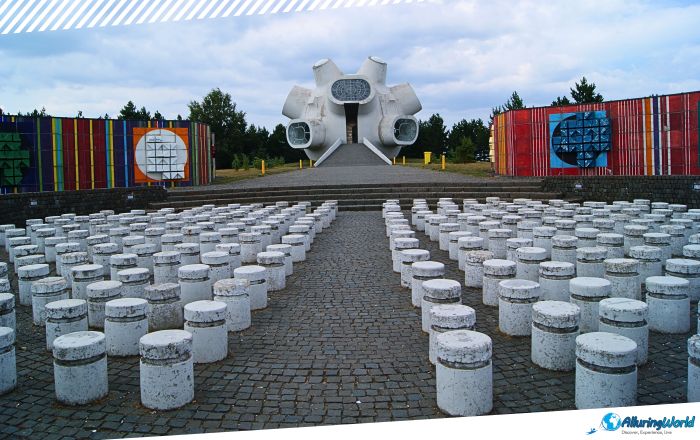
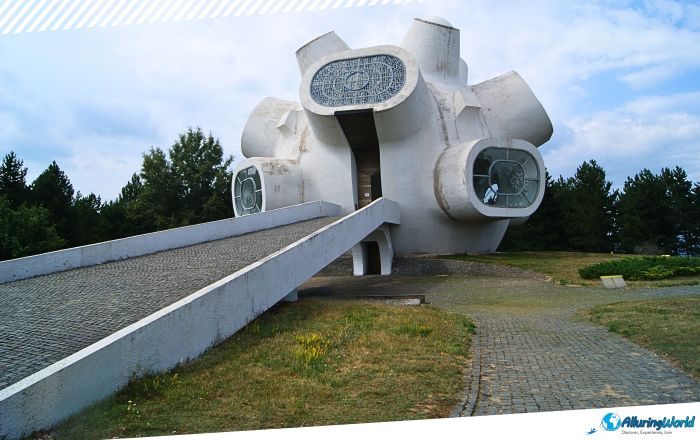
Makedonium, which is officially referred to as Ilinden Memorial, is a famous landmark and big monument located in the city of Krushevo, which is located in the southern part of the Republic of Macedonia. This majestic monument, sometimes colloquially referred to as Spomenik, commonly represents the great Ilinden Uprising, which in turn created the first Republic on the Balkan Peninsula, the Krushevo Republic.
The Ilinden Uprising in modern Macedonian history happened in 1903, when a group of brave Macedonians charged into battle against the mighty army of the Ottoman Empire, which had been ruling Macedonia for more than 500 years by then, and sparked the movement of creating a free country, which would be united as one Macedonia.
The construction of the Makedonium monument was initiated by the Yugoslav government, and through careful planning, it was officially opened on 2 August 1974. This date is one of the most important dates for the Republic of Macedonia because in that year, it happened to be the 30th anniversary of the Second Session of the Anti-fascist Assembly for the National Liberation of Macedonia, and the 71st anniversary of the Ilinden uprising. Also, it is interesting to note that at the time when it was built, the monument followed the creative architectural style of the time in Yugoslavia, when many monuments were built in the same architectural style, hence why the majority of monuments built during this period are called spomeniks. Another spomenik is the Monument to the Revolution in Croatia.
ADVERTISEMENT
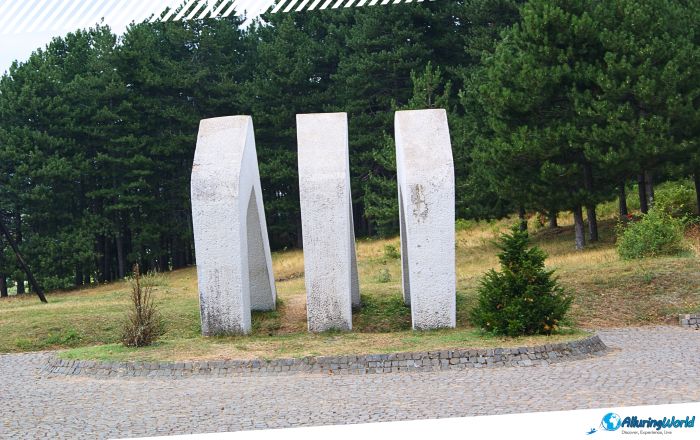
The artists who created this alluring memorial are Jordan Grabuloski and Iskra Grabuloska. The memorial is divided into a couple of segments, which have some kind of meaning or symbolism. The first segment, where it begins, shows the torn chains in three different places. These chains represent the oppression the Macedonian people have witnessed throughout the centuries from the Ottomans (500 years more precisely), and most likely they are placed in three places because at that time Macedonia, as part of the Ottoman Empire, was planned to be divided between its neighbors in three different parts.
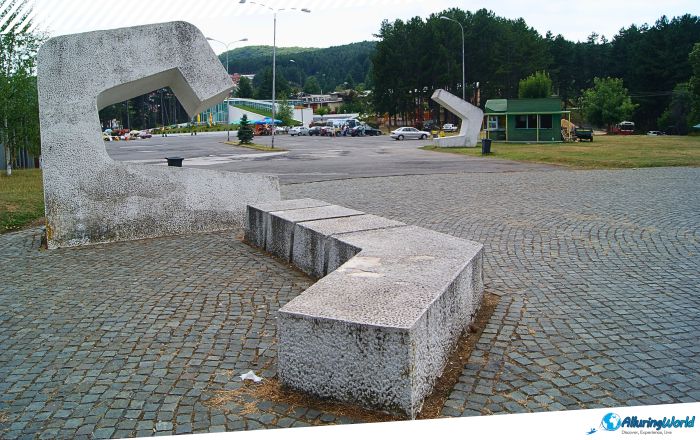
Even though there are no official statements from the architects behind the construction, the Macedonian people will be happy to explain the history behind this monument. They will tell you that the Makedonium monument stands for Macedonia’s liberation from foreign rule, and it is not just the main building, but the entire assembly begins from the parking lot. It is, in fact, at the parking lot where visitors can see the shackles. all in number three, which represent the three parts of Macedonia: Aegean, Pirin, and Vardar Macedonia.
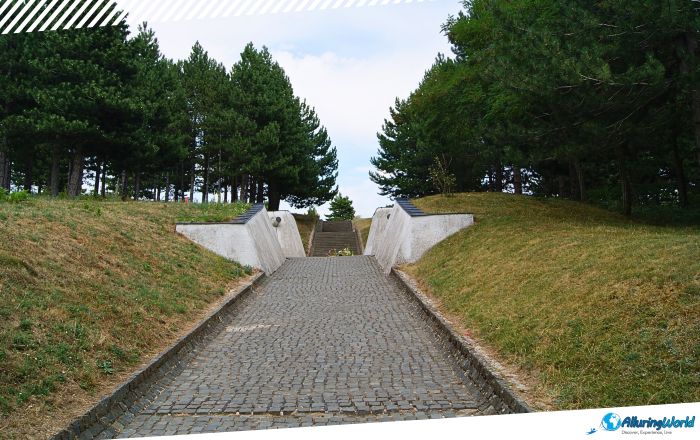
From there, the memorial continues up the hill through a small path to the next section, which is referred to as the Crypt. This part is circular in shape, and it has “canon-like” metal plaques on which are written the names of the important battles and the most important heroes. All of these names are from the period before and after the Ilinden Uprising, and they pay tribute to the people who gave their lives in those important battles to create Free Macedonia. As they are encircled, each of them holds a different story for itself, each battle that was one of the bloodiest or the most important for the struggle against the Ottoman Empire that year, or simply heroes who did something great for their motherland.
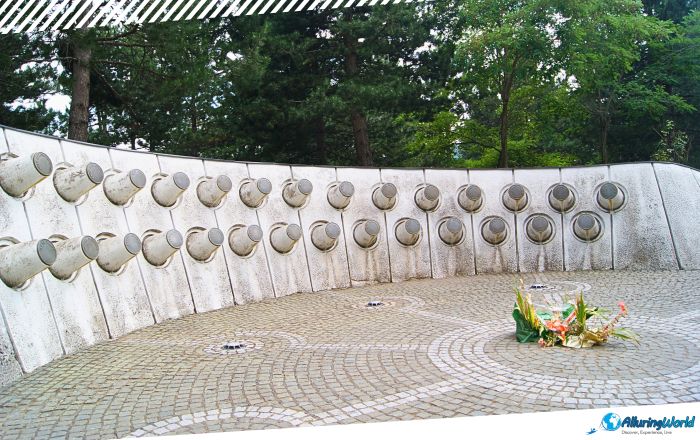
Serving as a coded library of stories, there are in total 58 plaques that try to show the most important events, making every visitor curious enough to search for the story, whether that be from the local people, someone who is a connoisseur of Macedonian history (told from the Macedonian point of view), or perhaps searching online.
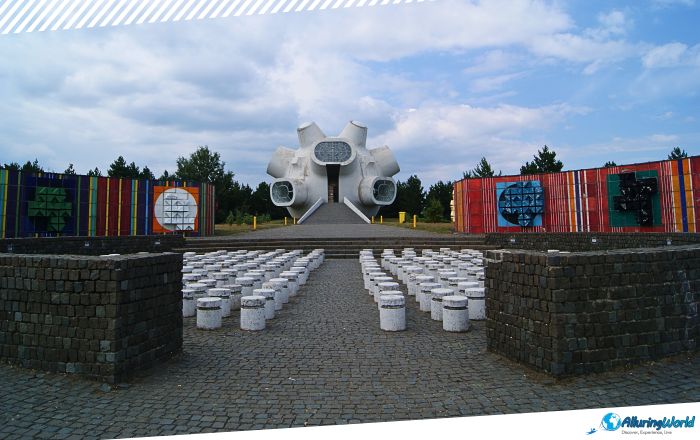
The path then continues towards the next segment, which is the place from where the main piece of the memorial can be seen better. First, when getting to the next section, the visitors can see a place which is most commonly known as the Amphitheater. Abstract mosaic features surround this large open space, and in the middle of them are concrete seats so that when events or speeches happen, people will be able to sit down and listen carefully. Nevertheless, the mosaics form peculiar geometric shapes, and as mentioned above, people can gather around in the Amphitheater and hear poetic readings, lectures, presentations, exhibitions, etc. From here, visitors can go towards the final piece of the memorial, which is quite amazing and is also the centerpiece of this magnificent memorial.
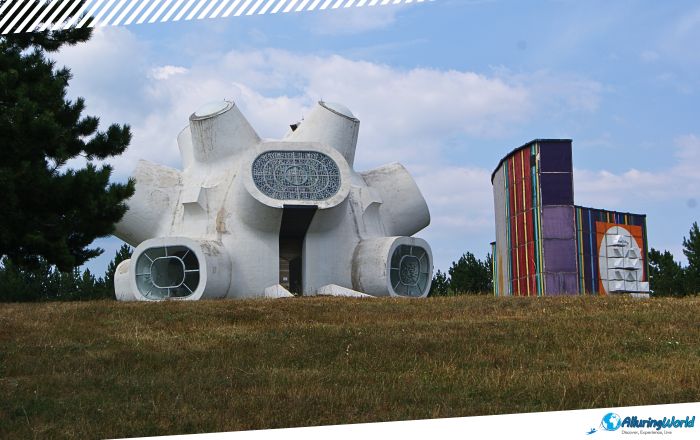
The main piece of the memorial is actually the Dome, which has the shape of the weapon Mace. During Ottoman times, the Mace was one of the most common weapons that were used in battles, so throughout time it has become known as one of the biggest symbols of resistance used in battles.
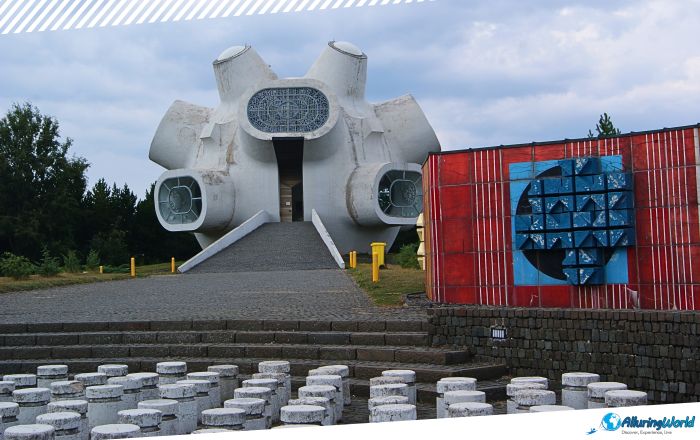
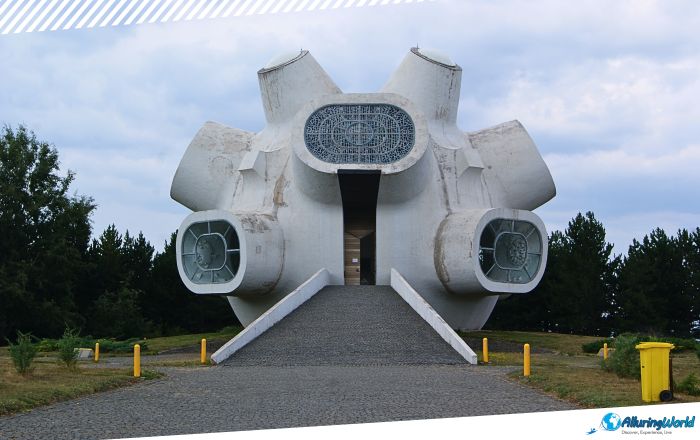
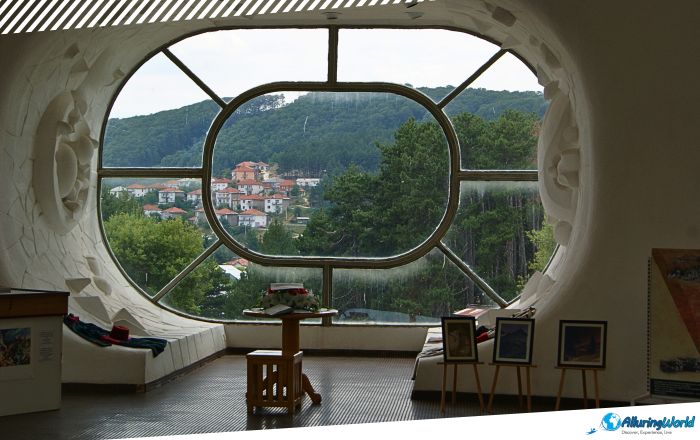
The Dome is approached from a raised walkway, which takes you right to the tall entrance door, and noticeable on the front door is the letter M, which stands, of course, for Macedonia. Once at the entrance, each visitor can turn around and see the vast open space, together with the beautiful city of Krushevo. Nonetheless, once you enter, from there you can clearly see four horizontal nodules branching out from the sphere, each ending in a glass observation window. There are also abstract mosaics on the walls of each of the four observation windows, which have some symbolism and/or tell the story of the struggle against the Ottoman Empire.
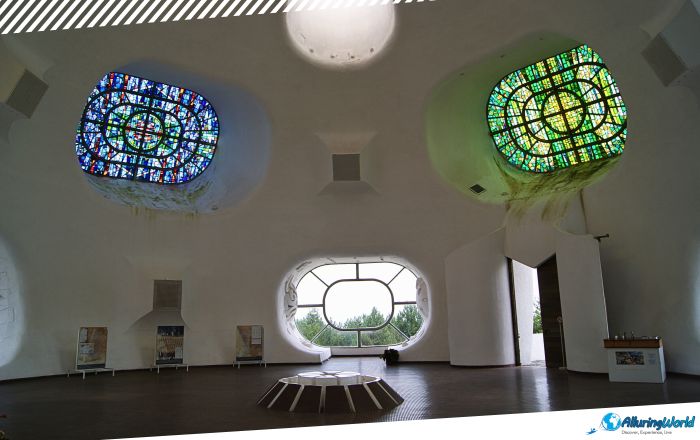
Above those, there is another set of four window-like openings aligned with the spaces in between, and fitted with different and unique coloured glass. These are the largest windows of the structure, and when lit by the sun, they broadcast a magnificent hue of colors to the ground. Moving higher, there are another four lumps that are raised towards the heavens, and show the path to the heavens for the people who lost their lives in making Macedonia free.
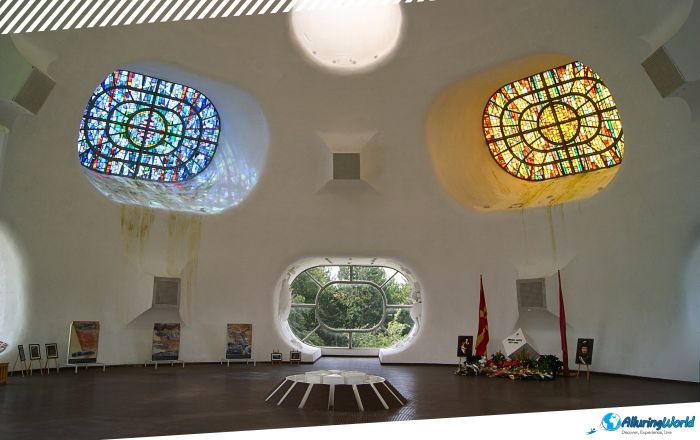
One thing to note about the interior is that it is minimalist, with a symbolic eternal flame in the middle of the structure, which is raised from the floor. This eternal flame, while not real, still illuminates the interior of the monument, forming, of course, the Macedonian flag.
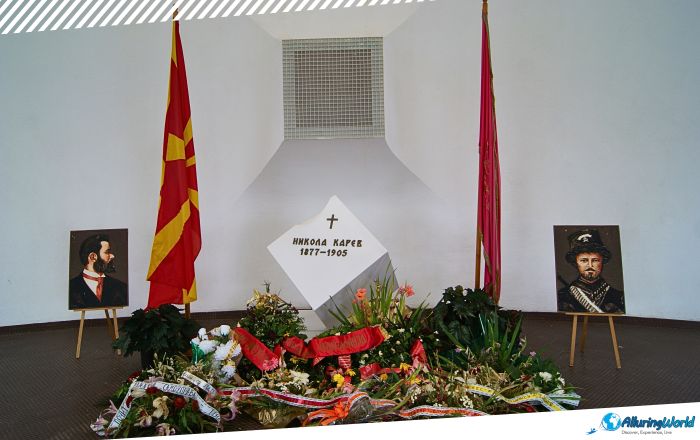
Within the main monument is the final resting place of Nikola Karev, who was the first President of the Krushevo Republic. Since 1990, there have been both flags of the Republic of Macedonia and the Krushevo Republic standing next to the grave of the first President of the Krushevo Republic, whereas his tombstone is a cube of white marble that is inscribed with his first and last name together with the year of birth and death. Interestingly enough, when visiting the last resting place of Nikola Karev, one can notice that there is a piece of the marble missing in one of the corners, and this is a small symbol that speaks about the unfinished work of Nikola Karev. Even though he did not survive to see Macedonia as a free country, he, in fact, became the biggest hero of Macedonia.
In conclusion, even though Karev’s dreams of Macedonia are not as he wanted, nor planned, yet today Macedonia is an independent Republic which enjoys the opportunities an independent country can have. Nowadays, the Makedonium memorial is one of the most important and unique structures in the country, and since it is well-known worldwide due to its unique shape, it is considered to be among the most visited ones in the country.