
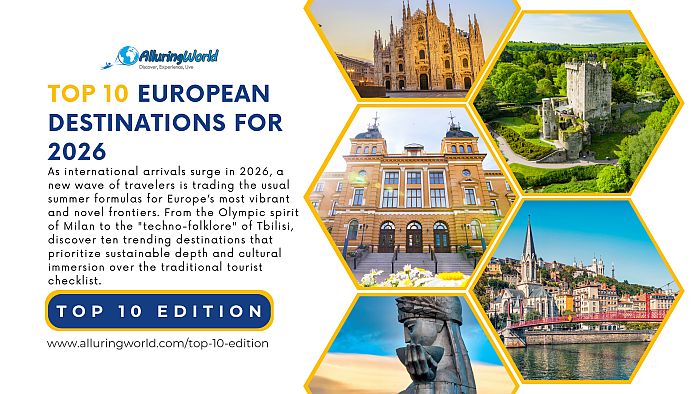
2026 in Europe is not your usual summer vacation formula that you are used to. According to a recent update by the European Travel Commission, international visitors to Europe experienced an increase in 5.6% of arrivals for the early part of 2026, while overnight stays increased by 5.5%. Meanwhile, arrivals and overnights in 2025 continued to grow beyond 3%. What this means is that demand remains strong, but vacationers are becoming increasingly aware of their destinations’ vibrancy and novelty. Travelers are starting to discover new destinations, new countries that were not on the map before, so here is a list of the top 10 European destinations that you should keep your eye on in 2026.
1. Brussels, Belgium, for culture that finally feels current
Despite its reputation as a city that other major European cities have always overshadowed, 2026 appears to be the year that Brussels will finally come into the limelight. With the opening of Kanal-Centre Pompidou in November 2026, new hotel openings, revitalized public areas, and an increased focus on its design and culinary culture point to the fact that Brussels will become a city where art, architecture, transportation, and urbanism all converge without seeming too polished. This is to be expected of Belgium’s capital since it is considered to be the capital of Europe, considering the European Union’s main seat is located in this city.
2. Seville, Spain, for long nights, serious food, and a city on the rise
One of those cities you can never be disappointed with is the Spanish city of Seville, which also comes with some added momentum for 2026. According to travel blogs and reviewers, Seville sees a number of openings in terms of new restaurants, cocktail bars, and hotels, not to mention new flights and a high-speed railway connection with Madrid. That will all add up to transform the essence of a city. The city will become more accessible, allowing visitors to explore it even further while seeking more than just a standard sightseeing tour. Seville requires spontaneity, impromptu booking options, and a glance at maps in between visits to tapas bars, thus making a European eSIM essential to have beforehand.
3. Greece, but not the version everyone books first
Greece keeps its place in any true European ranking, but the more intelligent choice for a holiday in 2026 lies outside those usual summer choices. In the first instance, Crete is an obvious destination thanks to its culinary heritage and being named as the European Region of Gastronomy in 2026. Then again, the filming of the Christopher Nolan movie The Odyssey in Messinia, along with the region’s archaeology, will help in promoting the Peloponnese. This is in line with what the European Travel Commission is reporting regarding overall tourist behavior in favor of experience-oriented choices from Mediterranean regions. Overall, the performance of Greece in early 2026 has been exceptional, with a 33% increase in tourist numbers in the year to date.
4. Oulu, Finland, for a cooler, more thoughtful Europe trip
In case your 2026 plans include trading hot weather and loud cities for fresh air and a slower pace, then Oulu, within the north-central part of Finland, should definitely be considered as one of the better alternatives. This city features excellent pedestrian and cycling amenities, a unique Arctic food culture, a rich history of saunas, and an abundant cultural calendar based on the idea of celebrating the year when the city will become one of the northern European capitals of culture. In particular, the city has managed to create a modern and unique identity through the use of culture, technology, and public spaces. Also, it should be noted that the European Travel Commission reports on 2025 and early 2026 confirm the rising popularity of Northern Europe and Finland specifically.
5. Saint-Gervais-les-Bains, France, for an Alpine trip that leans greener
The Alps will still attract many people, yet the most intriguing thing about them as a destination in 2026 will be the transformations that are taking place. The most remarkable feature at Saint-Gervais-les-Bains is the introduction of the new generation of Mont Blanc Express trains. They will increase passenger capacity while reducing carbon emissions, but at the same time, the Le Valléen gondola will allow visitors to get from the train station to the ski resort center within a few minutes. Overall, this would be a better opportunity to enjoy the Alps without thinking about the carbon footprint you leave behind while traveling.
ADVERTISEMENT
6. Milan, Italy, for winter sports, design, and a city in full motion
Milan in 2026 is no longer simply a transit point but is rather a destination in its own right, having an agenda of its own. Milan hosted the Winter Olympic Games from 6 to 22 February, and people are paying attention to the fact that Milan has been considered a design destination because of Salone del Mobile in April. In addition to this, there are hotel launches that will happen throughout 2026, but the sheer magnitude of the Winter Olympic Games has put Milan once again on the world map. Alongside the venue that had pre-existing and temporary sites, travelers like you can still enjoy the mesmerizing architecture and amazing history this city has to offer.
7. Cork, Ireland, for a culinary and coastal revival
The poetic aura of Ireland never fails to entice visitors, but 2026 will see Cork become a hotbed of rebellious energy. As Dublin takes care of the throngs of tourists, Cork embraces its legacy as the “Rebel City” by highlighting its artisanal history. Although the English Market continues to be its center, a surge of micro-distilleries and farm-to-table food centers is giving a new meaning to Irish hospitality. Given the proximity of the untamed Wild Atlantic Way coastline, Cork is the perfect blend of urban edginess and nature. It is the kind of destination where the banter equals the quality of the stout.
8. Lyon, France, for the ultimate intersection of history and innovation
While Paris may be considered the heart of France, Lyon is its soul, especially when one is looking beyond the superficial. Lyon will continue to push forward with its “green city” plans in 2026 by enhancing its riverside pathways and bike trails, making the Presqu’île district feel more inviting than ever before. While it is already known as the world capital of gastronomy, Lyon has seen the emergence of new creative zones such as La Croix-Rousse, which combines its historic silk weaving with digital arts. Lyon is one of those cities that can be described both as ancient and futuristic, providing a cultured option away from the madness of the capital.
9. Utrecht, Netherlands, for a canal-side escape that breathes easier
While Amsterdam is classic, Utrecht will be the destination of 2026 for tourists wanting the traditional Dutch look with some space to spare. The unique wharf level cafés of Oudegracht give visitors an outlook of canal living that cannot be experienced anywhere else. More and more people have started noticing how Utrecht excels in cycling facilities and how much energy the university gives the area. Art lovers and those interested in nightlife will find themselves in a vibrant, inclusive scene where there’s always something new to experience. For tourists who wish to visit parts of the country off the beaten track, Utrecht will be the center stage of their trip.
10. Tbilisi, Georgia, for a frontier that feels like the future
Tbilisi is the perfect place where boundaries between Europe and Asia become blurred in the most enchanting way ever. By 2026, its “techno-folklore” culture of polyphonic heritage and electronic music that the world knows so well will attract a new wave of explorers. While Abanotubani sulfur baths continue to emit their steam surrounded by the Narikala Fortress walls, the most exciting thing is that former Soviet factories are being repurposed into boutique hotels, art galleries, and wine bars with 8,000 years of vintage expertise. This is a place to discover, and you know it’s hard to come by in the already over-tread western routes.
Ultimately, when you take a look at the European landscape of 2026, it is easy to notice that the key to any successful trip lies not in a checklist but in gaining as much depth as possible. No matter whether your destination is the Olympic spirit of Milan, the gourmet adventure of Lyon, or the frozen charm of Oulu, there will be no lack of opportunities.
In choosing your destination in 2026, the choice will not be so much where you decide to go as how you choose to experience it: taking the train rather than flying, dining at a local café instead of a chain restaurant, and exploring the unfamiliar corner rather than the celebrated landmark. This list of destinations is not simply indicative of the places that Europeans will visit in 2026, but it represents the trend towards more intelligent, more sustainable tourism that is taking place on the continent. The only action you need to take is to go over the list carefully and decide what it is that you want to do this year in Europe.