
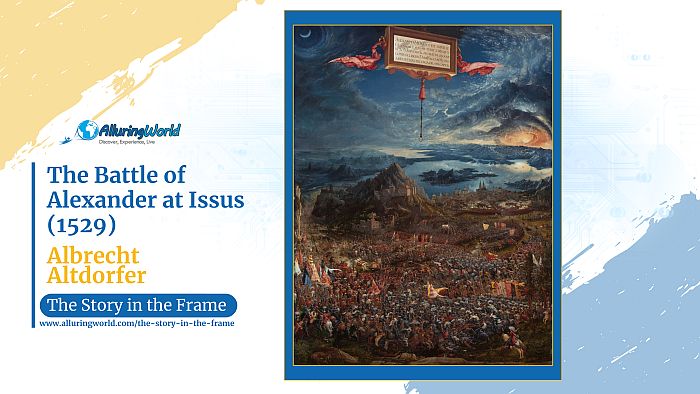
Painted in 1529, The Battle of Alexander at Issus by the German Renaissance artist Albrecht Altdorfer is a monumental and intricate depiction of the historic clash between Alexander the Great and King Darius III of Persia, which was a defining series of military engagements that led to the collapse of the Achaemenid Persian Empire and the rise of Alexander’s vast Macedonian kingdom. The painting is celebrated for its vast scale, dramatic detail, tiny details, and combination of historical narrative with imaginative landscape.
About the Painter:
The German artist Albrecht Altdorfer (ca. 1480–1538) was a painter, engraver, and architect who was a member of the Danube School of painters, and this school is famous for pioneering landscape painting as a major element in art. Altdorfer received his artistic education in Regensburg, and his paintings were often characterized by meticulous detail, expressive color, and dynamic composition, which overall emphasized the natural beauty and historical narrative.
Inspiration and Reasons Behind the Painting:
The Battle of Alexander at Issus is a depiction of the historic victory of Alexander the Great over the Persian army on 5 November 333 BCE in southern Anatolia (near modern-day Dörtyol, Hatay, Turkey). Altdorfer was influenced by stories of the past and the Renaissance fascination with classical culture, striving to capture the majesty of the battle scene, as well as the magnificence of nature and the cosmos. The painting is characteristic of the period’s fascination with heroism and divine order in the world. Some critics, such as Jonathan Jones writing for The Guardian, might even argue that the painting’s detached, apocalyptic depiction of mass slaughter anticipates the totalizing mindset that would later emerge in 20th-century fascism and World War II.
What is Depicted in the Painting:
In this work of art, you get to see Alexander’s cavalrymen as they are galloping across the battlefield towards the escaping Persian soldiers. The composition is very crowded with many details, as it features thousands of soldiers, horses, and warriors engaging in intense combat, as the day was slowly ending and turning into night. In the background, you can notice a sweeping landscape that stretches to distant mountains and a dramatic, cloud-filled sky, while a stylized representation of the Mediterranean coast and cities adds historical context. Overall, this painting balances the chaos of the historic battle with a sense of cosmic order, highlighting the heroism and the scale of human conflict. At the top of the painting, added between the clouds, is a grand, ornate hanging tablet held aloft by red ribbons. This tablet, written in Latin, serves as an informational placard that explains the historical context, the combatants, and the immense casualties of the historic clash. The inscription reads:
ALEXANDER M. DARIU M. ULT. SUPERAT
DARIUM III PERSIAR. REGEM
CAESIS IN PRELIO FACTIS PERSIAN.
PEDIT. C. MIL. EQVIT. VERO
X. MIL. INTERFECTIS MATRE DARI
CONIUGE LIBERIS DARI REGIS CVM
AMPLIUS M. EQVITIBUS FUGA DILAPSI CAPTIS
When we translate this to modern-day English, we get:
Alexander the Great defeats the last Darius, King of the Persians, after 100,000 Persian infantrymen and over 10,000 cavalrymen were killed in battle. King Darius’s mother, wife, and children were taken captive, while Darius fled with no more than 1,000 horseback riders.
Colors and Techniques:
Altdorfer uses an active and diverse color scheme, where the bright reds, blues, and greens used to depict the soldiers’ clothes contrast with the earthy natural colors of the landscape. The elaborate brushwork allows for the depiction of the armor, weapons, and facial expressions of the figures, whereas the atmospheric perspective adds depth to the scene. Overall, the dramatic sky and sunlight accentuate movement and highlight the epic scale of the battle.
Conclusion:
To conclude, The Battle of Alexander at Issus is a great example of how Albrecht Altdorfer managed to combine history, landscape, and minute details. Through a good composition, bright colors, and a detailed view, the artist was able to depict the chaos and heroism of war and, at the same time, place human activities in the context of the greatness of nature and the cosmos. In the end, it remains a masterpiece of Renaissance art, admired for its ambition, technical skill, and narrative complexity.