
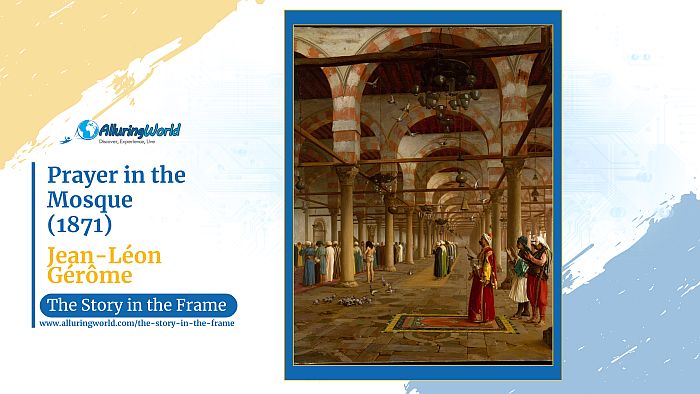
Created in the late 19th century, Prayer in the Mosque by Jean-Léon Gérôme is an Orientalist painting that takes the audience on a historical journey into the magnificence of the mosque’s architecture and its spirituality. This painting is a good example of how precise and detailed Gérôme’s works are and how he was interested in other cultures beyond the cultures of Western Europe.
About the Painter:
Jean-Léon Gérôme (1824-1904) was a French academic artist whose works ranged from historical and Oriental paintings to genre painting. Gérôme is famous for his mastery of technique and photographic realism because he would often paint scenes of exotic places, classical themes, and daily life in great detail. Overall, his paintings combined storytelling with visual effects and appealed to both art critics and the general public, thus making him among the more sought-after painters who showcased something different from an era when paintings were quite similar.
Inspiration and Reasons Behind the Painting:
The inspiration for Prayer in the Mosque came from Gérôme’s journeys to the Middle East, where he saw Islamic architecture and the rituals people performed there. This painting shows the European fascination with the “Orient” in the 19th century and illustrates Gérôme’s fascination with ritual, order, and human devotion to God. Gérôme aimed to create a visually striking composition that conveyed the solemnity and structure of Islamic worship; thus, he combined architectural sketches from Cairo with studio models to summarize the visual forms of prayer for Western audiences.
What is Depicted in the Painting:
This painting shows worshippers praying inside a majestic mosque, positioned in neat lines under towering arches and geometric patterns. These individuals, who are dressed in robes, are seen standing and bowing in an attitude of reverence. There are four lines of worshippers shown across the background, while on the right-hand side, there is a group of people prominently featured in the right foreground. These are three figures representing Ottoman Cairene society: a central dignitary in a gold-trimmed crimson robe, an Arnaout mercenary in a pleated white skirt, and an armed Bashi-Bazouk irregular soldier. This illustrates the multicultural mix of military and social ranks in 19th-century Egypt, as the painter tried to capture the Mosque of ʻAmr ibn al-ʻAs in Cairo, which was at that time ruled by the Ottoman Empire. Scattered across the stone floor and fluttering through the colonnade, you will notice pigeons, which introduce a touch of everyday movement while reinforcing the tranquil, sacred atmosphere of the mosque’s sanctuary. While the architecture of the mosque is the focal point in the picture, the use of geometrical patterns on the floor and high ceilings overall makes up the whole composition.
Colors and Techniques:
Jean-Léon Gérôme makes use of a complex color palette with warm tones of earth colors, white, blue, and red, giving equal importance to both the characters as well as the architectural elements. The brushstrokes of the painter are extremely accurate and detailed in showing different textures such as those of fabrics, stones, and tiles. While the mosque’s interior is shown in a somewhat darker tone, there is still light that penetrates through the openings of the mosque, thus creating diffused clarity in the picture.
Conclusion:
In order to sum up this masterpiece of a painting, it should be stated that Prayer in the Mosque is a great example of Jean-Léon Gérôme’s ability to show details, composition, and his cultural sensitivity. Through his meticulous rendering of architecture, costuming, and light, he captured the aesthetic magnificence of Islamic spaces, and he managed to introduce Western viewers to the quiet majesty of Orientalist art, even while artistic choices guided his depiction of the ritual itself.