
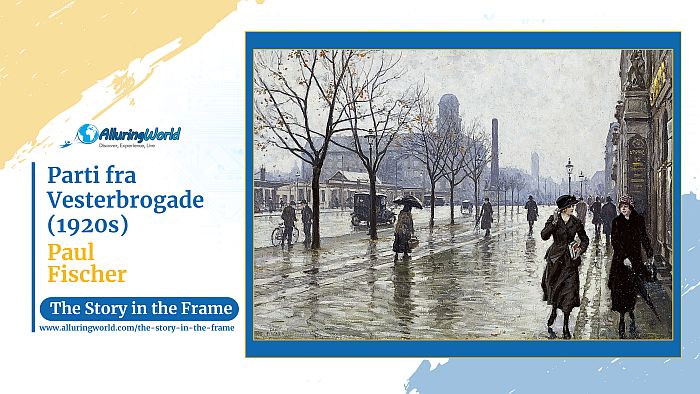
The painting Parti fra Vesterbrogade was done by Danish painter Paul Fischer, who was mainly known for paintings with naturalistic and lively depictions of urban life, harbors, and seaside leisure. The painting is officially called by its longer name Parti fra Vesterbrogade ved Axelborg og Frihedsstøtten en regnvejrsdag, or in English View of Vesterbrogade near Axelborg and the Liberty Column on a Rainy Day, and it is a great work of art by Fischer, as he is famous for the detailed paintings he has done that capture the essence of life in the city, as his paintings are skilfully brought to life and brought closer to you. For example, his most common subjects were usually pedestrians, carriages, and buildings, as well as the life of the Danish capital, Copenhagen, during that time. The painting Parti fra Vesterbrogade perfectly captures his skills as a painter and the vitality and character of Copenhagen at the beginning of the 20th century.
About the Painter:
Paul Gustav Fischer (1860–1934) was a Danish painter renowned for his urban landscapes, street scenes, and illustrations of Copenhagen. As a student who attended the Royal Danish Academy of Fine Arts for two years without graduating, Fischer acquired the ability to observe details and narrate his works quite meticulously. He was skilled in painting all the details of life in the city, whether that be from elegant promenades to routine activities, as he combined accuracy and composition in his art. Fischer’s paintings are renowned for their exactness, vivid portrayal of people, and the capacity to capture the spirit of cities.
Inspiration and Reasons Behind the Painting:
Fischer was an artist who worked in an era when Copenhagen was being developed, and the urban areas of the city were being brought closer to the modern times of the 19th and 20th centuries. His painting Parti fra Vesterbrogade is a great example of the artist’s interest in what was happening in the city, as well as the activities of a modern city. There is no official date that will confirm when the painting was painted; however, the fashion and automobiles shown in it could suggest around 1920, although the building Axelborg was built between 1918 and 1920, which would place the painting after 1920. Regardless, Fischer created this amazing painting out of his interest in capturing the changing social and architectural scene of the city, both in terms of the dynamism of the city and the subtle nature of its people.
What is Depicted in the Painting:
This painting is an example of Copenhagen’s Vesterbrogade street, which is an important one in the city; as presented in the painting, there are people walking around, motorized vehicles driving along the street, and bustling life. The scene is set on a cold, rainy autumn day, as there are no leaves on the trees, and one of the people depicted in the painting is carrying an open umbrella. There are numerous individuals shown walking, talking, or doing whatever they are busy with amid buildings, shops, and other details of the street. In the central background part of the painting, you can notice the Liberty Column, or in Danish, Frihedsstøtten, and this is the prominent obelisk which was erected to commemorate the agrarian reforms of 1788 and the abolition of stavnsbåndet (a form of serfdom/adscription that legally bound Danish peasant boys and men aged 14 to 36 to their birthplace estate). The large building structures lining the background along Vesterbrogade are the famous Axelborg building and the even more famous Tivoli Gardens amusement park. Overall, this artist manages to illustrate the dynamism of city life by giving emphasis to individuals and their interaction while the city continues to move forward into the future.
Colors and Techniques:
The artist uses a naturalistic color scheme that includes earthy colors for the street and buildings, bluish-gray colors for the sky, and a few splashes of color in the clothing, trees, and buildings. His painting style involves fine details that emphasize the architecture, textures, and the uniqueness of the people depicted in the painting. While the painting could be dark, Fischer painted the light in a realistic manner so that he could provide illumination for the street and add vibrancy to the painting, unlike in reality, when Copenhagen could be darker and gloomier during autumn.
Conclusion:
To summarize, Parti fra Vesterbrogade is an excellent illustration of Paul Fischer’s ability to depict the vitality and characteristics of Copenhagen in the early 20th century. With the help of detailed observation and good composition, the artist managed to capture the spirit of the city through his painting, which not only represents the vitality but also the social environment of Copenhagen.