
Read time ca. 7 minutes
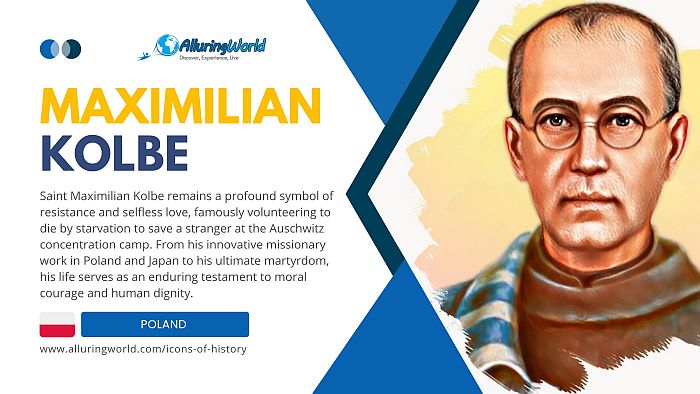
Maximilian Kolbe was a Conventual Franciscan friar, priest, and martyr who was born on 8 January 1894 in Zduńska Wola, Poland, and he remains one of the most revered figures of the 20th-century Catholic Church. Father Kolbe is known for his unwavering faith, humanitarian commitment, and ultimate act of self-sacrifice, which is why his life embodies courage, compassion, and moral integrity that have not been seen in anyone else. He was canonized by Pope John Paul II in 1982 and officially declared as Saint Maximilian Maria Kolbe, and since then, he has been remembered not only as a religious leader and missionary but also as a symbol of resistance against oppression and the transformative power of selfless love.
Early Life and Formation:
Saint Kolbe was born as Raymund Kolbe to a devout Catholic family, and he displayed deep religious inclination even from a young age. His early education and upbringing highlighted the moral responsibility, prayer, and devotion to the Virgin Mary, further shaping his spiritual character and motivating him to devote his life to the Catholic Church. At the age of 12, he entered the minor seminary in Plock, and this was the place where his intellectual abilities and pious nature were quite evident. Since he excelled in academics and demonstrated a profound capacity for theological reflection and philosophical reasoning, his path was set for him.
Still, Saint Kolbe’s early life was marked by a combination of intellectual curiosity and spiritual devotion because he was drawn to the study of scripture, Church history, and the writings of the saints. This intellectual curiosity made it possible for his sense of purpose to be cultivated and would guide his vocation. His formative years were also characterized by a strong commitment to service, consequently reflecting an early awareness of the needs of others and the moral imperative to act in the face of injustice.
Religious Vocation and Missionary Work:
In 1910, Kolbe joined the Conventual Franciscans, adopting the religious name Maximilian Maria. His formation in the Franciscan order emphasized discipline, community life, and missionary zeal. It was eight years later, in 1918, when he was ordained as a priest, and he embarked on a path of evangelization and social engagement. As soon as he was ordained, he was able to demonstrate a unique blend of intellectual vigor, spiritual devotion, and practical initiative.
Throughout his years of spreading the Catholic faith, Saint Kolbe was deeply committed through his direct missionary work and innovative means of communication, as technology advanced. Recognizing the power of media to reach large audiences and bring them to the House of God, he founded the monthly publication Rycerz Niepokalanej, or as the English translation would be, the Knight of the Immaculate. This publication was dedicated to promoting devotion to the Virgin Mary and spreading religious education. In addition to this, he also established the Monastery of Niepokalanów near Warsaw, which became a center for religious publishing and missionary activity, reflecting his ability to combine spiritual vision with organizational skill.
While other priests were able to concentrate mostly on their region, Saint Kolbe’s missionary work extended beyond the borders of Poland. He traveled to Japan in 1930, where he founded a monastery in Nagasaki and managed to continue his evangelization efforts in the Far East. His work in Japan demonstrated his amazing adaptability and perseverance because this evangelical work showed how he could navigate the cultural differences while maintaining the core principles of his faith. One of the more interesting details is that the monastery he founded managed to survive the atomic bomb that was released on Nagasaki during World War II. This period highlighted Kolbe’s commitment to global missionary outreach and his belief in the universality of the Church’s mission.
Advocacy and Resistance During World War II:
With the outbreak of World War II and the German occupation of Poland, the ultimate test was put on Saint Kolbe’s humanitarian and spiritual commitments. During this very dark period of humanity, he provided shelter, food, and spiritual guidance to refugees, persecuted individuals, and Jewish families, consequently demonstrating extraordinary courage and moral conviction for those who were unable to protect themselves. These actions placed him in direct opposition to the oppressive Nazi regime, and they showed how he is committed to justice and human dignity. As a consequence of his actions, he was arrested by the Gestapo in February 1941 and was sent to the harsh Auschwitz concentration camp. Despite the brutal conditions he faced in Auschwitz, he continued to minister to fellow prisoners, offering spiritual comfort, sharing food, and encouraging hope among the people who faced unimaginable suffering. His leadership and compassion there exemplified the moral courage and the transformative power of faith that can be endured under extreme adversity.
ADVERTISEMENT
Martyrdom and Ultimate Sacrifice:
Nevertheless, Saint Kolbe’s most renowned act of heroism occurred in July 1941. Following the escape of a prisoner from the camp, the authorities selected ten men to be executed by starvation as punishment. When one of the selected men, a fellow prisoner, expressed fear for his family and pleaded for his life, Kolbe voluntarily took his place.
The starvation he endured lasted for two weeks, and alongside the other condemned men, he was still able to provide moral and spiritual support to his fellow prisoners. Ultimately, on 14 August 1941, he was executed by lethal injection after surviving the starvation ordeal longer than the others. This act of heroism, great courage, and self-sacrifice became an enduring symbol of altruism, courage, and unwavering faith that inspired millions worldwide.
Canonization and Legacy:
Considering his steadfast commitment and courage, Maximilian Kolbe was beatified in 1971 and canonized as a saint in 1982 by Pope John Paul II. It was Pope John Paul II who highlighted Kolbe’s act of selfless love as a powerful testament to Christian values, and Saint Kolbe was recognized as a martyr of charity. This is a title that reflects his dedication to the welfare of others, thinking of the spiritual salvation of others, even at the cost of his own life.
Overall, Saint Kolbe’s legacy extends beyond religious veneration because he left behind writings that include spiritual reflections, theological essays, and letters. All of this work of his continues to inspire readers and scholars interested in ethics, theology, and human rights. His legacy at the monastery of Niepokalanów continues its dedicated work, and the monastery remains an active center of religious and cultural engagement. This is the place where Saint Kolbe’s life is commemorated in numerous educational, religious, and humanitarian initiatives worldwide.
Influence and Contemporary Significance:
Nowadays, it can be safely said that the life of Saint Kolbe is an epitome of the interrelationship between faith, morality, and social commitment. The courage he displayed in the face of tyranny, his dedication to the underdogs, and his martyrdom are all subjects of much discourse in the realm of morality, human rights, and interfaith dialogue. There are many schools, hospitals, and humanitarian agencies named after the saint, and all of them continue to embody the commitment he displayed in the realm of service and morality.
The story of Maximilian Kolbe is one that hits home because it is the ultimate test of character. It is one thing to learn about ethics in a classroom, but it is another thing entirely to see a person stand up for human dignity when it counts. He was not simply a rule-follower; he was a person who made decisions when it mattered most. Even today, his life is an effective reminder of what it means to be a person of compassion and adhere to one’s principles no matter what.
Conclusion:
In conclusion, Maximilian Kolbe was an outstanding figure whose life and deeds reflected courage, faith, and selflessness. The amazing missionary work, humanitarian activities, and final martyrdom he performed in the Auschwitz concentration camp proved that morality and spirituality could leave a lasting mark on all future generations. The legacy of Maximilian Kolbe remains an enduring symbol of hope, compassion, and morality, ensuring that his story will live on forever, both in religious and secular societies.