
Read time ca. 7 minutes
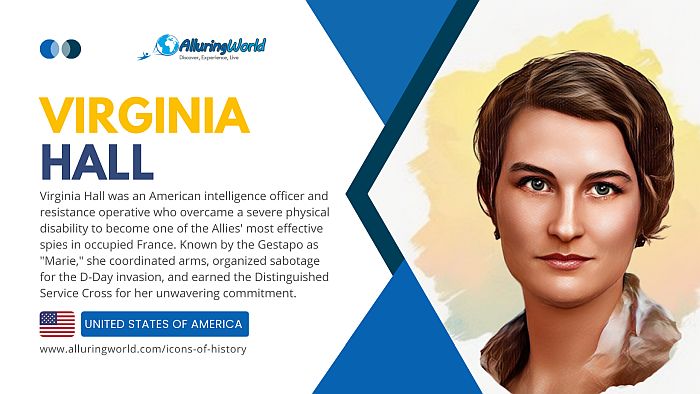
Virginia Hall was an American intelligence officer and resistance operative whose extraordinary courage and ingenuity made her one of the most effective Allied spies during World War II. Even though she faced significant physical challenges, she managed to conduct covert operations behind enemy lines in occupied Europe, earning a reputation as one of the most daring and resourceful agents of her time. Today, her story is known as one of the most remarkable examples of determination, intelligence, and unwavering commitment to freedom.
Early Life:
Virginia Hall was born on 6 April 1906 in Baltimore, Maryland, into a very prominent family that favored her education, independence, and social responsibility. After completing her early schooling in the United States, she attended Radcliffe College, where she developed an interest in European culture and politics. Following graduation, she pursued further studies in France and became fluent in French, a skill that would later prove invaluable in her espionage career.
Hall began her professional life in diplomacy in the 1930s when she joined the U.S. Foreign Service. She managed to get firsthand insights into the political tensions as she was stationed in France, Austria, and Poland, and these would later lead to the outbreak of World War II. Her postings exposed her to the rising influence of fascist regimes in Europe and heightened her awareness of the looming conflict. During her service, she faced a life-altering accident in 1933 when she was on a hunting trip in Turkey. On 8 December 1933, she was climbing over a fence when her shotgun accidentally discharged, resulting in a severe injury to her left foot, which, later due to gangrene, would result in amputation. As she was courageous, she adapted swiftly as she started using a prosthetic limb, nicknamed “Cuthbert,” but the injury ultimately ended her diplomatic career.
Transition to Espionage:
With the outbreak of war in Europe, Hall was determined to contribute to the Allied effort despite her physical disability. She joined the British Special Operations Executive (SOE) in 1941, which was an organization tasked with conducting espionage, sabotage, and resistance operations in occupied territories. She was the ideal candidate to do some covert work in France as she was perfect one due to the background in languages, diplomacy, and European culture made her an ideal candidate for covert work in France.
The first assignment Hall received was supporting resistance networks in southern France, as she coordinated the delivery of arms, explosives, and funds to local fighters. She additionally trained local operatives, organized sabotage missions against German infrastructure, and maintained secret communication lines with Allied command. She was quickly distinguished and could be recognized through her ability to operate independently under extreme pressure, often moving alone through enemy territory without detection.
Operations in Occupied France:
Operating under the codename “Marie,” Hall developed a network of informants, safe houses, and supply routes that became critical to the French Resistance. She employed extraordinary ingenuity to evade German counterintelligence, often disguising herself and using false identities to move freely in towns and rural areas. Her missions included gathering intelligence on German troop movements, coordinating supply drops, and assisting downed Allied airmen to escape occupied territory.
Hall’s work was marked by significant personal risk. As the Gestapo considered her to be one of the most dangerous Allied operatives in France, they placed a bounty on her head, but even with this looming over her head, she continued to operate. She was even more motivated to show her remarkable courage, as she was frequently traveling through hostile regions and relying on her wit, charm, and careful planning to avoid capture. Despite having a prosthetic leg, this was far from being a limitation, since it became part of her legend, something for which she would be proud as she used it to conceal documents and weapons during her missions.
ADVERTISEMENT
Arrests, Near Misses, and Adaptability:
Throughout her tenure in occupied France, Hall faced numerous close calls. Many times, German forces raided safe houses, arrested collaborators, and conducted extensive searches for resistance operatives, but on several occasions, Hall narrowly avoided being captured as she changed identities, hiding in plain sight, or sometimes fleeing to remote areas. The adaptability to any situation when the circumstances were rapidly changing was amazing while still maintaining operational security, which was critical to the success of her missions and the survival of her colleagues.
In addition to fieldwork, Hall coordinated intelligence networks that facilitated large-scale sabotage operations. It is interesting to note that she played a important role in preparing for the D-Day invasion because she organized French resistance groups which would disrupt German supply lines, sabotage railways, and provide reconnaissance information to Allied planners. All these contributions significantly weakened the German defenses, and they further enhanced the effectiveness of the Allied advance.
Postwar Recognition and Later Life:
Even when France was liberated, Hall did not stop as she continued to work in intelligence, and in 1951, she joined the newly established Central Intelligence Agency (CIA). She remained involved in clandestine operations during the early years of the Cold War, focusing on Europe and maintaining the skills and networks she had developed during the war.
In the end, Virginia Hall received numerous honors for her service and the important work she did for her country and allies, among which is the Distinguished Service Cross, which made her the only civilian woman to receive the United States’ second-highest military decoration during World War II. This quite important award recognized her extraordinary bravery, initiative, and unwavering commitment to the Allied cause. But regardless of these accolades, Hall preferred to avoid public attention as she wanted to maintain her private life while continuing to mentor younger intelligence officers.
Legacy and Inspiration:
Nonetheless, Hall’s life is embodied with resilience, intelligence, and moral courage. She is a woman who overcame a severe physical disability and managed to conduct operations that would help alter the end of World War II in a positive way. She simply demonstrated through her actions and deeds that determination and skill can overcome even the most daunting and complex obstacles. Today, her legacy continues to inspire generations of both men and men, and all personnel involved in intelligence, military service, and humanitarian work, thus highlighting the impact that one determined individual can have in the pursuit of justice and freedom.
Conclusion:
In conclusion, Virginia Hall remains one of the most iconic figures of wartime espionage. As she is celebrated for her resourcefulness, courage, and unwavering dedication to the Allied cause, it will be her work in occupied France, often conducted under extreme danger, that will motivate her to continue with the intelligence work she was excellent at. Not only did she contribute directly to the success of the French Resistance and the liberation of Europe, but today, her legacy serves as a powerful example of the difference one person can make through courage, intellect, and an unyielding commitment to human values.