
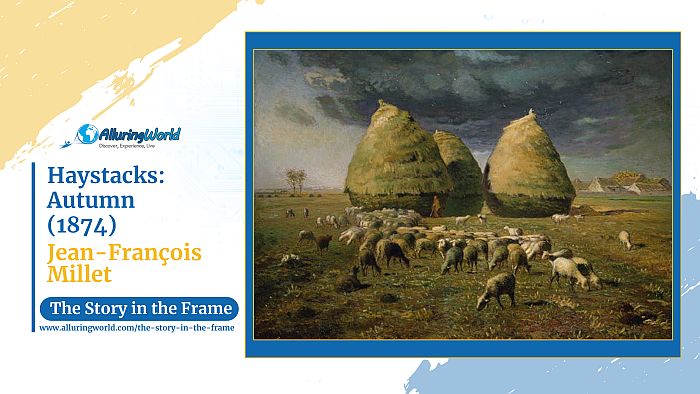
Created around the mid-19th century, more precisely in 1874, Haystacks: Autumn by Jean-François Millet is a reflective painting of the countryside that portrays the deep respect of the artist toward agrarian life as well as the rhythms of the seasons, in this case, the rhythm of the autumn. In this interesting work of art, it shows a period of harvest, mainly the labor, land, and time, which are viewed as an inseparable part of human existence.
About the Painter:
Jean-François Millet (1814 – 1875) was a French artist and painter who was well known for founding the Barbizon School. He gained recognition for painting peasant life, portraying rural workers with gravity and empathy rather than sentimentality. Millet defied the norms of traditional academies because he used ordinary laborers to depict their work, rather than painting heroism through mythological, biblical, or aristocratic subjects. Overall, the agricultural scenes depicted in his paintings were considered morally important with heavy emotional significance.
Inspiration and Reasons Behind the Painting:
Haystacks: Autumn was influenced by Millet’s own background and experience with the countryside, since he had been living and working in Barbizon, where he felt as one with the nature that he depicted through his paintings. For Millet, farming had the dignity of being a necessary occupation that should be depicted in art, instead of something that others ignored, and he followed a more classical approach. Autumn, being the season of harvest and completion, gave him the opportunity to examine these concepts without overt narrative or drama.
What is Depicted in the Painting:
In this painting, there are large haystacks dominating the landscape in front of open fields and an expansive sky. The human figure that can be seen standing at the base of the front-left haystack is almost blended perfectly with the haystack, and it is kept as minimalist as possible in the painting. Jean-François Millet did try to bring humans into his painting incidentally, since he wanted to give closer attention to the farm work, and further emphasize the fact that the land is more important than the person itself, along with the products of his efforts. The haystacks have firm forms suggesting permanence and strength. Throughout the painting, a flock of sheep can be seen grazing in the field, and the heavy, brooding autumn clouds are slowly enveloping the landscape in the background. In the right background, rural farmsteads can be seen, probably the home of the sheep herder, while to the left side there are two lonely trees that are standing amidst the open field, which do not have any specified meaning and are open to interpretation.
Colors and Techniques:
Millet uses a palette of colors in the brownish range, ochres, muted greens, and grey, mirroring the colors of the autumn landscape. He balances these earthy tones with deep slate-blues in the heavy clouds and pale, silvery highlights along the horizon and the lit edges of the haystacks. The strokes of his brush are restrained and textured, providing weight and substance to the haystacks and soil depicted. In the foreground, however, his brushwork becomes much looser and more economical, leaving glimpses of his dark underdrawing visible around the grazing sheep and grass. The light in the artwork is moderate and natural, adding to the atmosphere of stillness and serenity of the season. Filtering softly through the overcast sky, this diffused light avoids harsh shadows and unifies the entire scene.
Conclusion:
Haystacks: Autumn is a fine example of how Jean-François Millet approached the representation of rural scenes with integrity, dignity, and reverence. With its simple shapes, muted colors, and well-balanced composition, the painting manages to turn an everyday scene into a contemplation of labor, land, and changing seasons. It still stands as a strong testimony to the influence of Millet on modern landscape painting.