
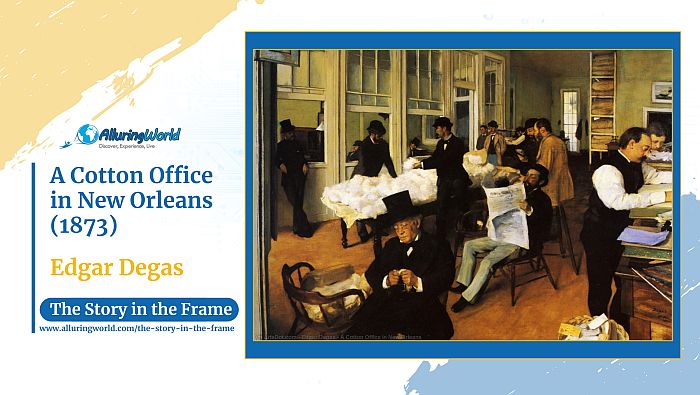
Painted in 1873, A Cotton Office in New Orleans by the French Impressionist Edgar Degas is an insightful look at the economic and social aspects of life in New Orleans during the years after the Civil War. The artwork features both Degas’ passion for modern city life and his compositional techniques.
About the Painter:
Edgar Degas (1834–1917) was a French artist who practiced painting and sculpture. He belonged to the Impressionists but identified himself as a realist. Degas studied art at the École des Beaux-Arts in Paris and became famous for his works on modern life. His paintings focused more on composition, movement, and the psychology of his subjects than on outdoor scenes.
Inspiration and Reasons Behind the Painting:
Degas painted A Cotton Office in New Orleans while he was visiting his mother’s relatives in Louisiana, within the southern part of the United States of America. The painting is an illustration of how Degas liked modern life and how much he was interested in industrial life and its organization, just like he was interested in any other aspect of human activity.
What is Depicted in the Painting:
The painting shows a number of men and boys who are busily doing work in an office setting, such as testing the cotton samples, writing, and talking to each other. This has been considered a setting that was common for that period. The papers, scales, and bales of cotton can be seen everywhere, which signifies that the office is a commercial one. The people are arranged symmetrically in the painting, their gestures showing that they are serious about their work and have interaction among themselves. Overall, Degas has made sure to capture the setting properly, so that we can feel like we are present in the moment that Degas has imagined when painting this masterwork.
Colors and Techniques:
Degas has used colors such as brown, gray, and dull blue, with accents of white and flesh tone. The realistic effect that can be observed in the painting is achieved through his precise brushwork and meticulous portrayal of textures like cotton, paper, and clothes. Lighting is done from an out-of-the-frame source and focuses on faces and hands.
Conclusion:
Conclusively, a Cotton Office in New Orleans is an embodiment of how Edgar Degas painted modern life with precision and grace in his works. Through meticulous organization of elements in the painting, use of appropriate colors, and accurate details, Degas manages to portray the life dynamics of the labor and society within a commercial office setting during the post-Civil War period.