
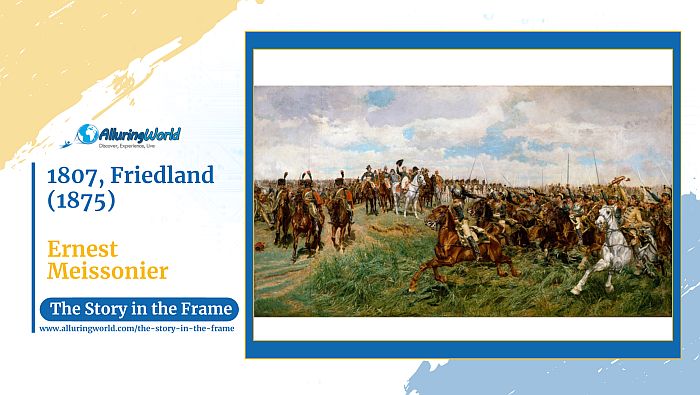
Painted by Ernest Meissonier, 1807, Friedland was created during the height of the 19th century period, and it is a masterful historical painting depicting a significant event in Napoleon’s history. Famous for being highly precise and historically accurate, Meissonier shows the events after the Battle of Friedland in all their glory and in great detail. The painting represents a masterpiece of French art in the 19th century, connecting Romantic history painting with the more realistic and meticulous style of late Academic art. Each detail of the painting, such as trampled grass, polished brass buttons, and expressions of fierce loyalty, is captured with obsessive attention to detail, rarely rivaled in art history.
About the Painter:
Ernest Meissonier (1815 – 1891) was a well-known painter from France who created a reputation for himself through his paintings of historical and military themes. Ernest Meissonier is noted for creating paintings that showed the battlefields and military operations of Napoleon with immense skill and finesse.
Meissonier experienced a great amount of success during his lifetime. One aspect that set him apart from other artists was his refusal to use shortcuts. This meant buying real costumes of the time period, studying military maneuvers, and even renting horses to make sure they ran through muddy fields so that he could observe their splattering effect. The artist’s work was highly rewarded, making him one of the highest-paid and most influential artists of the 19th century. He became a key figure in the French Academy of Fine Arts.
Inspiration and Reasons Behind the Painting:
The painting 1807, Friedland is an illustration depicting the triumph of Napoleon Bonaparte in the famous Battle of Friedland fought on 14 June 1807. The battle, which marked a turning point in the War of the Fourth Coalition, saw him defeat the Russian Army. Meissonier was motivated by the importance of this historic event and the general admiration for Napoleonic heroes of his era. The painting aims to preserve the historic victory by capturing the discipline, valor, and humanity of the soldiers in it.
This was a project of great passion for Meissonier, and it consumed him over the course of decades of work. He did not himself live during the Napoleonic age, but he was raised during an era immediately after it, an era in which France could still recall Napoleon with considerable nostalgia. The Battle of Friedland represented the pinnacle of Napoleon’s career as a general, compelling Alexander I to agree to the Treaty of Tilsit, thus bringing an end to hostilities in Europe on France’s own terms. By painting this particular event, Meissonier hoped to produce the definitive musical tribute to French military prowess.
What is Depicted in the Painting:
The painting is organized around Napoleon and his subordinates viewing the battle from their place on the field. These figures are portrayed in a way that suggests power and authority. The other figures in the painting include soldiers, artillerymen, and flags. The battlefield extends back into the distance of the canvas, where one can see smoke, dead soldiers, and mounted cavalry.
Unlike traditional battle paintings that focus on the chaotic clash of swords or the direct horror of hand-to-hand combat, 1807, Friedland focuses on a thunderous surge of adulation. The 12th Cuirassiers, which were known as heavy cavalrymen clad in steel breastplates, are shown charging past Napoleon at a full gallop, waving their swords and roaring in triumph. Napoleon sits calmly on his famous white charger, Marengo, positioned on a slight hillock.
The foreground becomes an absolute master class in storytelling: There is a field of rye that has not been harvested, which is entirely flattened by the weight of the approaching horses, representing the destruction caused by the war. Dead bodies, discarded arms, and pieces of equipment and shako caps can be found in the mud, providing a physical sense of what is happening during the fight. The faces of the soldiers express either ecstasy or intense determination.
Colors and Techniques:
Meissonier uses a well-regulated use of color, using muted earth colors, gray and blue hues, with splashes of red and gold to create emphasis on uniforms, flags, and important individuals. The brush strokes are highly detailed, such that every individual soldier, weapon, and natural setting in the artwork appears clear. Light and dark shades have been employed in an attempt to emphasize Napoleon at the center of the painting.
In terms of technique, 1807, Friedland is truly remarkable. Meissonier painted with minute brushes applying paint in very thin layers that enabled him to convey the texture with great precision; be it the cold shine of the metal armor or the sweat glimmering on the sides of the horses. The lighting is carefully crafted, as it was ensured that the sunlight piercing the thick clouds of gunpowder smoke created a theatrical effect, casting a spotlight on Napoleon himself. Thus, thanks to the skillful use of chiaroscuro, no matter how much turmoil there is among hundreds of characters, our attention always goes back to the emperor.
Conclusion:
Therefore, 1807, Friedland serves as an excellent example of how Ernest Meissonier was skilled at creating historical paintings through accurate detail, perfect composition, and clarity of story. By means of precise rendering, appropriate coloring, and detailed depiction of human and military figures, Meissonier created a masterpiece that preserves a significant event from the Napoleonic era.
In the present time, the picture is appreciated not only because of its historical significance, but also because it embodies the peak of Academic realism. It acts as an example of the link between today and the past, giving contemporary people the chance to experience the feelings of patriotism and creative aspirations that prevailed in France in the 19th century. The picture created by Meissonier remains appealing both for art historians and people interested in military history.