
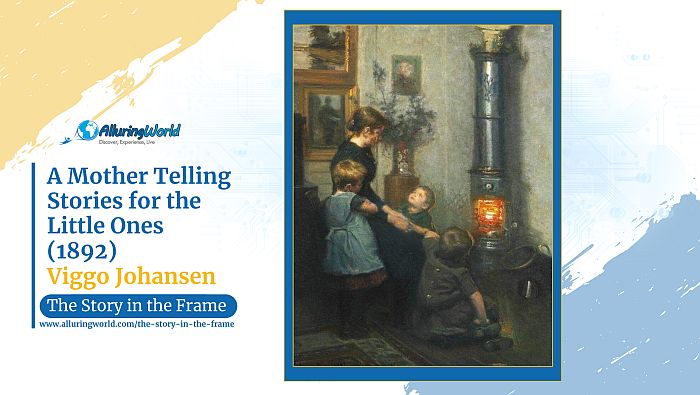
A Mother Telling Stories for the Little Ones, painted in 1892, is a touching genre scene from Denmark that captures the warmth and intimacy of domestic life, and it was painted by the artist Viggo Johansen. Johansen was associated with the Skagen Painters, who were well-known for their ability to capture the nuances of light, atmosphere, and human interaction through their compositions that were realistic and, at the same time, full of emotion. Overall, this painting exemplifies his skill in portraying family life with sensitivity and charm.
About the Painter:
Viggo Johansen (1851 – 1935) was a Danish artist who was famous for his portrait art, landscapes, and interior scenes. He was an important member of the Skagen Painters group, as he was heavily inspired by light and impressionism; however, he always tried to preserve the subtle realism in all of his paintings. Viggo Johansen received his education at the Royal Danish Academy of Fine Arts and distinguished himself with the talent of conveying an atmosphere that captures everyday moments with a poetic touch, combining precise observation with a sense of warmth and humanity. It can be noted that his paintings often feature intimate domestic interiors, outdoor scenes, and the nuanced interplay of light and color.
Inspiration and Reasons Behind the Painting:
Johansen lived during a time when the domestic realm and family life were popular themes among Danish artists because of the growing European interest in genre paintings in the 19th century. A Mother Telling Stories for the Little Ones glorifies the maternal care, storytelling, and the nurturing environment of the home. It is possible to say that this painting came from Johansen’s passion for painting moments of human communication that are full of emotions and intimacy, thus highlighting the simple yet profound acts of love and attention within a family setting.
What is Depicted in the Painting:
This painting features a scene set in a home, right at the chimney corner, wherein a mother sits down with her children surrounding her as she narrates a story to them. The faces of the children are illuminated by the warm light, particularly the small child on the mother’s lap gazing up at her in wonder and the child seated beside the stove, while the mother’s profile is turned affectionately toward them. There are no elaborate furnishings, but the atmosphere is warm and intimate, with the glowing firelight from the tall iron stove bathing the family in a soft, cozy light. There are family paintings that hang on the walls and some modest furniture that was available to the general public at the end of the 19th century. The vase and its upward-reaching foliage create a vertical line that closes the gap between the figures gathered around the warm stove and the framed artwork on the walls. Overall, this part of the painting helps to frame the mother’s head and shoulders, thus drawing the viewer’s eye toward her as the focal point of the narrative.
Colors and Techniques:
The color palette consists of deep, muted dark tones, slate greys, dark blues, and earthy browns, strikingly contrasted with the vibrant red and orange glow of the hearth fire. The lighting is driven entirely by the firelight, creating deep shadows throughout the dim room that enhance the sense of warmth and privacy. The brushstrokes are soft, and the artist has captured the textures of fabrics, skin, and furniture in a realistic yet impressionistic way. The interplay of light and shadow underscores the nurturing and serene mood of the scene.
Conclusion:
To sum it all up, A Mother Telling Stories for the Little Ones is an emotional masterpiece by Viggo Johansen that captures how expertly this artist can depict the beauty of family life in Danish society. Thanks to his ability to pay attention to details, gestures, and facial expressions, the artist immortalized those beautiful moments of a mother telling stories to her little ones. As such, it is one of those paintings in the genre painting tradition that will be remembered forever.