
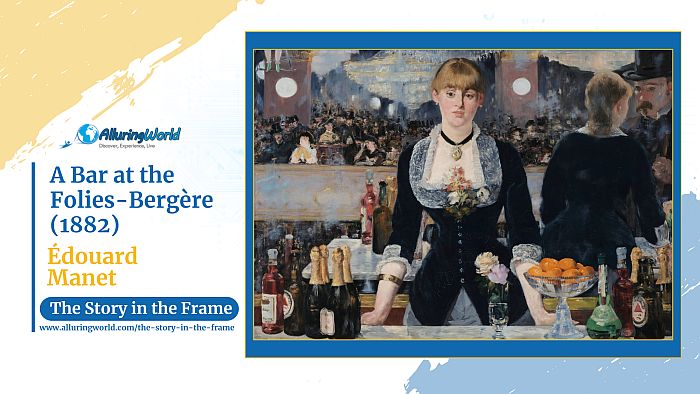
A Bar at the Folies-Bergère is an outstanding painting that was created in 1882 by the French Impressionist artist Édouard Manet, which reflects all aspects of modern life, such as modern urban life, social observation, and psychological complexity. The painting is famous for its exceptional composition, reflective surfaces, and unique depiction of Parisian nightlife, and it is widely considered to be Édouard Manet’s last and greatest masterpiece, in addition to being a cornerstone of modern art history.
About the Painter:
Édouard Manet (1832–1883) was a French painter whose paintings were a fusion of Realism and Impressionism, pioneering modern approaches to subject matter and technique. He was trained as a painter in Paris and, influenced by both classical art and contemporary life, was well known for his bold compositions, direct brushwork, and candid depictions of social and urban scenes. Among the other paintings he created, he is also known for paintings such as Olympia and The Balcony.
Inspiration and Reasons Behind the Painting:
A Bar at the Folies-Bergère is a painting by Manet that shows his interest in modern-day Paris, its lifestyle, and the public sphere of cafes, music halls, and entertainment. The painting examines the social position of women in the urban environment, especially in Parisian life at the time, the dynamics of service and observation, and the ambiguity of perception with the help of the mirror, which serves as a compositional and thematic device.
What is Depicted in the Painting:
The painting revolves around the figure of a barmaid who is standing behind the marble counter of the Folies-Bergère, the music hall in Paris, and looking at the observer with an almost detached and composed facial expression. Bottles, glasses, and a bowl of oranges can be seen on the counter. In the background, you can see a huge mirror that reflects the lively activity that is within the music hall, including people, chandeliers, and artists. Overall, the mirror creates a complex spatial relationship and introduces subtle ambiguities, inviting the viewer to question perspective, reality, and social interaction. In the right part of the painting, one can see the mirror’s reflection of the barmaid with a gentleman who has a top hat. Manet here magnificently shifted the perspective of the reflection slightly to the right of the barmaid’s actual physical body, thus creating a subtle optical puzzle that art historians still study and discuss today.
Colors and Techniques:
Manet uses a range of cold colors like blues, grays, and blacks with a touch of warm colors such as oranges and yellows, adding more dimensionality to his work through contrasting colors. His rough but sharp style shows the textures of marble, glass, and textiles in the painting in an instantaneous manner. The reflection in the mirror clearly shows his skillful observation of light and perspective, enhancing the psychological and compositional depth of the painting.
Conclusion:
In summary, A Bar at the Folies-Bergère is considered a perfect representation of Manet’s ability to depict urban life in the modern world at the end of the 19th century through his unique techniques and compositions. By using reflections, precision, and expression, Édouard Manet captures the intricacies of social interaction, observation, and modern life. Overall, this painting remains one of Manet’s most celebrated works and a defining masterpiece of late 19th-century French art.