
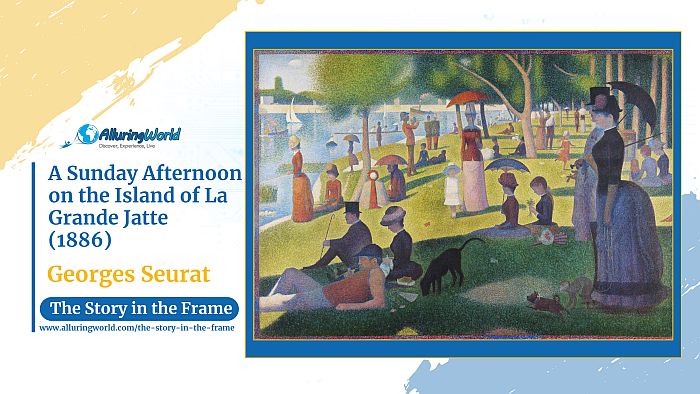
A Sunday Afternoon on the Island of La Grande Jatte is a large-scale painting created by the French artist Georges Seurat between 1884 and 1886. It is an impressive composition illustrating the leisure time of people who spent it at the River Seine at the end of the 19th century, thus bringing the everyday life of people who lived during this era closer to us. This masterpiece painting is distinguished by the innovative technique of pointillism and the scientific application of colors that the artist used.
About the Painter:
Georges Seurat (1859–1891) was a French artist who was well-known for his contributions to the creation of Neo-Impressionism and Pointillism. He was a student at the École des Beaux-Arts in Paris and combined his knowledge of color theory with new compositional techniques. This work of his resulted in an artwork that was based on both scientific and artistic principles, and it inspired other artists to create their paintings in this format.
Inspiration and Reasons Behind the Painting:
Seurat was motivated by the Parisian society at that time, noting the way people enjoyed their leisure time in outdoor settings, so he wanted to bring closer to others the leisure time people spent on the Île de la Grande Jatte in the Seine River located just northwest of Paris. La Grande Jatte captures Seurat’s interest in the structure of society, modernity, and the rhythm of urban entertainment, but overall it can be noted that this painting highlights Seurat’s efforts to experiment scientifically with color and light, as he created the painting to be in a very lively and inspiring colors.
What is Depicted in the Painting:
This painting is almost a full panoramic view of Parisians who are taking their time in a leisurely break on the banks of the Seine River during a bright, possibly summer day. There are men, women, and children doing different things like walking, sitting, fishing, or talking, while there are boats moving on the river. The placement of the figures has been done in an organized manner, almost geometrically, despite all the activity going on between the people. Seurat did manage to showcase the casting shadows of the people and trees, which might suggest that this was a scene that might have been captured during the latter part of the day, as the bright hot sun was starting to slowly set on the horizon.
Colors and Techniques:
Seurat uses pointillism, where small dots of color are applied that blend together optically due to the distance, while still giving shape to figures, people, and other objects in the painting. The colors used in the painting include harmonizing shades of green, blue, yellow, and red, with rich purple and violet tones heavily featured throughout the shadows. The dotting process, coupled with the manipulation of light and dark, makes the image appear to have a shimmering quality, while still preserving the high quality of a painting that captures the everyday Parisian life of people who wanted to enjoy a summer day in Paris.
Conclusion:
In summary, A Sunday Afternoon on the Island of La Grande Jatte is a perfect illustration of how well Georges Seurat could compose, use colors, and observe. With his new techniques, arrangement, and depiction of contemporary life, he turned this creation into a masterpiece, even though it could have been just another recreation scene. Overall, this painting is considered to be one of the greatest works of Post-Impressionism, which has inspired other artists to follow Seurat’s path, be bold in their creative work, and make other masterpieces.