
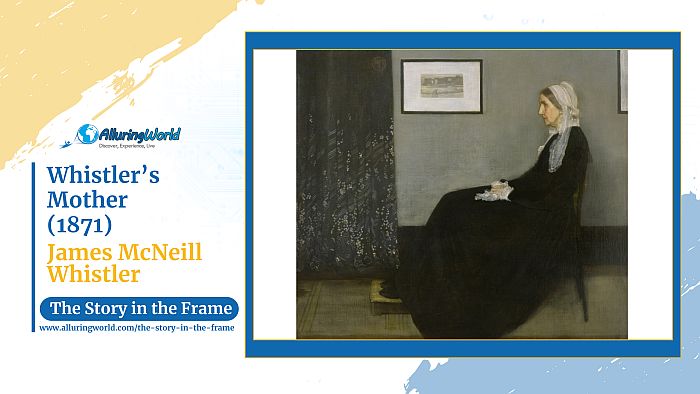
Whistler’s Mother, or as it is formally named, Arrangement in Grey and Black No. 1, was painted in 1871 by the American painter James McNeill Whistler, and it is an iconic portrait painting admired for its elegance and formal composition. It is a perfect example of what the painter concentrated on: tonality and aesthetics.
About the Painter:
James McNeill Whistler (1834-1903) was an American artist born into a family of painters. He is considered one of the representatives of the movement “art for art’s sake,” whose major paintings were portraits and nocturnes with a focus on coloristic harmony. Whistler worked mostly in Europe, especially in France and England, despite his American origin.
Inspiration and Reasons Behind the Painting:
Whistler created this majestic piece to portray his mother, Anna McNeill Whistler, as a dignified and restrained figure. Whistler’s work in this painting demonstrates his desire to achieve visual harmony through organizing shapes, colors, and lines. Although his painting deals with a personal topic, it still goes far beyond just making an image of his mother and explores some important aspects of art theory.
What is Depicted in the Painting:
In this painting, Whistler’s mother is portrayed in profile sitting on a simple wooden chair against a grayish wall. She wears a dark-colored dress with a lace collar around her neck. Her hands are folded and resting in her lap. There is interesting simplicity in how she is portrayed with stillness and silence, while the photo itself is quite inspirational. There is also a simple floorboard in the foreground and a framed piece of art hanging on the wall behind her.
Colors and Techniques:
Whistler’s color scheme is restricted to greys, blacks, and whites, but he managed to bring life to the painting despite using these dark tones. This creates tones within the work of art that complement each other, thus giving it a unique artistic style. The brushwork of Whistler is gentle; his focus is more on flat surfaces and how the figure interacts with the background.
Conclusion:
In essence, Whistler’s Mother is an excellent portrayal of James McNeill Whistler’s proficiency in tonal composition, control, and elegance. The image reveals dignity, contemplation, and harmony through simplified forms, subdued colors, and a peaceful attitude. This work is among the best-remembered portraits of all time and is still considered a work of perfection.