
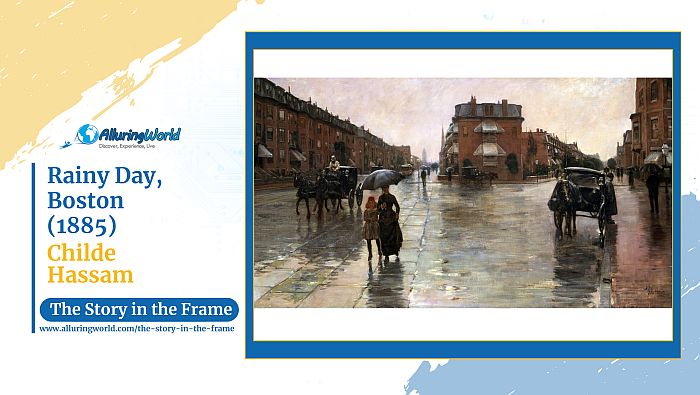
Rainy Day, Boston, which is dated to 1885, was painted by the American Impressionist painter Childe Hassam and depicts the effect of rain on an urban city street. Known for his ability to capture effects of light and weather as well as his ability to depict the modern world, Hassam frequently depicted the interaction between architecture, pedestrians, and environmental elements, and this is what has made him a well-known painter.
About the Painter:
Childe Hassam (1859-1935) was one of America’s foremost Impressionist painters known for his city landscapes, coastal pictures, and portrayal of everyday life. He was educated in Boston and inspired by French Impressionists, so Childe Hassam painted with a style marked by vibrant colors, free strokes, and atmospheric effects. Many of Hassam’s paintings depict the dynamism of urban life in a realist and impressionist manner, and even Rainy Day, Boston is a unique art creation that has mesmerized numerous art lovers. Overall, Hassam’s paintings are valued for their ability to integrate realism, emotions, and impressionism.
Inspiration and Reasons Behind the Painting:
Hassam worked in an era when American artists were getting increasingly affected by Impressionist ideas that emerged in Europe, and they began working on color and light as well as urban themes. Rainy Day, Boston shows how Hassam was interested in cityscapes and effects that weather could have on architecture and urban life, so he intended to bring to life what he would have seen in front of him. This painting is most probably based on personal observations that Hassam made while walking around Boston streets. He struck inspiration and painted this marvel that we can gaze upon today.
What is Depicted in the Painting:
The painting shows a scene of a street in Boston with rainwater, where the pedestrians have to walk on the wet pavements, in addition to the horse-drawn carriages, and distant city building façades. The reflection in the pavements and the lighting created by the cloudy sky provide depth to the scene, and as there is no sun protruding through the clouds, the painting has greyish tones which are well mixed with the buildings’ reddish colors. On the whole, Hassam emphasizes the movements and gestures made by people who can be observed on the street since the rain turns the usual activity, just like the rain itself, into a story that can be painted.
Colors and Techniques:
The color scheme of Hassam’s work is soft and harmonious, consisting mainly of gray, brown, and light blue tones that get accentuated by bright elements from clothes, signs, and carriages. Hassam uses an impressionistic brushstroke to portray reflections of rain, its texture, and the atmosphere of this weather condition. Light is subtly depicted on the wet surfaces, which creates a soft shine, thus contributing to the impressionistic character of the painting.
Conclusion:
In summary, the Rainy Day, Boston painting is an excellent example of the talent of Childe Hassam in using common elements of an urban setting and turning them into an exploration of light and weather conditions through human action. Through keen observation and impressionist art and atmosphere, the painting manages to capture the ephemeral nature and energy of a rain-filled street in a city.