
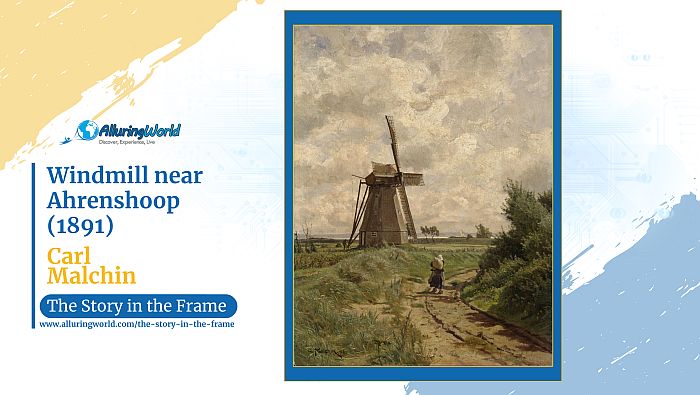
The painting Windmill at Ahrenshoop by Carl Malchin was painted in 1891 and represents a tranquil scene of the northern German countryside. Malchin was famous for his realistic landscape paintings, which mostly focused on capturing light, atmosphere, and seasonality in a rural setting. Windmill at Ahrenshoop is one such example where the artist has successfully combined realism with poetry.
About the Painter:
Carl Malchin (1838-1923) was an acclaimed German painter whose specialty was painting landscape pictures, especially those of northern Germany. Educated in the Berlin Academy of Arts, Malchin became famous for his keen observations on nature, his ability to capture atmospheric moods, and rural scenes. Most of his artworks show large expanses of sky, field, water, and rustic structures, showing the harmony between natural and artificial features.
Inspiration and Reasons Behind the Painting:
Malchin lived and created his works in the era of the German landscape painting tradition that focused on the realistic representation of places, local colors, and the appeal of everyday countryside. The picture Windmill near Ahrenshoop is the result of Malchin’s interest in the landscape of northern Germany and the interaction between manmade objects and nature. This work of art was probably influenced not only by the visual features of the place but also by the cultural role of windmills in rural industry and culture.
What is Depicted in the Painting:
The painting revolves around the windmill, which can be seen standing against the backdrop of an expansive natural environment comprising either fields, meadows, or a seaside setting in Ahrenshoop. The mill functions not only as a focus but also as a symbol of the human element in nature by blending in well with its surroundings. Trees, the sky, and perhaps some bodies of water or elements of a village add to the sense of perspective created in the work.
Colors and Techniques:
In Malchin’s painting, the colors that he used are those associated with nature. He, as a matter of fact, uses greens, browns, soft blues, and earthy colors that remind you of the northern German scenery, which some people might mix with a Dutch one. The painting techniques are very smooth and exact and are used to depict the texture of wood, grass, and skies with accuracy. The light used in the painting brings out the architecture of the windmill and the naturalness of the environment.
Conclusion:
In conclusion, Windmill at Ahrenshoop provides an excellent example of how well the great German artist Carl Malchin could capture the simple beauty of rural northern Germany, and bring it to life so that it would be admired throughout the centuries. With the use of his excellent skill and technique, he creates not only a tribute to nature but also an appreciation of manmade structures found amidst the beauty of nature, and this amazing painting is definitely serving as an example that inspires people to visit different parts of Germany.