
Read time ca. 9 minutes
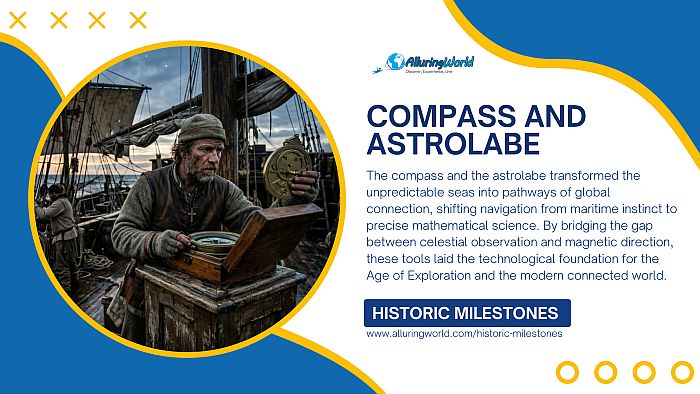
Few inventions have altered the trajectory of human history as profoundly as the compass and the astrolabe. Long before engines, satellites, or digital maps were shown to the world, these were the two instruments that guided humanity throughout the whole wide world, and they transformed the relationship with the natural world. Both these tools made the vast and unpredictable seas be seen as pathways of connection, trade, and discovery. While the world was large at that time, they made it easy for humans to venture farther than ever before, additionally reshaping geography, economics, science, and cultural exchange.
Considering them as historical milestones, the compass and astrolabe represent a shift in human thinking as they enabled abstract concepts to become practical guides for exploration. By abstract concepts, we consider direction, latitude, and celestial measurement, and both tools laid the intellectual and technological foundation for the Age of Exploration and permanently changed how civilizations understood the planet and their place upon it.
Before Instruments: Navigation by Instinct and Memory
Before the compass and astrolabe, early seafaring was done by accumulated experience. Navigation was mainly done by watching coastlines, memorizing landmarks, and interpreting winds, currents, stars, and the behavior of birds. While these methods worked fine for short distances and familiar regions, they unfortunately became unreliable when voyages extended beyond known regions, such as the Americas.
This is why seafarers did not dare to venture beyond coastal routes and inland seas that were unknown at that time. Quite often, open-ocean travel carried enormous risk, as clouds could obscure stars and storms could disorient even the most experienced navigator. Without dependable instruments, exploration remained cautious, and large-scale global connectivity was impossible.
The Astrolabe: Measuring the Sky to Understand the Earth
The astrolabe is a multifunctional astronomical instrument that was used to tell the time, to determine the length of day and night, as well as to simulate the movement of the heavenly bodies. The astrolabe emerged as one of the earliest scientific instruments that was capable of translating celestial observation into navigational knowledge. The astrolabe’s origins can be traced to ancient astronomy, where scholars sought to model the movement of heavenly bodies. Throughout the centuries, this knowledge was preserved, refined, and expanded by Islamic scientists, and it was the Islamic scientists from the Middle East who transformed the astrolabe into a practical and highly sophisticated tool that would bring the much-needed guidance to Europeans to venture beyond the then-known world.
What the astrolabe did was allow sailors to measure the altitude of the sun or specific stars above the horizon, and it allowed them to calculate latitude with reasonable accuracy. With this new improvement, the sailors can determine their position north or south of the equator even when far from land, and it was for the first time that the sky became a reliable map, consequently linking astronomy directly to geography.
The Compass: Finding Direction Without the Stars
While the astrolabe depended on visible celestial bodies, the compass, on the other hand, offered a revolutionary advantage that had not been seen before. The compass actually provided consistent direction regardless of weather or time of day, and it made it easier for sailors to navigate better towards their destination. The magnetic compass originated in China, where early observations revealed that magnetized objects aligned with the Earth’s magnetic field. At first, the compass was used for divination, but it eventually found its most transformative application in navigation, and hence it became a must-have tool for every sailor.
As knowledge of the compass spread westward through trade networks, it quickly proved to be indispensable, something that would allow sailors to sail over unknown waters. Unlike stars, which changed as the night passed, the magnetic north remained constant even under cloud cover or during storms. This important reliability allowed sailors to maintain bearings over long distances, thus making sustained oceanic travel more feasible.
From Separate Tools to a Navigational System:
Individually, the compass and astrolabe were powerful innovations; however, when they were joined together, they formed the core of an early navigational system that combined direction and position. As the compass provided a stable sense of orientation, the astrolabe enabled calculations of latitude. It was this pairing that dramatically reduced uncertainty at sea and allowed old kingdoms to expand their reach to the New World.
The integration of these tools marked a shift from experiential navigation to analytical navigation, and seafaring became less dependent on inherited knowledge. Sailing became more reliant on measurement, recordkeeping, and mathematical reasoning, and these were the signs of broader intellectual developments that would later characterize the scientific revolution.
ADVERTISEMENT
The Islamic World as a Bridge of Knowledge:
The scholars of the Islamic Golden Age were the true architects behind the navigational tools we often take for granted. By pushing the boundaries of astronomy, math, and cartography, Middle Eastern thinkers transformed the astrolabe from a basic device into a precision instrument. Throughout the years, they mastered them for land and sea, and they further documented every breakthrough in detailed guides.
Through a constant flow of trade and translation, this wealth of knowledge eventually filtered into Europe. The astrolabe and compass arrived as part of a deep intellectual culture rooted in observation and data. This transfer of ideas provided the missing pieces Europe needed, setting the stage for a new era of global exploration and scientific navigation.
Maritime Expansion and the Opening of the World:
The explosion of maritime exploration that we know of today didn’t happen by accident, but the sudden, widespread mastery of the compass and the astrolabe fueled it. For the first time, European sailors felt bold enough to push into the Atlantic, moving beyond familiar coastlines to tackle the “green sea of darkness.” These tools turned what were once suicidal missions into calculated transoceanic journeys that finally stitched the continents together.
As navigation became something people could actually rely on, the pace of exploration went into overdrive. Trade routes stretched across the globe, and maps finally began to look like the world we recognize today. But this wasn’t just a story of “discovery” and wealth, as it was marked as an era of progress that came with a high cost. This era triggered centuries of colonization, broken cultures, and systemic exploitation. While they brought immense advances and a bright future to certain European nations, in the end, these instruments represent a double-edged sword: they are symbols of incredible human ingenuity and the messy, moral complexity that followed in its wake.
Changing the Nature of Maps and Knowledge:
Improved navigation didn’t just change how people traveled, but it completely transformed how they saw the world on paper. Maps in the beginning were seen as artistic sketches, and then they shifted from being symbolic to actual, data-driven tools that accurately captured coastlines and distances. By using compass bearings and astrolabe readings, cartographers finally began to replace long-held myths with hard geographic facts.
This move toward precision changed the very fabric of society. The Earth was no longer a mysterious, unreachable void bounded by folklore; it became something measurable and navigable. This newfound sense of a “connected globe” didn’t just fuel economic greed; it shifted human philosophy, making the world feel both larger and, for the first time, accessible.
Impact on Trade, Power, and Empire:
Once people mastered the compass and the astrolabe, the balance of global power shifted, and states that mastered maritime technology gained access to distant markets, resources, and strategic advantages. The state’s naval strength became synonymous with political influence, so as a consequence, seafaring nations rose rapidly on the world stage, and these two tools were instrumental in this transformation. Both of them enabled long-distance trade networks that linked Asia, Africa, Europe, and the Americas, while at the same time, they facilitated military expansion and imperial control, further embedding these tools deeply within the structures of emerging global empires.
Scientific Thinking and the Path to Modern Navigation:
Beyond their immediate practical use, the compass and astrolabe encouraged a new way of thinking about the world. They emphasized measurement, prediction, and repeatable results, and these are considered to be principles that would later define modern science. Navigators became early practitioners of applied astronomy and mathematics, but over time, these instruments inspired further innovation. Quadrants, sextants, and eventually chronometers were built upon the same conceptual foundations, but if we move forward to today, we can notice that even today’s satellite-based navigation systems trace their lineage back to the fundamental idea that position and direction can be calculated through observation and reference points.
Conclusion: Instruments That Changed Humanity Forever
To sum it all up, the compass and the astrolabe represent far more than milestones in technological history. They were catalysts that transformed human mobility, knowledge, and ambition, and by simply making the world navigable, they managed to expand the boundaries of civilization while connecting societies across vast distances.
Their legacy is intertwined into every map, voyage, and global exchange that followed, and they taught humanity to trust measurement over myth and observation over instinct. They are one of the greatest foundations for a world defined by exploration and interconnection, and they deserve their title as one of the most important inventions that moved the world. As instruments that bridged the sky and the sea, the compass and astrolabe permanently altered humanity’s relationship with the planet, proving that understanding direction and position could ultimately change the course of history itself.