
Read time ca. 7 minutes
Zoroastrianism is one of the oldest continuously practiced monotheistic religions in the world that originated in Persia more than 3,000 years ago, and its most recognizable symbol is the Faravahar. This quite iconic symbol embodies a complex interplay of spiritual philosophy, moral guidance, and cultural identity for the believers, and it is often displayed in temples, on jewelry, and in modern Iranian art. Still, this symbol continues to convey messages about the human soul, ethical living, and the eternal struggle between good and evil, so having to understand the Faravahar requires a comprehensive look at its history.
Historical Origins of the Faravahar:
Originating at first in the ancient Persian culture, this central emblem is specifically associated with the teachings of Zarathustra (Zoroaster). Zoroastrianism, as a matter of fact, emphasized the duality of existence, the conflict between asha (truth, order) and druj (falsehood, chaos), and the importance of human choice in aligning with cosmic order. This has been shown through the Faravahar, which visually represents these ideas, thus serving as a reminder of moral responsibility and spiritual guidance.
The Faravahar motif is suggested to date back to the Achaemenid Empire (c. 550–330 BC) as per certain archaeological evidence, even though there have been others that suggest the winged disc itself was adapted from earlier Mesopotamian and Egyptian symbols, where it appeared in carvings, reliefs, and royal iconography. Often associated with kingship, divine authority, and protection, the Faravahar has been continuously linking political power with spiritual principles. Even though at first it might have been considered as a royal emblem, over centuries, the symbol evolved from a representation of royal legitimacy to a broader emblem of Zoroastrian ethical philosophy, retaining its spiritual resonance through time.
The Structure and Symbolism of the Faravahar:
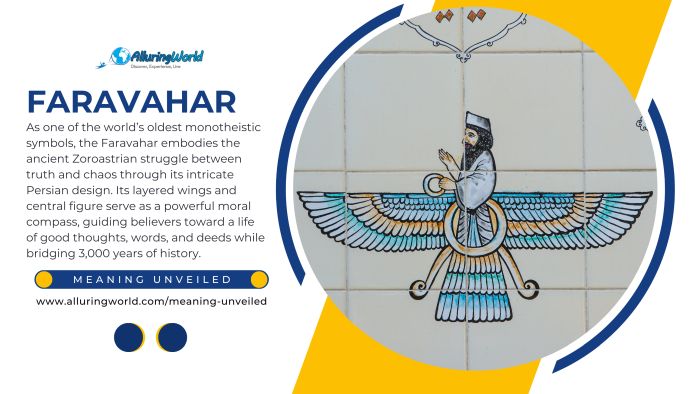
The Faravahar’s design is highly symbolic, with each component conveying specific philosophical concepts:
- The Central Figure: A human figure stands at the heart of the Faravahar, and this person is often interpreted as the soul of an individual. Through this figure, the human responsibility and morality are highlighted, reminding believers that ethical decisions shape their spiritual path. The head often faces forward, consequently symbolizing progress, focus, and awareness of life’s journey.
- The Wings: One of the other central points of the Faravahar is the wings, which are divided into three layers of feathers. These three feathers have different meanings, and they represent the Zoroastrian principle of “Good Thoughts, Good Words, Good Deeds”. This triad forms the core ethical guideline for living a righteous life, suggesting that spiritual elevation comes from aligning thought, speech, and action. The wings’ upward direction signifies aspiration, growth, and striving toward higher spiritual realms.
- The Tail Feathers: Below the human figure, we can see the tail feathers, which mirror the wings’ structure. These are also divided into three segments, whereas they represent bad thoughts, bad words, and bad deeds, serving as a caution against immorality. This duality reinforces Zoroastrianism’s focus on personal choice and the constant struggle between righteousness and wrongdoing.
- The Ring or Circle: The central figure often holds a ring, and this is sometimes interpreted as a ring of covenant or loyalty. This ring symbolizes eternity, the cyclical nature of life, and the enduring bond between the soul and divine principles. Certain interpretations, though, state that this ring also represents loyalty to truth and commitment to ethical living, tying individual action to cosmic order, although it is not fully accepted.
- The Two Streamers: Extending from either side of the central figure are two streamers, and these are sometimes interpreted as representing the path of good that everyone should follow, and the path of evil, the one everyone should avoid. These elements underscore the dualistic worldview of Zoroastrianism, reminding individuals that life involves choices that influence their spiritual destiny.
Philosophical Significance:
Philosophically speaking, the Faravahar at its core is a symbol of human potential and moral responsibility. If we compare it with other symbols, which are somewhat decorative or ritualistic, the Farvahar is a different kind of symbol. The Faravahar actively encourages ethical reflection and conscious decision-making. This reflection is purely because the Zoroastrian philosophy teaches that humans are not passive observers but participants in the cosmic struggle between asha and druj, and every action has its consequence or reaction. The forward-facing figure and segmented wings, which are visual cues of the Faravahar, function as daily reminders of the Zoroastrian believers and ofthe necessity of virtuous thought, speech, and action.
Furthermore, we must note that the Faravahar embodies the Zoroastrian belief in the immortality of the soul. In the symbol itself, the central, human figure positioned above the wings symbolizes the soul’s transcendence over base instincts. This, in other words, can be interpreted as reinforcing the idea that ethical conduct leads to spiritual elevation and alignment with divine truth.
ADVERTISEMENT
Faravahar in Cultural and Historical Contexts:
If we go through the history, we can notice that the Faravahar extended beyond its religious symbolism. It has become a national and cultural emblem in Persia (modern-day Iran). With the archaeological excavations and further discoveries from the once powerful Empire, we can see that the Faravahar was prominently displayed in royal palaces, public monuments, and coins, thus signifying spiritual authority and imperial power. Over time, it became a cultural identifier for Iranians, and today this important symbol signifies a heritage, moral values, and continuity with ancient traditions.
In modern-day Iran, the Faravahar is not confined to religious contexts, but despite Islam being the national religion, the Faravahar is widely embraced as a symbol of national pride, cultural resilience, and philosophical heritage. Iranians today display the Faravahar in art, architecture, and popular culture, and even for Iranians who are not practicing Zoroastrians, the Faravahar serves as a visual connection to a rich historical and ethical legacy.
Modern Interpretations and Usage:
These days, the Faravahar has really evolved beyond just a religious symbol, and it continues to be seen as a universal emblem of morality and cultural pride that people take everywhere with them. You’ll see it everywhere throughout Iran, especially as jewelry, hanging in homes, or even in logos, further acting as a constant reminder of things like integrity, wisdom, and keeping going when things get tough.
The fact that people still use the Faravahar shows how ancient symbols can adapt over time and be adapted to our modern age. This symbol is no longer only a religious icon, but it is seen today as a guide for morality and culture. Because it focuses on personal responsibility and choosing good over evil, its message resonates with people all over the world, not just those within the Zoroastrian faith.
The Faravahar as a Moral Compass:
While we see the Faravahar as a moral compass, its visual representation is quite clear with the details of its creation. The symbol itself encourages you to self-reflect and inspires you to have an ethical life with good words, thoughts, and even deeds. With our conscious choices from every day, our souls get elevated based on the actions with truth and righteousness.
In this sense, the Faravahar is not merely an artistic motif but an active participant in spiritual life, guiding believers toward personal growth, moral integrity, and harmony with the divine order. Its message is both timeless and practical, offering a framework for ethical decision-making applicable to everyday life.
Conclusion:
In conclusion, the Faravahar stands as one of the most enduring and meaningful symbols of ancient Persian culture and Zoroastrian philosophy. Through its intricate design and rich symbolism, we are guided towards the right moral way, spiritual aspiration, and cultural identity. Its central figure of a human, together with the different meanings of the feathers, collectively illustrates the dualistic struggle between good and evil, the immortality of the soul, and the importance of ethical living.
If we look over its historical and religious significance, we will come to the conclusion that the Faravahar continues to inspire modern audiences, thus serving as a reminder of the universal human pursuit of virtue, self-improvement, and connection to higher principles. Today, the Faravahar is not a symbol for Zoroastrianism, but it is a symbol for the Iranians and people who love the meaning behind it.