
Read time ca. 9 minutes
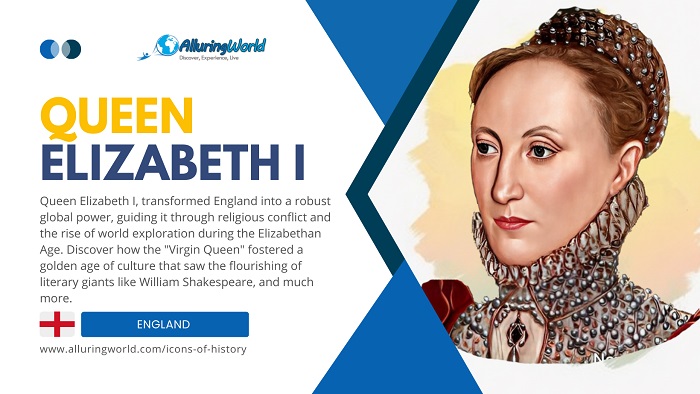
Queen Elizabeth I is considered to be one of the most iconic monarchs in world history, as she reigned over England from 1558 until her death in 1603. Being the last of the Tudor dynasty to rule England, she is also known as the “Virgin Queen”, but she managed to transform England into a robust and influential kingdom, guiding it through political turbulence, religious conflict, and the rise of global exploration. The period of her reign is often referred to as the Elizabethan Age, and it became synonymous with cultural flourishing and national pride.
Early Life and Challenges:
Born on 7 September 1533 at Greenwich Palace, Princess Elizabeth was the daughter of King Henry VIII and Anne Boleyn, his second wife. While her birth was a cause for the nation to celebrate, it was the will of the King who had desperately wanted a son, and her gender was a disappointment. Her legitimacy was tied directly to her mother’s controversial marriage to the King, which was at the heart of the English Reformation. In May 1536, after Anne Boleyn was accused of treason and executed, the young Elizabeth was declared illegitimate by an act of Parliament, and as a response, she was stripped of her title as princess and became known simply as “Lady Elizabeth.” Her younger half-brother, Edward, born to Henry’s third wife, Jane Seymour, became the heir apparent, and Elizabeth’s place at court became increasingly uncertain.
Despite the political turmoil, Elizabeth received a remarkable education that was atypical for a woman of her time. Tutors like Roger Ascham instilled in her a deep knowledge of classical languages, including Latin and Greek, as well as French and Italian. She also studied history, philosophy, rhetoric, and theology. This rigorous academic training, which included reading and translating texts by ancient writers, not only honed her intellect but also gave her the skills she would need to navigate the complexities of governance. Her intellectual prowess and sharp wit were noted by contemporaries and became a defining characteristic of her rule.
The unfortunate death of Henry VIII in 1547 placed Elizabeth under the care of her half-brother, King Edward VI. During this period, she experienced a scandal involving Thomas Seymour, who had married her stepmother, Catherine Parr. Seymour’s inappropriate advances and his ambition to marry Elizabeth caused a major controversy and led to his execution, leaving her once again in a precarious position. When Edward VI died in 1553, her staunchly Catholic half-sister, Mary I, ascended to the throne.
Elizabeth’s adherence to Protestantism and her potential to be a focal point for Protestant rebellion made her a direct threat to Mary’s rule. She was imprisoned in the Tower of London in 1554 on suspicion of being involved in the Protestant uprising better known as Wyatt’s Rebellion. During this imprisonment, Elizabeth was subjected to intense scrutiny and interrogation, and she narrowly escaped execution. This period of confinement taught her extreme caution and the importance of public image and strategic silence. By adopting a subservient and non-threatening demeanor, she survived Mary’s reign.
As Mary’s health declined, Elizabeth’s prospects improved. Mary had no children, and it became clear that Elizabeth would be her successor. Upon Mary’s death on 17 November 1558, Elizabeth’s long period of peril and uncertainty finally ended. She was proclaimed queen, and her ascension to the throne marked a new chapter in English history.
ADVERTISEMENT
Accession to the Throne and Religious Settlement:
Elizabeth ascended the throne on 17 November 1558, following Mary I’s death. England was deeply divided by religious strife between Catholics and Protestants, and Elizabeth’s first challenge was to bring stability. She introduced the Elizabethan Religious Settlement, which established the Church of England’s independence from Rome while allowing for some compromise to ease tensions.
This settlement not only prevented civil unrest but also solidified Elizabeth’s reputation as a pragmatic and intelligent ruler. Her cautious approach to governance, often described as “politique,” demonstrated her ability to prioritize stability and national unity over personal beliefs or ideology.
Defending England and Building Power:
During Elizabeth I’s reign, one of the most formidable external challenges came from Philip II of Spain, who was a fervent Catholic monarch who governed the world’s most extensive empire at that time. Philip saw Protestant England as both a heretical state and a direct competitor to Spanish global dominance. This rivalry intensified because of Elizabeth’s financial and military aid to the Dutch Protestants, who were in open rebellion against Spanish rule. Further provoking Spain were the raids of English privateers, such as Sir Francis Drake, who relentlessly attacked and plundered Spanish treasure fleets returning from the Americas. The final catalyst for a full-scale invasion came in 1587 with the execution of Mary, Queen of Scots, a Catholic claimant to the English throne. This event removed any remaining doubt for Philip, who then began to assemble the Spanish Armada, a massive naval fleet designed to transport an invasion force to England and re-establish Catholicism.
In 1588, the Spanish Armada launched its invasion. As Elizabeth I personally rallied her forces at Tilbury in a very personal leadership role, she delivered her famous “Heart and Stomach of a King” speech. This powerful address demonstrated her unwavering courage and solidarity with her people. The English navy, despite being outmatched in size, possessed more maneuverable ships and used superior tactics, including the strategic deployment of fire ships, to break the Armada’s crescent formation. The fate of the Spanish fleet was sealed not only by English naval prowess but also by a powerful storm, which became known as the “Protestant Wind,” that battered and dispersed the remaining ships. The catastrophic defeat of the Armada was a monumental victory for England, solidifying its national identity and proving that a smaller Protestant kingdom could stand triumphant against the might of the era’s greatest global superpower.
Elizabeth’s rule, often called the Elizabethan Age, extended beyond military victories to a period of unprecedented exploration and commercial growth. She actively sponsored ambitious voyages that challenged the established maritime supremacy of Spain and Portugal. English adventurers like Sir Walter Raleigh led pioneering colonial efforts, most notably the establishment of the Roanoke Colony in North America, while Sir Francis Drake’s epic circumnavigation of the globe brought both fame and vast wealth to the English Crown. These expeditions were crucial, not just for the riches they secured but also for the critical knowledge they provided of new trade routes and distant lands. This era of daring enterprise laid the foundational groundwork for what would become the British Empire and firmly established England as a rising naval and commercial force on the world stage.
The Elizabethan Age and Legacy:
The Elizabethan Age is perhaps considered one of the best eras in English history, because this period stands out for English arts, culture, and literature, since numerous famous artworks came from this period. This period saw the flourishing of some of the nation’s most celebrated literary figures, whose works continue to define the English canon. William Shakespeare is arguably the most famous playwright in history, and as he wrote his masterpieces during this time, he captured the human experience with unparalleled depth and poetic language. Alongside him, influential playwrights like Christopher Marlowe and poets such as Edmund Spenser enriched the literary landscape. The vibrant theater scene, centered in London, became a powerful medium for entertainment and social commentary. This cultural renaissance was not limited to literature; music and visual arts also thrived, reflecting a newfound sense of national pride and a powerful, unified English identity that had been solidified by recent military victories.
During the Elizabethan Age, marriage was primarily seen as a tool of political alliance for European royalty, so Queen Elizabeth I’s decision to remain unmarried was a defining feature of her reign for which she would be remembered in the history books. Even though she received numerous proposals from many powerful foreign princes and nobles, she continued to refuse them and did not intend to wed, as she famously declared that she was “married to England.” This deliberate choice earned her the enduring title of “The Virgin Queen.” Her unmarried status was a strategic masterstroke that allowed her to maintain complete autonomy and avoid being politically dominated by a husband or a foreign power. It projected an image of a monarch singularly devoted to her kingdom and her people, a powerful message in a male-dominated political landscape.
Elizabeth’s long reign, from 1558 to 1603, provided a crucial period of stability and security that England had not experienced for decades. Following the religious and political turmoil of her predecessors, particularly her half-sister Mary I, Elizabeth’s steady hand and pragmatic leadership brought an end to religious persecution and factional strife. Her skillful management of domestic and foreign affairs allowed the nation to prosper economically and culturally. Her legacy is one of transformation; she steered England from a vulnerable, second-tier state into a formidable naval and commercial power. Her unwavering commitment to her country, her strategic political decisions, and her patronage of the arts collectively cemented her place as one of the most influential and successful monarchs in English history.
Conclusion:
Queen Elizabeth I remains one of history’s most remarkable rulers, blending intelligence, political skill, and charisma to guide her nation through a transformative era. Her reign strengthened England both culturally and politically, ensuring its place on the global stage. Elizabeth’s legacy endures as a symbol of resilience, wisdom, and leadership, defining her as a monarch who truly shaped the destiny of her country.