
Read time ca. 7 minutes
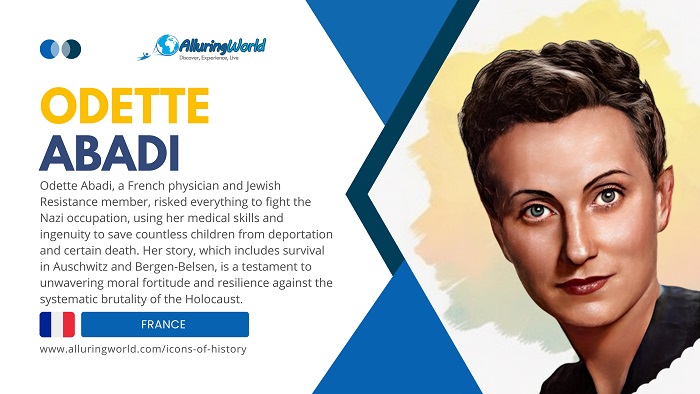
Odette Abadi was a French physician and a member of the French Resistance during World War II, whose life embodied bravery, resilience, and the determination to fight injustice. When World War II was in full swing, she risked everything to resist France’s Nazi occupation, as she managed to save countless children from deportation and certain death. Later in life, after the war ended, she combined her wartime experiences with her training as a doctor to dedicate her life to humanitarian causes. Her story is one of quiet heroism, one that deserves to be remembered alongside the significant figures of the French Resistance.
Early Life and Education:
Born on 24 August 1914 in Paris, France, as Odette Rosenstock, who later became known as Odette Abadi, she was born into a Jewish family. Growing up in an intellectual and cultured environment, she displayed a keen intelligence and a sense of determination from a young age. She pursued her education with focus and ambition, choosing to study medicine.
Due to the period when she lived, it was very unfortunate that the opportunities for women in medicine were very limited, so Odette distinguished herself as a capable and committed student with a promising future. She specialized in dermatology and venereology, eventually becoming a respected physician. The medical skills she would learn and practice would later prove invaluable during the war, because survival often depended on resourcefulness, improvisation, and the ability to treat both injuries and illness under challenging conditions.
The Rise of Nazism and the Outbreak of War:
By the late 1930s, Europe was engulfed in tension as fascism spread and Hitler’s power expanded. As the war started in France in 1939, unfortunately, it marked the beginning of a dark chapter for the country. When Germany invaded in 1940 and established the Vichy regime, Jews in France found themselves increasingly targeted by oppressive laws, discrimination, and deportations.
For Odette, the Nazi occupation and the collaborationist policies of Vichy posed a direct threat, not only because of her Jewish identity but also because of her strong moral opposition to fascism. She recognized that inaction meant complicity, and her medical background gave her unique skills that could support resistance efforts.
Entry into the French Resistance:
With a quiet determination, Odette joined the Resistance against the Nazis, thus becoming deeply involved in clandestine activities that would help to remove the Nazi grip over France. She was a member of the Organisation Juive de Combat (Jewish Combat Organization), one of the groups that fought against deportations and organized rescue missions. Alongside other activists, she dedicated herself to saving Jewish children who were at risk of being rounded up and sent to concentration camps.
Her methods were both courageous and ingenious. She helped forge identity papers, arranged safe houses, and personally escorted children to rural areas or convents where they could be hidden. These operations required nerves of steel, as Gestapo patrols and collaborators constantly searched for escape networks. A single mistake or suspicion could lead to arrest, torture, and deportation.
Odette’s medical training also became an asset. She treated the sick in hiding, provided care to those who could not access hospitals, and used her knowledge of official documents to manipulate medical records when necessary. Through her actions, she directly contributed to saving dozens, possibly hundreds, of young lives that otherwise would have been lost in the Holocaust.
Arrest and Deportation:
In 1943, Odette was arrested by the Gestapo. Like many members of the Resistance, she was betrayed and fell into the hands of the occupiers. She was deported to Auschwitz, one of the most infamous Nazi concentration camps.
The horrors of Auschwitz are well documented: starvation, forced labor, disease, and systematic extermination. For Odette, survival was a matter of both physical endurance and psychological strength, so she managed to endure the dehumanization of camp life, the big brutality that was experienced by the guards, and the constant presence of death. Her background as a doctor allowed her to contribute in small but meaningful ways, sometimes treating fellow prisoners or offering comfort in an environment designed to strip people of hope.
From Auschwitz, she was later transferred to Bergen-Belsen, another camp notorious for its appalling conditions. Here, disease outbreaks such as typhus decimated the prisoner population. Despite her weakened condition, Odette continued to assist others as best she could, drawing on her medical knowledge to alleviate suffering even when resources were almost nonexistent.
She managed to survive until liberation, though the physical and psychological scars of the camps remained with her for the rest of her life.
ADVERTISEMENT
Post-War Life and Medical Career:
After the liberation of the camps in 1945, Odette returned to France, determined to rebuild her life. The war had taken much from her, but it had not broken her spirit. She resumed her medical career, this time channeling her experiences into humanitarian and social causes.
In the post-war years, she specialized in treating venereal diseases and worked extensively with marginalized populations. Her compassion for the vulnerable was undoubtedly strengthened by her wartime encounters with suffering and injustice. Odette believed that medicine was not only a science but also a tool for dignity and social justice.
In 1959, she married Moussa Abadi, another Resistance figure who had been instrumental in rescuing Jewish children in France. The couple would dedicate their lives to remembering the Holocaust and ensuring that the stories of the children they saved were never forgotten. Their unique partnership was not only personal but also deeply rooted in shared values of courage, memory, and responsibility.
Advocacy, Memory, and Testimony:
Both Odette and Moussa Abadi became key figures in preserving the history of Jewish resistance during the dark history of humanity and the experiences of Holocaust survivors. They gave lectures, participated in commemorations, and encouraged survivors and rescuers to share their stories. Odette, in particular, was committed to educating future generations, ensuring that the crimes of Nazism would not be repeated.
Her testimony about Auschwitz and Bergen-Belsen provided invaluable insights into the realities of camp life. Unlike many who could not find the strength to speak about their suffering, Odette felt it was her duty to bear witness. She did so with dignity, highlighting not only the cruelty of the oppressors but also the resilience and solidarity of the victims.
But her work was not only that, as it also extended into humanitarianism. She was involved in organizations dedicated to protecting refugees and displaced persons, recognizing in their plight the same struggles that she had endured during the war.
Recognition and Legacy:
For her extraordinary contributions, Odette Abadi was awarded several honors. She received the Croix de Guerre for her resistance activities and was also recognized by Jewish and humanitarian organizations for her tireless efforts during and after the war.
Yet, like many resistance fighters, she never sought fame or glory. Her focus remained on the lives that had been saved, the memory of those who were lost, and the importance of continuing to fight against injustice.
Odette Abadi passed away on 29 July 1999 at the age of 84. She left behind not only a remarkable personal history but also a legacy of courage, compassion, and resilience that continues to inspire.
Conclusion:
In conclusion, the story of Odette Abadi is one of bravery against overwhelming odds. As a doctor, resistance fighter, deportee, and humanitarian, she dedicated her life to saving others and to resisting injustice in all its forms. She risked her life to rescue Jewish children during the Holocaust, survived the brutality of Auschwitz and Bergen-Belsen, and afterward chose to continue serving humanity through medicine and advocacy.
Her life reminds us that true heroism often lies not in grand gestures but in the steady, unyielding commitment to do what is right, even when it involves the most significant personal risk. In remembering Odette Abadi, we honor not only her courage but also the countless unnamed individuals who resisted oppression, saved lives, and kept alive the flame of humanity in one of history’s darkest times.