
Read time ca. 8 minutes
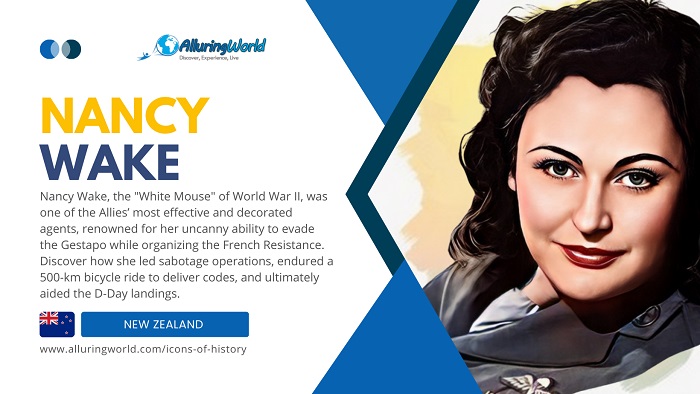
Nancy Wake stands as one of the most remarkable figures of World War II, as she was a woman whose courage, resourcefulness, and determination turned her into one of the Allies’ most effective agents in occupied France. Known by the Gestapo as “the White Mouse” for her uncanny ability to evade capture, she became one of the most decorated women of the war. Her entire story is one of resilience, daring operations, and a fearless commitment to freedom that earned her admiration across the world and cemented her as a heroine in the history books.
Early Life and Formative Years:
Nancy Grace Augusta Wake was born on 30 August 1912 in Wellington, New Zealand, the youngest of six children in a family of Irish descent. When she was still a child, her family moved to Sydney, Australia, where she grew up in relative modesty. Her father abandoned the family when she was young, leaving Nancy’s mother to raise the children. This difficult upbringing instilled in her a sense of independence and toughness that would later define her wartime years.
Nancy has always displayed a rebellious spirit and a longing for adventure, even from a younger age. She left her home when she was 16 to work as a nurse, but she soon felt drawn to a broader world. Using money inherited from an aunt, she traveled to London in the 1930s, where she pursued a career in journalism. This decision brought her to Europe, where she witnessed firsthand the rise of fascism.
When she was a reporter in Vienna and Paris, Nancy interviewed numerous political figures while also covering major events in the then very tense pre-war climate. In Vienna, she saw Jewish men and women being publicly whipped by Nazi thugs, a scene that left her horrified and deeply affected. It was then that she resolved to oppose fascism and Hitler’s ideology by any means possible. These experiences became the moral foundation for her later resistance work.
Life in France and the Outbreak of War:
In 1937, Nancy settled in Paris and soon after met Henri Fiocca, a wealthy French industrialist. The two married in 1939, just before the outbreak of the Second World War. When Germany invaded France in 1940, Nancy’s life changed forever. Refusing to stand by passively, she joined the French Resistance, using her charm, intelligence, and connections to smuggle people, particularly downed Allied airmen and Jewish refugees, across the border into Spain and then to Britain.
Nancy’s fearless work quickly drew the attention of the Gestapo, who placed her on their most wanted list. She became known as the “White Mouse” because she seemed to slip away from their grasp time and again. Even with a large bounty placed on her head, she continued to operate boldly, showing no fear in the face of constant danger.
Her husband, Henri, supported her activities, though doing so ultimately placed him at grave risk. When Nancy had to flee France in 1943, Henri was captured by the Gestapo and executed. Nancy would later admit that she carried deep guilt for his death, though she also knew he believed in the cause for which they both risked everything.
Training with the Special Operations Executive:
After she escaped from France, Nancy traveled to Britain so that she could join the Special Operations Executive (SOE), which was a secret organization established by Winston Churchill to conduct espionage and sabotage in occupied Europe. The SOE recruited men and women capable of operating behind enemy lines, and Nancy’s experience in the French Resistance made her an ideal candidate.
During this time, she had a grueling training in Britain, which covered weapons handling, explosives, communications, survival skills, and unarmed combat. Despite the physical demands, Nancy excelled, impressing her instructors with her endurance and determination. She also proved to be an expert marksman and parachutist. Her ability to adapt quickly to challenging situations became one of her defining qualities.
By 1944, Nancy was parachuted back into France as part of a mission to support the Maquis, the French Resistance fighters operating in the Auvergne region. She carried with her the necessary codes and served as a liaison between the local resistance groups and the Allies. Her arrival reinvigorated the resistance forces, who admired her courage and leadership.
ADVERTISEMENT
Resistance Activities in France:
Nancy Wake’s contributions to the Resistance were simply extraordinary. She helped coordinate guerrilla warfare operations against German forces, organized supply drops from Allied aircraft, and ensured that weapons and resources reached the Maquis. She also served as a courier, carrying sensitive information across dangerous terrain, often traveling hundreds of kilometers on foot or by bicycle.
One of her most famous exploits was a 500-kilometer bicycle ride through Nazi-controlled territory to deliver codes after radio equipment had been destroyed. This journey, completed without rest, displayed both her physical strength and her determination to see the mission succeed.
Nancy was not only a courier and organizer; she also fought directly in combat. She led raids on German convoys, ambushed patrols, and took part in attacks that disrupted enemy supply lines. Known for her fearlessness, she carried a Sten gun and was willing to use it when necessary. Resistance fighters respected her authority and followed her orders, recognizing her as both a capable strategist and a formidable warrior.
Her leadership was vital in preparing the Maquis for the Allied invasion of Normandy in June 1944. Under her guidance, resistance forces carried out sabotage missions that severely weakened German communication and supply networks, aiding the success of the D-Day landings.
Recognition and Decorations:
Nancy Wake’s wartime service earned her widespread recognition. After the war, she was awarded numerous honors by several countries. From Britain, she received the George Medal for bravery. France awarded her the Croix de Guerre with three bronze stars and the Médaille de la Résistance. The United States awarded her the Medal of Freedom, and Australia later recognized her with the Companion of the Order of Australia.
Despite these honors, Nancy remained humble about her actions. She often said that she had done what needed to be done and did not consider herself extraordinary. Her modesty made her even more admired, as she deflected personal glory in favor of honoring the collective struggle of the resistance fighters and the sacrifices of those who did not survive.
Later Life:
After the war, Nancy briefly entered politics in Australia but did not achieve electoral success. She later returned to Europe, where she worked for the British Air Ministry in intelligence. She remarried in the 1950s, though she was widowed again in the 1990s.
Nancy spent much of her later life in Britain before eventually returning to Australia. She became a celebrated figure, giving interviews and writing her autobiography, The White Mouse, which detailed her wartime experiences. Her story was also the subject of documentaries, books, and television dramatizations, which introduced her bravery to new generations.
In her final years, Nancy lived in London before moving into a care home for veterans. She died on 7 August 2011 at the age of 98. At her request, her ashes were scattered in Montluçon, France, near the countryside where she had fought alongside the Resistance.
Legacy:
Nancy Wake’s legacy endures as a symbol of Resistance against tyranny and oppression. Her courage in the face of overwhelming danger, her unwavering commitment to justice, and her extraordinary achievements as an SOE agent made her one of the most respected figures of the Second World War. She challenged stereotypes about women’s roles in wartime and proved that determination and skill mattered more than gender.
Her story continues to inspire not only those who study history but also anyone facing adversity. In classrooms, military academies, and public commemorations, Nancy’s life serves as a reminder of the power of individual bravery in shaping the course of history.
Conclusion:
Nancy Wake lived a life of extraordinary courage, rising from humble beginnings to become one of the most effective and celebrated agents of the Second World War. She risked everything for freedom, endured personal loss, and fought with unrelenting determination against Nazi tyranny. Known to the Gestapo as the “White Mouse,” she outwitted her enemies time and again, leaving a legacy of heroism that still resonates today. Nancy Wake’s story is a testament to the strength of the human spirit, proving that one individual’s bravery can change the course of history.