
Read time ca. 8 minutes
The story of Matthew Wayne Shepard continues to resonate far beyond the small town of Laramie, Wyoming, where his life tragically ended in 1998. He was only 21 years old when he was brutally attacked, tied to a fence, and left to die because of his sexual orientation. His murder shocked not only the United States but also the entire world, as it exposed the violent realities of homophobia. His murder also sparked a movement that reshaped conversations around hate crimes, LGBTQ+ rights, and justice, and nowadays Matthew Shepard’s name stands as a symbol of both the cruelty that prejudice can inflict and the enduring power of courage, empathy, and change.
Early Life and Childhood:
Matthew Wayne Shepard was born on 1 December 1976 in Casper, Wyoming, to Judy and Dennis Shepard. As his family was close-knit, Matthew grew up alongside his younger brother, Logan, and Matthew displayed qualities from an early age that would define him throughout his short life: kindness, empathy, and a willingness to stand up for others. His friends and teachers would often describe him as a gentle and compassionate person, simply put, someone who could make others feel included and understood.
Growing up in Wyoming, Matthew experienced both the beauty of the open landscapes and the challenges of living in a place where diversity was not widely embraced. His family moved to Saudi Arabia for a time due to his father’s job, giving Matthew an early experience of different cultures. He attended the American School in Switzerland during high school, where he became fluent in several languages and formed friendships with peers from around the globe. This exposure to international perspectives gave him an openness and empathy that he carried into adulthood.
College Years and Identity:
Upon his return to the United States, Matthew enrolled at the University of Wyoming in Laramie, where he studied political science, international relations, and foreign languages. He was very passionate about equality and human rights for minority groups, and he even dreamed of a diplomatic career or perhaps a career of advocacy where he could help build bridges between people and cultures.
At university, Matthew also became more open about his identity as a gay man. Although he found acceptance among some friends and peers, Wyoming in the late 1990s was not a place known for tolerance. Homophobia was common, and LGBTQ+ individuals often lived with fear and silence. Despite being aware of this, Matthew still managed to carry himself with courage, believing that being true to oneself was the only way to live authentically. That is why his quiet bravery made him a role model for others who also struggled with acceptance for being different.
The Night of 6 October 1998:
Matthew Shepard’s life changed forever on the night of 6 October 1998. That evening, he met two young men, Aaron McKinney and Russell Henderson, at the Fireside Lounge in Laramie. They pretended to be gay to lure Matthew into leaving with them, under the guise of offering him a ride. Instead, they drove him to a remote area outside of town.
There, they brutally beat him, tied him to a wooden fence, and left him alone in the freezing Wyoming night. He was discovered nearly 18 hours later by a cyclist who, at first glance, was under the impression that Matthew was a scarecrow because of how badly he had been beaten. Matthew was rushed to a hospital in Fort Collins, Colorado, where doctors fought to save his life. Despite their efforts, he died on 12 October 1998 from severe head injuries.
National and Global Reactions:
News of Matthew Shepard’s death echoed not only across the country but also around the world. It was the first time for many people to be confronted with the reality of anti-gay violence in such a visceral and despicable way. Vigils were held in cities across the United States, and his story was covered extensively in national and international media.
Even then, President Bill Clinton addressed the tragedy, as well as leaders of various faiths and political backgrounds who called for justice and Matthew’s death to be investigated. His funeral in Casper drew hundreds of mourners, though it also drew protests from members of the Westboro Baptist Church, who carried hateful signs. Yet their hostility only underscored the urgency of addressing the hatred that had taken Matthew’s life.
Artists, writers, and activists responded too. The award-winning play The Laramie Project was created in 2000, based on interviews with residents of Laramie in the aftermath of Matthew’s death. Since then, the play has been performed worldwide, and it has managed to keep the story alive and to spark conversations about prejudice and acceptance.
ADVERTISEMENT
The Fight for Justice and Legal Reform:
Matthew’s murder became a rallying point in the push for hate crime legislation in the United States. At the time, Wyoming had no hate crime laws, and federal protections for victims targeted because of their sexual orientation were limited. Judy and Dennis Shepard, despite their unimaginable grief, became tireless advocates for change.
They established the Matthew Shepard Foundation in 1998, dedicated to erasing hate and promoting acceptance through education, outreach, and advocacy. Their work gave Matthew’s death meaning by turning pain into progress.
It took over a decade of political struggle, but on 28 October 2009, President Barack Obama signed into law the Matthew Shepard and James Byrd Jr. Hate Crimes Prevention Act. This landmark legislation expanded the federal definition of hate crimes to include those motivated by a victim’s sexual orientation, gender identity, or disability. Named after Matthew and James Byrd Jr.—an African American man murdered in a racist attack in Texas—the law became one of the most significant advances in civil rights protection in decades.
Matthew’s Legacy in Culture and Society:
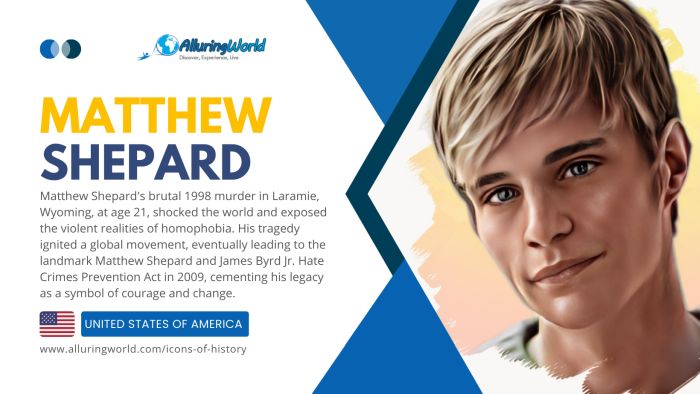
Beyond legislation, Matthew Shepard’s story profoundly influenced American culture. He became a symbol of the fight against intolerance and violence, and his face is often shown in photographs as he smiles gently. His innocent smile came to represent countless others who had suffered in silence or who lived in fear because of their identity.
The Laramie Project and its sequel, The Laramie Project: Ten Years Later, continued to remind audiences of the human impact of prejudice. Documentaries, books, and films have also retold his story, ensuring that his name is not forgotten.
In 2018, two decades after his death, Matthew Shepard’s ashes were interred at the Washington National Cathedral in the US capital city, Washington, D.C. This historic resting place, which is often reserved for presidents and national leaders, became a permanent memorial for a young man whose life inspired a movement and made changes possible. Thousands attended the ceremony, reflecting the profound and lasting impact he had on the nation.
Inspiring a New Generation:
Today, Matthew Shepard’s story continues to inspire new generations of activists, students, and everyday people to stand against hate and bigotry. His story is used in schools to inspire discussions about bullying, tolerance, and empathy. Additionally, numerous LGBTQ+ organizations in the US and worldwide often invoke his name when pushing for equal rights and protections.
Judy and Dennis, his parents, still remain active today in promoting acceptance through the Matthew Shepard Foundation. Judy Shepard, in particular, has become a strong and powerful voice for LGBTQ+ rights, as she travels across the country to speak about her son’s legacy and the importance of erasing hate. Their resilience in transforming personal tragedy into hope has been a source of inspiration for many.
Conclusion:
In conclusion, Matthew Wayne Shepard’s life was heartbreakingly short, but the impact of his story has been immeasurable. He was born with kindness and empathy, and as he lived authentically as himself, he even managed to show his true self in a place where doing so carried risks. His brutal murder revealed the deadly consequences of hatred, but it also ignited a movement that led to legal reform in the country, increased cultural awareness, and made a more substantial commitment to protecting human dignity.
Today, Matthew Shepard is remembered not as a victim but as a symbol of change. His story encourages people throughout the world to stand up against persecution, to embrace compassion over prejudice, and to fight for a world where everyone can live openly and safely. Countless individuals found courage through his memory, and his legacy continues to inspire the ongoing struggle for equality and acceptance.