
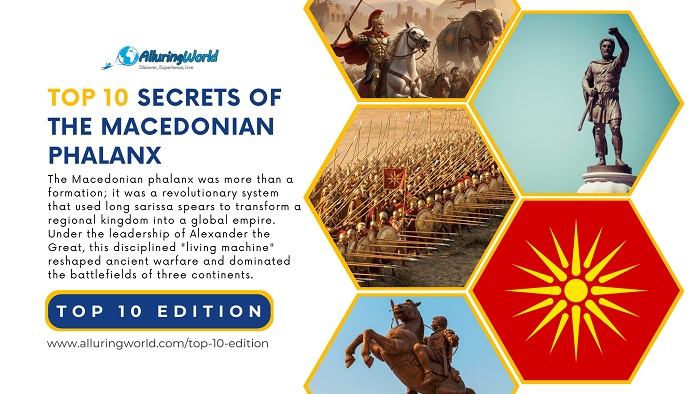
The Macedonian phalanx wasn’t only a formation of soldiers that fought with long spears. It was considered to be a revolutionary system of warfare that reshaped the ancient world and enabled one of history’s most extraordinary expansions of power. As King Philip II slowly forged the Macedonian phalanx in the hills and plains of ancient Macedonia, it was his son, Alexander the Great, who made it perfect, and it became the backbone of an empire that stretched from Macedonia to Egypt and deep into Asia. What made it so formidable was not only its equipment but the discipline, innovation, and strategic thinking behind it. If you are fascinated by military history, then you certainly know that the Macedonian phalanx represents a turning point when organization and engineering began to outweigh the sheer number of soldiers on the battlefield. Below you will find the ten defining details that made this ancient fighting force something to be feared.
1. The Sarissa: A Weapon That Changed Warfare
At the heart of the Macedonian phalanx was the sarissa, which was a spear that was unlike anything else used before. Measuring between 5 and 6 m (16 and 20 ft) in length, it gave the Macedonian soldiers an extraordinary reach that allowed them to strike enemies long before opponents could come close enough to retaliate. Made of tough cornel wood and fitted with iron tips on both ends, the sarissa could be planted in the ground if the front tip broke. Handling such a long weapon required intense training, but when wielded correctly, it turned the phalanx into a moving wall of deadly points that was almost impossible to penetrate head-on.
2. A Deep, Dense Formation
Unlike earlier hoplite formations that were typically eight men deep, the Macedonian phalanx was different since it often fought in ranks that reached sixteen soldiers from front to back. This depth gave the formation tremendous pushing power, as the men behind added weight and stability to the front lines. When the phalanx advanced, the rear ranks leaned forward, further helping to drive the entire unit ahead like a single massive organism. This compact density made the phalanx exceptionally resistant to frontal attacks, because the enemies had to push through layer after layer of tightly packed soldiers.
3. Soldiers Trained as One Body
The final success of the Macedonian phalanx in each of the battles it fought depended on absolute coordination. The soldiers part of the phalanx had to move in unison, further maintaining alignment and spacing even while marching across uneven ground. This is why training was the most crucial part since it emphasized synchronized movement, rapid formation changes, and precise handling of weapons. Unfortunately, individual bravery mattered far less than discipline and cohesion. When thousands of men moved together with perfect timing, the phalanx became a living machine, capable of advancing, halting, and turning with remarkable efficiency.
4. A Smaller Shield for Greater Mobility
To be able to accommodate the massive sarissa, the Macedonian infantry had to carry a smaller shield when compared to the earlier ancient Macedonian warriors. This was better known as the pelte, and it was strapped to the left arm of the soldiers, rather than held with a central grip. This allowed the soldier’s hand to be free for better coordination of the long spear, while still offering protection. The lighter the shield was, it would allow also for greater mobility, consequently enabling the phalanx to maneuver more effectively across the battlefield while maintaining its defensive integrity.
5. Integration with Other Military Units
Despite what some might think, the Macedonian phalanx was so mighty that it did not need anyone else, but in fact, it was not meant to fight alone. It functioned as the central pillar of a combined-arms army that included other army sections, such as cavalry, light infantry, and specialized troops. While the phalanx pinned the enemy in place, fast-moving cavalry units attacked from the flanks and rear. Skirmishers harassed opponents and disrupted their formations. This allowed a flexible and devastating system in which each element supported the others, and all Macedonian commanders were able to exploit the weaknesses of their enemy with precision.
ADVERTISEMENT
6. Designed to Dominate Open Terrain
The Macedonian phalanx thrived on flat or gently rolling ground where its long spears and tight ranks could be used to full effect. On such terrain, the formation was almost unbeatable in a frontal clash, so the enemies struggled to break through the forest of spear points, while the mass of soldiers behind added relentless pressure. Even though mountainous ground could reduce its effectiveness, it was the careful planning and support from other units that the Macedonian phalanx often compensated for these limitations.
7. Leadership and Tactical Innovation
Philip II of Macedonia and Alexander the Great are the two responsible rulers who made the Macedonian phalanx a reality and demonstrated its full potential. Both rulers understood that technology alone was not enough; tactics and leadership turned the formation into a strategic masterpiece. Alexander used the phalanx to fix enemy forces in place, creating openings for decisive strikes by his elite cavalry. He knew the right time and position for his army to strike, hence why he proved that the Macedonian phalanx was a relentless force that could fight across three continents.
8. Psychological Impact on the Battlefield
Facing a Macedonian phalanx was a terrifying experience for everyone who came face-to-face with it. As it advanced, the long sarissas formed a bristling wall of steel that seemed to stretch endlessly. The steady, rhythmic movement of thousands of soldiers marching in step created an overwhelming visual and emotional effect. There are stories of how many opponents broke before the actual contact occurred, as they were unable to withstand the sheer presence and momentum of the formation. This psychological dominance often proved as important as physical strength, and stories of Alexander’s mighty army spread throughout the known world.
9. Adaptation from Earlier Warfare
The Macedonian phalanx evolved from the classical hoplite tradition, and it made it better by introducing its own innovations. By extending the length of the spear, deepening the formation, and providing more professional training, Philip II transformed a citizen militia model into a standing army that was capable of continuous, sustained campaigns. These changes marked a shift toward more organized and technologically advanced warfare, thus influencing military thinking for centuries to come, and changing how other leaders fought in their battles.
10. A Legacy That Shaped Military History
The impact of the Macedonian phalanx was not limited to the ancient world or ancient Macedonia. It extended well beyond the lifetime of Alexander’s empire, and the successor kingdoms that came after ancient Macedonia continued to use variations of the formation. Even Rome, which eventually defeated the Macedonian armies, studied its principles and made improvements to the system. This simple yet brilliant idea, which disciplined the army forces, became a cornerstone of military theory. In many ways, the Macedonian phalanx laid the groundwork for later formations that shaped modern warfare by emphasizing coordination, structure, and combined tactics.
In conclusion, the Macedonian phalanx was not merely a clever arrangement of soldiers. This was a machine that had a revolutionary concept, which redefined how wars were fought in ancient times. By introducing innovative weaponry, rigorous training, and with the brilliant leadership of Philip II and Alexander the Macedonian, it transformed a regional kingdom into the center of a vast empire. If you are drawn to the drama and strategy of ancient warfare, then the story of the Macedonian phalanx will offer you a powerful reminder that even the most formidable machines begin with disciplined individuals moving together toward a shared purpose.