
Read time ca. 9 minutes
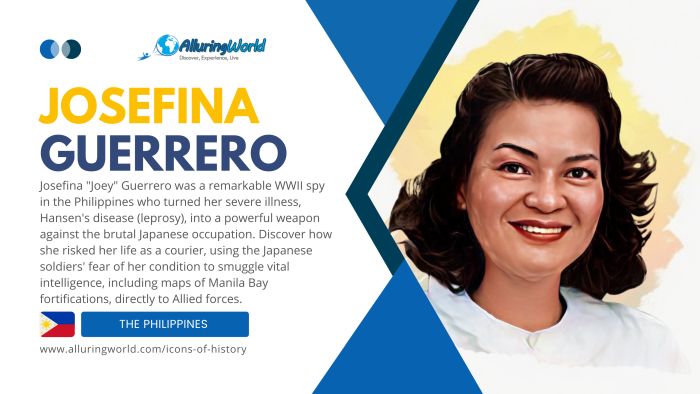
Josefina “Joey” Guerrero was an unlikely hero during World War II because she was a woman whose courage, resourcefulness, and willingness to risk everything made her one of the most remarkable spies in the Philippines. At a time when her country was under brutal Japanese occupation, she used her illness, Hansen’s disease, also known as leprosy, not as a source of weakness, but as a powerful weapon against tyranny. Her story is extraordinary, combining personal struggle with patriotism, sacrifice, and the will to turn misfortune into resistance.
Early Life:
Born in Manila on 5 August 1917, into a family of modest means, Josefina grew up in the Philippines, where she was surrounded by a culture of resilience and adaptability, which were great traits that would later define her. From an early age, she was known for her intelligence, her beauty, and her quick wit. By the time she reached adulthood, she had already built a reputation for being independent-minded, even in a society that expected women to remain confined to more traditional roles.
In her early twenties, Josefina married a naval officer, and the couple had a daughter. For a time, she lived what seemed to be a conventional and promising life, but her path soon took a drastic turn for the worse because she was diagnosed with leprosy. At that time, Hansen’s disease was poorly understood and carried immense stigma. Those afflicted were often ostracized, separated from families, and forced to live in isolation. For Josefina, the diagnosis was devastating, not only because of the illness itself but also because of the social consequences.
Her husband abandoned her, and she was separated from her child. Struggling with both illness and heartbreak, Josefina was thrust into loneliness at a time when the world around her was falling into chaos due to war. Nevertheless, she found a way to transform her life out of this profound suffering, and she turned her life into one of extraordinary purpose.
The Japanese Occupation and Call to Action:
In December 1941, Japan invaded the Philippines, quickly overrunning the islands and establishing a regime of terror marked by executions, forced labor, and widespread atrocities against civilians. The occupation was a dark period in Philippine history, and it awakened strong resistance movements among Filipinos who refused to submit to Japanese rule.
Josefina, though weakened by her illness, longed to fight back. She had already lost her family and social standing due to her leprosy, and she felt she had little left to lose. Her determination caught the attention of the Filipino underground resistance, who quickly realized that her condition could be used strategically.
Japanese soldiers and officials, like most people of the time, were terrified of leprosy, mistakenly believing it was highly contagious through casual contact. This fear gave Josefina a decisive advantage: she could move in areas where others would be searched, questioned, or even executed. The very illness that had marginalized her became her shield and her weapon.
Life as a Spy:
Josefina began her work as a courier and spy for the Philippine resistance. Despite her missions being hazardous, she showed resolution and courage to get involved in the transport of maps, intelligence reports, and crucial messages between guerrilla units and Allied forces. She often traveled on foot across rugged terrain, through forests and rivers, and past heavily guarded checkpoints.
One of her earliest and most famous missions came in 1944, when she was tasked with smuggling detailed maps of Japanese fortifications along Manila Bay to guerrilla fighters. The maps were vital for American forces planning to liberate the Philippines. Carrying the documents hidden in her clothing, Josefina passed through numerous Japanese checkpoints. Soldiers, noticing her skin lesions, recoiled in fear and allowed her to pass without searching her. What might have ended in certain death for another spy became possible because of her illness.
Over time, she carried out dozens of such missions, often slipping through Japanese patrols, weaving between occupied towns, and delivering intelligence that saved countless lives. Josefina’s work was very demanding as it required not only bravery but also immense physical endurance. Leprosy left her weak, and the tropical climate made her journeys exhausting. Yet she persevered, driven by a conviction that she could still contribute meaningfully to the liberation of her country.
Liberation of the Philippines:
As the war was turning in favor of the American forces by 1944 and 1945, General Douglas MacArthur started their campaign to retake the Philippines, which was of significant importance. Josefina’s intelligence reports played a crucial role in guiding Allied operations and ensuring that guerrilla fighters could coordinate effectively with incoming troops.
The most crucial task where she showed her immense bravery was during the Battle of Manila in early 1945. As fighting raged in the city, she crossed dangerous zones to deliver messages that helped Filipino guerrillas and American forces coordinate their assaults against entrenched Japanese defenders. These missions saved countless civilians and soldiers from ambush and unnecessary loss of life.
In the end, when the Philippines was finally liberated in 1945, Josefina’s contributions were acknowledged more among resistance circles, but even though she did not fight with weapons like her comrades, her exceptional courage in intelligence work had been just as vital, if not more so, to win the war.
ADVERTISEMENT
Post-War Struggles:
After the war, Josefina’s heroism was acknowledged, as she was awarded the Medal of Freedom with Silver Palm, which is considered to be one of the highest civilian honors bestowed by the United States at the time. Despite the verbal recognition, this recognition also highlighted her critical role in the liberation of her country and her unique story as a woman who turned personal tragedy into a powerful act of resistance.
Yet, even with these honors, Josefina’s life after the war was far from easy. Unfortunately, leprosy remained a stigmatized disease even after the war, and despite her heroism, she still continued to face discrimination and isolation. She was admitted to the Culion Leper Colony in the Philippines, where thousands of patients were sent to live apart from society.
In the late 1940s, her case was brought to the attention of American officials and doctors, who recognized both her wartime contributions and the injustice of her continued isolation. She was eventually allowed to travel to the United States for treatment. There, she received medical care with newly developed drugs that could control her illness.
Life in the United States:
Josefina remained in the United States, where she finally found a measure of peace and stability. Though she continued to live with the effects of leprosy, she was no longer viewed solely as a patient or an outcast. Instead, she was seen as a symbol of resilience, a woman who had risked everything to serve her country.
She spent the later years of her life living quietly, away from the limelight. As Josefina preferred to live her life in privacy and away from the public eye, unlike some resistance figures who sought recognition or used their fame to build public careers, she was remembered as a woman of grace and quiet strength. She would always be described as someone who had endured profound suffering but had never allowed it to define her.
She passed away in 1996, leaving behind a legacy that, while not as widely known as that of other wartime heroes, is no less remarkable.
Legacy and Importance:
The story of Josefina Guerrero is unique not only because of her bravery but also because of the way she turned personal adversity into strength. At a time when her illness might have led her to despair, she chose to act with courage and defiance. By using the fear and stigma surrounding leprosy to her advantage, she saved lives, aided liberation efforts, and demonstrated that even those considered marginalized or powerless could make an enormous impact.
Her life also highlights the deep intersection of war, gender, and illness. As a woman in a male-dominated resistance movement, and as a patient stigmatized by disease, she occupied multiple layers of vulnerability. Yet she overcame them, proving that heroism often comes from the most unexpected individuals.
In recent years, historians and writers have begun to recover her story, ensuring that she is remembered alongside other significant figures of the Philippine resistance. For Filipinos, she remains a symbol of national pride, courage, and determination. For the world, her life offers a lesson in resilience, showing how adversity can be transformed into a powerful force for justice.
Conclusion:
Josefina “Joey” Guerrero lived a life marked by hardship, illness, and loss, yet she rose above these challenges to become one of the most remarkable spies of the Second World War. Her work as a courier for the resistance, her ability to use leprosy as a shield against enemy forces, and her dedication to her country even when she had little left personally mark her as a true hero.
Her story is not only about wartime bravery but also about the ability to find purpose and dignity in the face of suffering. Though her name may not be as widely recognized as others, her contributions remain vital to the history of the Philippines and to the larger story of human resilience. In remembering Josefina Guerrero, we honor a woman who turned misfortune into strength and who, in her quiet and courageous way, changed the course of history.