
Read time ca. 7 minutes
Jim Thorpe, born on 22 May 1887 in a one-room cabin near Prague, Oklahoma, is a person who came from humble beginnings and achieved greatness as one of the greatest athletes of the 20th century. His abilities to play several types of sports, such as track and field, American football, and baseball, have earned him international recognition, though his journey was marked equally by triumph and controversy. Thorpe is often seen as a natural athlete whose abilities transcended individual sports, and the legacy he left behind continues even to this day to symbolize resilience, versatility, and the enduring pursuit of excellence that many modern athletes strive for.
Early Life and Heritage:
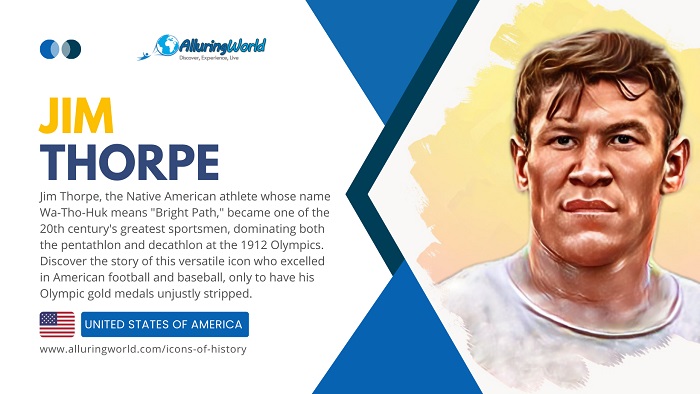
Thorpe was born into the Sac and Fox Nation, a heritage he carried with deep pride throughout his life. The Native name he was given is Wa-Tho-Huk, which translates to “Bright Path,” and will be a sign that foreshadowed the remarkable journey he would take. Unfortunately, his childhood was shaped by hardship as he lost his twin brother at a young age, so that later he’d endure his parents’ death during his adolescence. Despite these tragedies, Thorpe found comfort in outdoor life and physical activity, often hunting, running, and riding across the Oklahoma plains.
Education proved inconsistent for Thorpe, yet his talent for athletics soon drew notice. After attending various schools, he eventually enrolled at the Carlisle Indian Industrial School in Pennsylvania, which was an institution created to assimilate Native American youth into Western society, and became the platform where his athletic gifts would first gain national attention.
Athletic Breakthrough at Carlisle:
During his school years at Carlisle, Thorpe was under the guidance of his coach Glenn “Pop” Warner, who would become an instrumental figure in refining his abilities. As he was initially excelling in track and field, Thorpe’s dominance was noticed when he won multiple events in single meets, demonstrating remarkable strength, endurance, and coordination. As his versatility stretched across various athletic sports such as sprints, jumps, hurdles, and throws, they set him apart as a rare all-around competitor.
In addition to all this, Thorpe also thrived in American football at Carlisle, emerging as a powerful running back, kicker, and defensive player. Thorpe was gaining attention throughout the whole nation, but this would increase even more, especially during the 1911 and 1912 seasons when Carlisle became a formidable American football force. His ability to score from nearly any position on the field was unrivaled, earning him recognition as one of the greatest collegiate players of the era.
Olympic Glory:
The zenith of Thorpe’s career arrived at the 1912 Olympic Games in Stockholm. He was competing in two events, the pentathlon and the decathlon, and he managed to deliver performances that stunned the sporting world as he excelled in both. He was dominating the competition with remarkable ease, and in the end, he won the gold in both events. In the pentathlon, he placed first in four out of five events. At the same time, in the decathlon, he amassed 8,412 points (later recalculated under modern scoring systems to be even higher), setting a standard for multi-sport athletes.
King Gustav V of Sweden famously declared, “You, sir, are the greatest athlete in the world,” to which Thorpe modestly replied, “Thanks, King.” After the amazing triumphs in Stockholm, he cemented his place as an international icon who represented athletic brilliance and the potential of Native American athletes on the world stage.
Professional Sports Career:
Following the Olympics, Thorpe transitioned into professional sports. He signed with Major League Baseball’s New York Giants in 1913 and played for several teams over the next seven years. While not considered a standout baseball player, he displayed solid skills as an outfielder, contributing both speed and power.
American football, however, remained his strongest field as he played for the Canton Bulldogs of the early National Football League. At that time, it was known as the American Professional Football Association. His leadership and athleticism helped popularize the fledgling league, and he served as its first president in 1920. Thorpe’s role in professional American football laid critical groundwork for the sport’s growth into America’s most popular pastime.
ADVERTISEMENT
Controversy and Loss of Olympic Medals:
Unfortunately, despite the Olympic heroics he managed to do, Thorpe’s career was overshadowed by controversy. As a rule, in violation of the amateurism baseball rules of the era, in 1913, it was revealed that he had previously played minor league baseball for a small salary, something that was not allowed. This was a reason for the International Olympic Committee (IOC) to strip him of his gold medals, which would turn out to be a decision that would be widely criticized as unjust. Many argued that Thorpe had been singled out unfairly, as other athletes often earned money through similar means.
This decision haunted Thorpe for the rest of his life, diminishing what should have been an unblemished legacy, but all his medals would be restored posthumously in 1983, acknowledging the profound injustice he endured.
Later Life and Personal Struggles:
After his athletic career waned, Thorpe was not used to life outside the spotlight, and he faced difficulties adjusting to this life outside. It was unfortunate that financial instability would plague him, and he worked a variety of jobs, including construction, security, and even acting in minor film roles. Health issues further complicated his life and struggles with alcoholism.
While he endured all these challenges, Thorpe remained a revered figure among his peers and fans, admired for his athletic brilliance and his quiet dignity in the face of hardship. Despite the personal setbacks he had, his persistence became an enduring part of his life story.
Legacy and Recognition:
Jim Thorpe passed away on 28 March 1953 in Lomita, California. His death marked the end of a remarkable chapter in sports history, yet his influence over the next generations could still be felt. In 1950, he was named by the Associated Press as the Greatest Athlete of the First Half of the Century, underscoring the impact of his achievements across multiple disciplines.
In 1982, the U.S. Congress declared Thorpe the most outstanding athlete of the century, while statues, museums, and sporting institutions continue to honor his legacy. The Jim Thorpe Award, presented annually to the best defensive back in college American football, carries his name as a tribute to his enduring influence. On top of the inspiration he is to all Americans, his story has also been a source of inspiration within Native American communities. The success he had throughout his entire life represents both the triumphs and struggles that are faced by Indigenous athletes in the broader landscape of American sports.
Conclusion:
In conclusion, Jim Thorpe’s life embodied both the glory of athletic achievement and the harsh realities of injustice. As a man who excelled in virtually every sport he attempted, he set a standard few have matched. His Olympic victories, professional sports career, and contributions to American football positioned him as a pioneer, while the challenges he endured reflected the broader struggles of his heritage and era. Though often misunderstood and unfairly treated, Thorpe’s brilliance remained undeniable. Today, he is celebrated not only as a champion of his time but also as a symbol of resilience and excellence whose story continues to inspire athletes across generations.