
Read time ca. 7 minutes
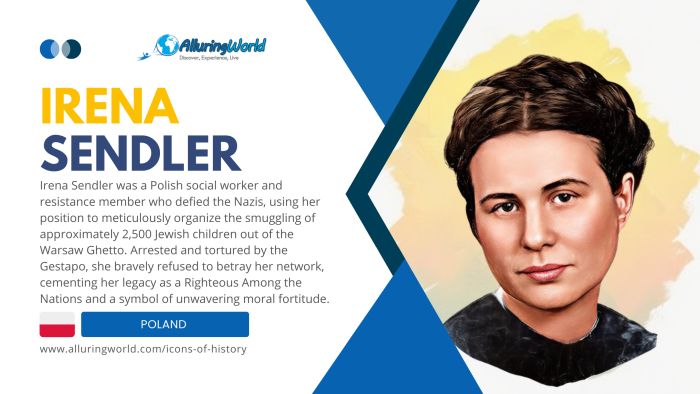
Irena Sendler was a Polish social worker, humanitarian, and member of the resistance who saved thousands of Jewish children while she risked her life during one of humanity’s darkest periods, the Holocaust. The shown extraordinary courage and the unwavering commitment to human dignity made her one of the most remarkable figures of World War II, exemplifying the resolute upholding of her beliefs despite facing great risk. Nowadays, she remains a testament to the power of individual initiative in times of widespread oppression.
Early Life:
Born on 15 February 1910 in Warsaw, which was then part of the Russian-controlled region of Poland, she was the only child of Stanisław and Jadwiga Krzyżanowska. Her father was a physician who encouraged her to have a deep sense of empathy and responsibility, which would be great values that would shape her later humanitarian work. Tragically, he died of scarlet fever when Irena was only seven years old, but despite this event profoundly influencing her commitment to caring for others, she managed to keep her father proud and follow his encouragement. On the other hand, her mother worked as a teacher, which clearly emphasized the importance of education and moral integrity in a person’s life, and this simply reinforced Irena’s early sense of duty.
Irena attended high school in Warsaw, where she excelled academically and cultivated an interest in social issues. The exposure she had to the harsh realities of poverty and inequality in her city inspired her to pursue studies in social work, and through these studies, she could combine compassion with practical action. In 1928, she enrolled in the University of Warsaw to study law and social sciences, developing the analytical and organizational skills that would later support her resistance activities.
Early Career and Social Work:
Before the outbreak of the Second World War, Sendler worked as a social worker with the Warsaw Department of Social Welfare. In this capacity, she focused on improving living conditions for impoverished children and families, often visiting the most neglected neighborhoods of the city. Her work exposed her to the vulnerabilities of marginalized communities and strengthened her resolve to intervene when people were in danger.
When Poland was invaded by Nazi Germany in September 1939, this event dramatically altered the context of her work. With the Nazi invasion, the German authorities imposed brutal restrictions, in particular on the Jewish population, so Sendler witnessed the systematic persecution of her fellow citizens, something she did not expect. She quickly came to a realization that traditional social work was insufficient to address the growing threats and the insecure situation of the vulnerable minorities, prompting her to take decisive action to protect those at the most significant risk.
Resistance and Rescue Efforts:
Irena Sendler became a member of the Polish underground organization Żegota, which was a resistance network that dedicated its work to aiding Jews in occupied Poland. As everyone in the organization was operating under extraordinary risk, she managed to develop a comprehensive system to rescue children from the Warsaw Ghetto. Using her position as a social worker as a cover, she gained access to the ghetto, where she provided food, medicine, and false identity documents for children and their families.
Sendler orchestrated the smuggling of approximately 2,500 Jewish children out of the ghetto, placing them with sympathetic Polish families, orphanages, and convents. All of the children received a pseudonym and a carefully documented record of their original identity, and their real identities were buried in jars and containers to preserve the possibility of reuniting them with their families as soon as the war ended. The planning Sendler did was reflected with compassion and strategic thinking, as it balanced immediate safety with long-term outcomes.
All of the methods she used were varied and inventive. Children were hidden in ambulances, suitcases, and even coffins, demonstrating her resourcefulness and willingness to confront danger directly. These operations were carried out under constant threat of detection by German authorities, who imposed death sentences for those caught aiding Jews.
ADVERTISEMENT
Arrest, Torture, and Survival:
Unfortunately, Irena Sendler was arrested by the Gestapo in October 1943, and her arrest was the result of a denunciation, possibly from a neighbor or from a woman who ran a launderette that served as a drop-off point for the resistance. This woman was arrested and, under torture, revealed Sendler’s name. During interrogation, Sendler was subjected to immense torture that was designed to extract information about her network and the children she had saved. Even though this was quite the brutal treatment, she refused to betray her colleagues or the identities of those she had rescued. The courage she showed under duress exemplified extraordinary moral fortitude, as she always put the safety of others before her own survival.
Although sentenced to death, Sendler’s life was spared through the intervention of Żegota operatives, who bribed German officials and arranged her escape from prison. As soon as she was released, she continued to work in secret as she managed to maintain contact with rescued children and continued assisting the broader resistance movement until the liberation of Warsaw in 1945.
Postwar Life and Recognition:
After the war, Sendler continued her social work, focusing on helping orphaned children and rebuilding communities shattered by conflict. She married Mieczysław Sendler, a fellow resistance member, and continued to live quietly in Poland, avoiding public attention for many decades despite her extraordinary wartime contributions.
Her heroism was eventually recognized internationally. In 1965, Yad Vashem honored her as Righteous Among the Nations, a distinction reserved for non-Jews who risked their lives to save Jews during the Holocaust. In subsequent years, she received numerous awards and honors, including the Order of the White Eagle, Poland’s highest civilian decoration. In addition to this, educational initiatives, documentaries, and biographies were made in her honor, which further secured her legacy and made sure that new generations understand the magnitude of her achievements during the dark chapter of human history.
Legacy and Influence:
As her actions demonstrate the profound impact of individual courage and ethical responsibility, she combined professional skill, organizational ability, and moral clarity to save thousands of lives. All these feats were often under circumstances that seemed impossible. Her legacy is a historical record of humanitarian achievement that could be used to inspire other people to fight against oppressed people, but it can also be used as a source of inspiration for social workers, educators, and activists worldwide. By doing amazing work in keeping the real identities of the rescued children and documenting her operations properly, she made sure that her interventions could be traced and remembered once the war is over, and this whole work offered tangible proof of human resilience and compassion.
Conclusion:
In conclusion, today, Irena Sendler exemplifies the extraordinary potential of one person to resist injustice and protect human life against overwhelming odds. The meticulously performed planning, fearless action, and unwavering dedication not only saved thousands of children from certain death but also left a legacy of courage and moral clarity for those after her to follow and admire. Today, she is remembered not only for her acts of heroism but also for embodying the ethical responsibility to intervene in the face of oppression, providing a timeless example of human compassion in the darkest of times.