
Read time ca. 8 minutes
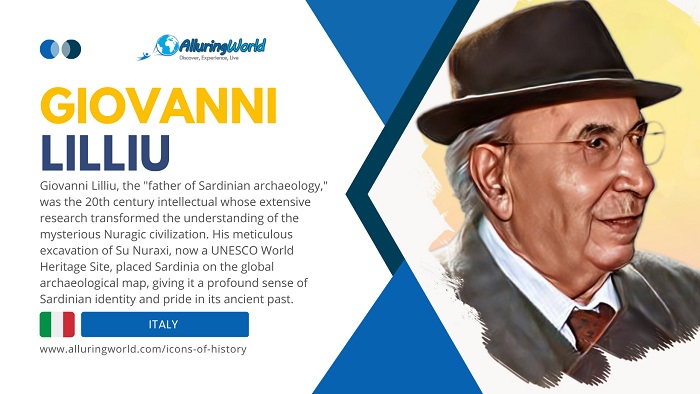
Giovanni Lilliu holds a place of distinction in Italian cultural history as one of the most influential archaeologists, historians, and intellectuals of the 20th century. Known as the “father of Sardinian archaeology,” his extensive research shed light on the Nuragic civilization. This mysterious and complex culture flourished on the island of Sardinia thousands of years ago. The work he did was not only for the transformation of the academic understanding of Sardinia’s past but also strengthened Sardinian identity, inspiring a deeper appreciation for its heritage.
Early Life and Education:
Giovanni Lilliu was born on 13 March 1914 in Barumini, a small town in the heart of Sardinia’s Campidano region. Growing up in a rural community, he developed an early fascination with the surrounding landscape, which was dotted with enigmatic stone towers, known as nuraghi. These prehistoric structures, unique to Sardinia, seemed to carry whispers of an ancient world, and young Lilliu felt drawn to uncover their secrets.
His intellectual curiosity was matched by academic discipline. When he finished school in the local school, he pursued higher education at the University of Cagliari, where he studied classical literature and archaeology. Lilliu’s talent and determination led him to further his training at the University of Rome La Sapienza, one of Italy’s most prestigious institutions for historical studies. During this period, he refined his methodologies and built the foundations for his lifelong research into Sardinia’s early civilizations.
Archaeological Career and Research:
Giovanni Lilliu dedicated much of his professional life to fieldwork, concentrating on the Nuragic civilization, which thrived on Sardinia from approximately 1800 BCE to 200 CE. This society left behind an extraordinary archaeological legacy in the form of nuraghi—tower-like stone fortresses—as well as tombs, sanctuaries, and settlements. Before Lilliu’s work, the civilization was poorly understood, often relegated to vague theories and speculation. His detailed excavations and scholarly rigor changed that perception entirely.
As it is known nowadays, his most significant achievement came in the mid-20th century as he did his work and excavated Su Nuraxi in his hometown of Barumini. Su Nuraxi is a complex of towers, defensive walls, and village structures, which turned out to be the most complete and best-preserved Nuragic site ever discovered. Through years of systematic excavation, Lilliu revealed the sophistication of the builders, who had advanced architectural knowledge and a well-organized social structure.
The discovery of Su Nuraxi not only deepened historical knowledge but also gained international recognition. Due to the high importance and in order to have the site better preserved, in 1997, it was declared a UNESCO World Heritage Site, which only serves as a testament to its cultural value and to Lilliu’s pioneering work. With this immensely important work, he had effectively placed Sardinia on the archaeological map of Europe, as it ensured its ancient heritage received the respect it deserved.
Contributions to Understanding the Nuragic Civilization:
Still, Lilliu’s scholarship extended far beyond excavation, because throughout his life, he published extensively, and he also authored books, essays, and academic papers that analyzed the Nuragic world in detail. His important research revealed that the Nuragic people were not isolated, as it might have been thought at the beginning, but participated in exchanges with other Mediterranean civilizations, and these would include the Phoenicians, Etruscans, and Carthaginians. By tracing artifacts, pottery, and trade networks, he demonstrated the dynamism of Sardinia’s role in ancient history.
To top it all, he also examined religious practices, social hierarchies, and the daily life of the Nuragic people, so through painstaking analysis, he managed to reconstruct certain aspects of their worldview, and Lilliu’s work highlighted the importance of community, defense, and spirituality. His interpretations went beyond technical archaeology; they sought to give voice to a culture that more dominant narratives of Mediterranean antiquity had long overshadowed.
Another significant contribution was his emphasis on cultural continuity. He argued that elements of Sardinian traditions, folklore, and rural life of the Nuragic world could have been transferred to modern life, preserving fragments of an identity that persisted through centuries of foreign influence and political upheaval. This perspective connected the ancient past with modern Sardinians, offering them a renewed sense of pride in their heritage.
ADVERTISEMENT
Academic and Political Roles:
Despite his archaeological achievements, Giovanni Lilliu was a public intellectual who managed to be an influential figure in cultural and political life. His lifework was carried out via a professorship that he had at the University of Cagliari, where he trained generations of archaeologists and historians, and inspired others to see beyond and make discoveries that others might miss. His influence as a teacher extended far, shaping the course of Sardinian scholarship for decades.
In addition, Lilliu was also engaged in politics, as he was a member of the Italian Parliament, and later he became a member of the Senate. The political work he was carrying out highly reflected the same values as his academic career because he continued to be dedicated to the preservation of culture, the promotion of Sardinian autonomy, and the defense of regional identity within the broader Italian framework. He consistently advocated for policies that supported archaeology, cultural heritage, and education, showcasing further his belief that the past could serve as a foundation for a stronger, more cohesive future for the new generations.
Writings and Intellectual Contributions:
There is a great number of published works throughout his life, which will remain essential reading for students of Mediterranean archaeology. Among his most notable publications is La Civiltà dei Sardi dal Neolitico all’età dei nuraghi (The Civilization of the Sardinians from the Neolithic to the Age of the Nuraghi), a sweeping synthesis of Sardinia’s prehistory that combined meticulous data with accessible interpretation.
The writing style he reflected in his work could be seen as a dual role: scholar and educator. Even though it could be seen as intensely rigorous, this work was also crafted to reach a wider audience, so that it would ensure that knowledge of Sardinia’s ancient culture was not confined to academic circles but could encourage ordinary people as well. He believed that cultural awareness was a cornerstone of civic identity, and the publications he completed played a vital role in shaping Sardinian self-understanding in the modern era.
Later Life and Recognition:
Even if he was getting old, Lilliu continued to write, lecture, and contribute to public life well into his later years. His efforts earned him numerous awards, honorary degrees, and recognition within Italy and internationally. He continued to be deeply connected to Barumini, and Su Nuraxi nowadays is considered to be not only a worldwide known symbol of Sardinia’s ancient past but also a personal legacy of his life’s work.
Unfortunately, he passed away on 19 February 2012, at the age of 97, leaving behind a body of work that transformed both the academic study of archaeology and the cultural landscape of Sardinia. His passing was marked by tributes from scholars, politicians, and citizens who recognized him as one of the island’s most important figures of the 20th century.
Legacy:
Nonetheless, Lilliu’s legacy endures in multiple ways. Academically, his discoveries and publications remain foundational, forming the basis upon which new generations of archaeologists continue to build, but culturally, his interpretation of the Nuragic world fostered a renewed sense of Sardinian identity. His life’s work, in other words, helped people connect their modern traditions with their ancient roots.
The preservation of Su Nuraxi as a UNESCO site is perhaps the most visible symbol of its influence, attracting visitors from around the world and ensuring that the Nuragic civilization remains a living part of Sardinia’s story. Equally important, his foundation and continued educational initiatives keep his vision alive, promoting heritage as a source of pride and learning for all.
Conclusion:
In conclusion, Giovanni Lilliu’s life was marked by a relentless pursuit of knowledge, a profound love for his homeland, and a belief in the power of culture to shape identity. Even if he came from a small town in Sardinia, he managed to rise to international recognition as one of the greatest interpreters of Mediterranean prehistory, and through his meticulous research, passionate teaching, and political engagement, he left an indelible mark on both academic scholarship and public life.
Through his work, Sardinia’s ancient civilization emerged from obscurity into global recognition, and its people were reminded of the richness of their history. Giovanni Lilliu’s legacy continues to resonate, reminding us that understanding the past is not only about studying ruins but about shaping how we see ourselves today and how we envision our collective future.