
Read time ca. 7 minutes
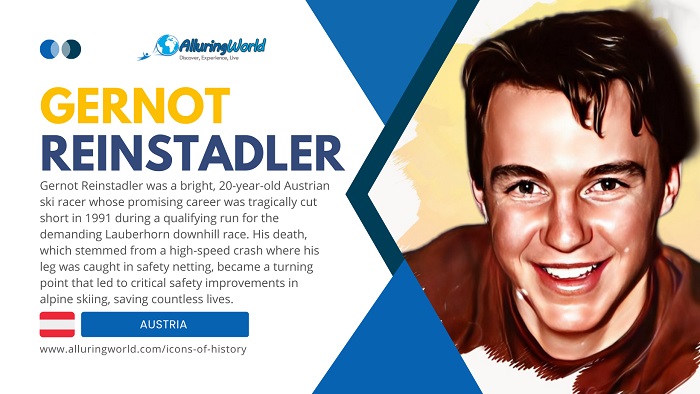
The world of alpine skiing has always been marked by moments of triumph and moments of tragedy, but sadly, among those stories that continue to linger in the collective memory of the sport is that of Gernot Reinstadler, a young Austrian ski racer whose life and career were cut short in 1991. As Reinstadler was 20 years old, he was seen as one of the brightest talents in downhill skiing, and he was a promising athlete who was thought to have the ability to continue Austria’s long tradition of producing world-class competitors. Unfortunately, his unexpected death became a defining moment in ski racing history, as it left behind a sense of loss but also led to essential safety improvements in the sport.
Early Life and Passion for Skiing:
Gernot Reinstadler was born on 24 August 1970 in Austria, a country where skiing is more than just a sport; it is part of the cultural identity. Growing up surrounded by mountains and snow, it was only natural that he gravitated toward the slopes from an early age. His family encouraged his athletic pursuits, recognizing his natural ability and determination on skis.
Like many Austrian children, he joined a local ski club, where his talent quickly stood out. Numerous coaches and fellow athletes noticed his courage and technical skill, which were qualities that are essential for excelling in the demanding discipline of downhill racing. By his teenage years, Reinstadler was already making a name for himself on the junior circuit, showing the blend of speed, balance, and focus that separates good skiers from great ones.
Rise in Competitive Skiing:
Throughout his young years, Reinstadler’s success was well noticed, and it brought him to junior competitions, which would lead him to take part in Austria’s national team. Being part of the national team was grandiose and quite a prestigious achievement in a country that is renowned for its ski racing dominance. The Austrian Ski Federation (ÖSV) has always held high expectations for its athletes, and Reinstadler was no exception. He was viewed as one of the new generation of racers who could carry on Austria’s proud legacy in the downhill and super-G events.
He began competing in the FIS World Cup circuit, where the world’s best skiers test themselves against some of the most challenging courses on the planet. Even though he was still in the early stages of his World Cup career, Reinstadler’s performances revealed his true potential, which would prove that he would have a promising future as a skier. His ability to handle speed with composure and his hunger to push limits impressed both fans and coaches alike. Many believed he would soon become one of Austria’s leading downhill racers.
ADVERTISEMENT
The 1991 Accident at Lauberhorn:
Tragically, Reinstadler’s rising career came to an abrupt and devastating end on 18 January 1991. He was participating in a qualifying run for the famous Lauberhorn downhill race in Wengen, Switzerland. The Lauberhorn is one of the most iconic and demanding courses in the World Cup, known for its high speeds, sharp turns, and unforgiving terrain.
During his run, Reinstadler lost control at one of the jumps near the finish section of the course. As he attempted to land, sadly, his skis spread apart, and his leg was caught in the safety netting at high speed. The violent crash caused severe internal injuries, including massive blood loss from a ruptured pelvis. Despite being rushed to a hospital in Interlaken and undergoing immediate surgery, Reinstadler succumbed to his injuries later that evening.
His sudden death sent shockwaves through the entire skiing community. As he was only 20 years old, he was on the cusp of what promised to be an extraordinary career with significant accomplishments. The loss of such a young and talented athlete left Austria and the international ski racing world in mourning.
Impact on Alpine Skiing Safety:
While Gernot Reinstadler’s death was a tragedy, it also became a turning point for safety in alpine skiing. His unfortunate accident exposed weaknesses in the protective measures that were used at that time at downhill races, particularly the design of safety nets, which would protect the skiers in case they fell. At the time, nets were not always able to absorb the force of high-speed crashes safely, and the openings in the netting could cause serious entanglement injuries.
Following the accident, the International Ski Federation (FIS) and race organizers took immediate steps to reevaluate safety standards. As a result, new netting systems were introduced, and this time they were better designed because they absorbed impacts without trapping skiers. These improvements became part of a larger movement within the sport because it prioritized every athlete’s safety while still preserving the thrilling speed and challenge of downhill racing.
As his death was a painful reminder of the ski racing-associated risks, but the changes that followed have undoubtedly saved lives and prevented similar tragedies in the years since. His name became associated not only with lost potential but also with reforms that made the sport safer for future generations.
Legacy of a Fallen Star:
As Reinstadler’s competitive record was relatively brief, he managed to leave an impact that has endured far beyond his results. For the Austrian people, he remains a symbol of promise that will be incomplete, and simply put, a talented racer whose life ended far too soon. His story is often told alongside those of other athletes whose deaths highlighted the inherent dangers of extreme sports and served as catalysts for change.
The Lauberhorn race, one of the most prestigious events in skiing, continues each year with added safety measures that owe much to the lessons learned from the accident. For many in the skiing community, remembering Reinstadler is also a way of honoring the risks athletes take when they compete at the highest levels.
Today, young Austrian skiers who dream of racing on the World Cup circuit grow up with stories of Gernot Reinstadler, understanding both the glory and the dangers of the sport. His life serves as a reminder that while victories and medals are celebrated, the true heart of skiing lies in the courage and passion of those who dare to race down the steepest mountains at incredible speeds.
Conclusion:
In conclusion, Gernot Reinstadler’s story is one of promise, tragedy, and lasting influence. He was a gifted young skier with a bright future who embodied the spirit of Austrian alpine racing before his life was cut short at only 20 years old. As his death shocked the skiing world, it was a reminder and a driver for critical safety improvements, as well as changes that continue to protect athletes today.
Despite his career being brief, Reinstadler’s legacy lives on in the slopes, the races, and the safer conditions that are given and enjoyed by skiers who came after him. His name will continue to remain as a poignant reminder of the fine line between triumph and tragedy in the world of alpine skiing.