
Read time ca. 9 minutes
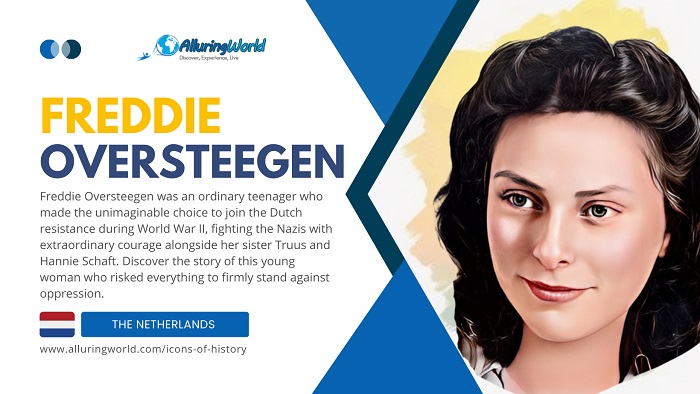
One of the stories of extraordinary courage is that of Freddie Oversteegen, who is fighting against remarkable figures in the darkest forces in modern history. As a teenager growing up in the Netherlands during World War II, she made the unimaginable choice to join the resistance and actively fight the Nazis. She carried out missions alongside her sister Truus and their friend Hannie Schaft, and these missions included sabotage, espionage, and even targeted assassinations, which would help in the continuation of the fight against the oppressor. Freddie’s legacy is a testament to the strength of ordinary people in extraordinary circumstances, and her life continues to inspire as a reminder of how even the youngest voices can stand firmly against oppression.
Early Life:
Freddie Nanda Oversteegen was born on 6 September 1925 in Haarlem, a city located in the province of North Holland, in the western part of the Netherlands. Ever since a young age, Freddie and her sister Truus, who were raised by their mother, were instilled with a strong sense of social justice and empathy. Their mother was a committed socialist who opposed fascism and believed in standing up for the vulnerable. Life was not always easy for the family, as they lived modestly and often faced financial struggles, but their home was filled with ideals of fairness and resistance to tyranny.
Even before the war, the Oversteegen family was involved in helping others. Their mother took in refugees, communists, and Jews who were fleeing persecution in Germany during the rise of the Nazi regime. This environment left a deep impression on Freddie and Truus, showing them that courage was not reserved for soldiers but could also be lived out in everyday acts of kindness and defiance.
When Germany invaded the Netherlands in May 1940, Freddie was just 14 years old. The occupation quickly turned Haarlem and the rest of the country into a place of fear, scarcity, and violence. For many, survival meant keeping one’s head down, but for Freddie, her sister, and their mother, it meant action.
Joining the Resistance:
The Oversteegen sisters began their resistance activities in small but meaningful ways. At first, their involvement included distributing anti-Nazi leaflets, helping to spread messages of defiance, and encouraging others to resist collaboration with the occupiers. They also secretly aided people who were hiding from the Nazis, including Jews and those who refused conscription into forced labor.
It was through this early resistance work that they came into contact with members of the Dutch armed underground. Soon, both sisters were recruited into more dangerous missions. At the time, Freddie was only 15 years old. Her youth and innocent appearance made her less likely to arouse suspicion, which became a powerful tool in her work.
Her recruitment into the resistance was not accidental; it was a recognition of her bravery, sharp mind, and willingness to act despite her young age. Together with Truus and later Hannie Schaft, she became part of a small but determined group of women who would go on to make a lasting impact on the Dutch resistance.
Acts of Sabotage and Espionage:
Being part of the resistance, Freddie took part in missions of sabotage that disrupted German supply lines, communications, and infrastructure. These operations were hazardous and often carried out at night, requiring both skill and nerves of steel. The sisters sometimes worked to derail trains or set fire to warehouses, knowing full well that discovery meant torture or execution.
In addition to this, Freddie also worked as a courier, managing to deliver messages, weapons, and even false identification papers to other resistance members. Her responsibilities with this role were to travel through checkpoints, interact with soldiers, and appear completely ordinary while carrying highly incriminating material. She was excellent in the tasks she was given since her ability to remain calm under pressure and blend into her surroundings allowed her to complete these missions successfully and without any issues.
Perhaps most famously, Freddie and her companions engaged in targeted assassinations of Nazi officers and Dutch collaborators. These missions were controversial, morally complex, and fraught with risk. Yet they were seen as necessary acts to weaken the occupiers’ grip and to deter those who aided the Nazis.
ADVERTISEMENT
Using Appearance as a Weapon:
One of the tactics that Freddie and Truus employed was the use of their youth and femininity as a weapon. Both sisters, and later Hannie Schaft, would ride bicycles through the streets of Haarlem, sometimes luring German soldiers into isolated areas under the pretense of flirtation, only for the soldiers to be ambushed and executed by resistance fighters.
Freddie herself admitted years later that these missions were not easy. Though she carried them out with determination, she described the deep psychological burden of taking lives, even in the context of war. “We had to do it,” she recalled in interviews, “but it was never something we enjoyed.”
This duality, being a teenage girl on one hand, and a deadly resistance fighter on the other, made Freddie’s story unique. She embodied both innocence and defiance, showing how the fight against fascism sometimes demanded unthinkable sacrifices.
Partnership with Truus and Hannie Schaft:
Freddie’s relationship with her sister Truus was central to her resistance work. The two were inseparable, supporting each other through the dangers and fears of their missions. Their bond gave them strength and courage at times when failure could mean death.
Later, they partnered with Hannie Schaft, a university student known for her fiery red hair, who became one of the most famous figures in the Dutch resistance. Together, the trio carried out some of the most daring missions in Haarlem and beyond. Hannie’s eventual capture and execution by the Nazis in 1945 left a deep scar on Freddie and Truus, reminding them of the fragility of their own survival.
The End of the War:
When the war ended in May 1945, Freddie was only 19 years old but had already lived through experiences that most could scarcely imagine. The liberation of the Netherlands brought relief, but it also left her and her sister grappling with the memories of what they had done and witnessed.
For many resistance fighters, the postwar years were complicated. Though hailed as heroes, they often struggled with trauma and the weight of having lived double lives. Freddie and Truus both faced these difficulties, but they also dedicated themselves to ensuring that the stories of the resistance were not forgotten.
Life After the War:
Freddie Oversteegen went on to live a quiet life, marrying and raising a family. For many years, she rarely spoke publicly about her wartime experiences. Like many survivors of the resistance, she carried the emotional scars privately, choosing not to dwell on the past.
In later decades, however, she and her sister Truus began to share their stories more openly, recognizing the importance of preserving the history of the resistance for future generations. They gave interviews, participated in documentaries, and worked to educate young people about the horrors of war and the necessity of standing up against injustice.
The Dutch government recognized their efforts, and both sisters received national honors for their service. In 2014, they were awarded the Mobilization War Cross, a decoration recognizing their extraordinary contributions during the occupation.
Freddie continued to live in Haarlem for most of her life, remaining deeply connected to her community and her family. She passed away on 5 September 2018, one day before her 93rd birthday, leaving behind not only her children and grandchildren but also an enduring legacy of courage.
Legacy and Importance:
The story of Freddie Oversteegen is one of youth, courage, and moral conviction. At an age when most teenagers are preoccupied with school and friendships, she was carrying out sabotage missions and confronting the brutal realities of war. Her story underscores the fact that resistance movements were not solely the work of soldiers or political leaders; ordinary people sustained them, many of them very young, who refused to submit to tyranny.
Freddie’s life also challenges stereotypes about women in war. Too often, history has overlooked the role of women in resistance movements, reducing them to supportive or secondary roles. Freddie, Truus, and Hannie Schaft defied those expectations, taking on missions as dangerous and significant as any carried out by men.
Her legacy is not just about the specific actions she took but also about the larger message that courage can come in many forms and from the most unexpected places. In an era when fascism sought to impose silence and submission, Freddie Oversteegen’s defiance is a reminder of the power of resistance and the strength of young voices.
Conclusion:
Freddie Oversteegen lived through one of the most harrowing periods of the twentieth century and emerged as a symbol of youthful courage against oppression. From her early resistance work to her daring missions alongside her sister Truus and Hannie Schaft, she demonstrated a resolve far beyond her years. Though the burden of her actions weighed heavily on her, she never allowed fear or doubt to silence her fight for justice.
Her story continues to inspire as a reminder of the resilience of ordinary individuals, particularly women and young people, in the face of extraordinary danger. Freddie Oversteegen’s life proves that even in the darkest of times, acts of courage, however small or large, can shape the course of history.