
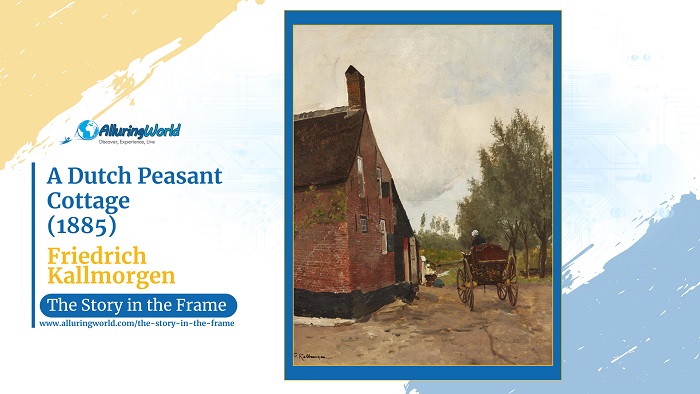
A Dutch Peasant Cottage by German artist Friedrich Kallmorgen is a detailed and evocative portrayal of rural life in the Netherlands. Known for his landscapes and genre scenes, Kallmorgen often focused on everyday environments, capturing the textures, atmosphere, and quiet charm of rural architecture. So, in fact, this masterpiece serves as a definitive example of late 19th-century German Realism and architectural study. As a prominent German artist and co-founder of the Grötzingen Artists’ Colony, Kallmorgen utilized this landscape painting to document the intersection of rural architecture and the cultural heritage of the Netherlands. By focusing on the atmospheric composition of a humble Dutch dwelling, the work transcends simple genre scenes to provide a technical masterclass in light, texture, and peasant life.
About the Painter:
Friedrich Kallmorgen (1856–1924) was a German painter celebrated for his landscapes, architectural studies, and genre scenes. Trained at the Berlin Academy of Arts, Kallmorgen developed a precise and realistic style that emphasized composition, lighting, and the depiction of human interaction with their environment. His works often focus on rural architecture, village life, and natural settings, reflecting both technical skill and an appreciation for cultural and regional characteristics. Kallmorgen’s paintings are admired for their clarity, atmospheric depth, and narrative richness.
Inspiration and Reasons Behind the Painting:
Kallmorgen painted during a period when artists were increasingly interested in the detailed observation of rural life and vernacular architecture. A Dutch Peasant Cottage reflects his fascination with the daily rhythms, domestic interiors, and cultural character of rural communities. The painting likely draws inspiration from the artist’s travels and studies of Dutch villages, aiming to preserve both the aesthetic qualities and the social authenticity of peasant dwellings.
What is Depicted in the Painting:
The composition centers on a modest Dutch cottage, perhaps with thatched roofing, wooden shutters, and stone or brick walls. Surrounding the building are gardens, pathways, and possibly farm animals or simple domestic activity, emphasizing the connection between the residents and their environment. Kallmorgen captures architectural details, textures, and the harmonious integration of the cottage with its surroundings. The scene conveys both the solidity of the structure and the warmth of everyday life, inviting the viewer to appreciate the charm of rural domesticity.
Colors and Techniques:
Kallmorgen employs a naturalistic palette, using earthy browns, muted greens, soft grays, and subtle highlights to depict the building and its surroundings. His brushwork is controlled and precise, rendering textures of wood, stone, and foliage with clarity. Light is carefully handled to enhance depth, illuminate architectural features, and convey the atmosphere of a quiet rural setting. The interplay of color, texture, and light creates a balanced composition that is both realistic and aesthetically pleasing.
Conclusion:
A Dutch Peasant Cottage exemplifies Friedrich Kallmorgen’s skill in portraying rural architecture and everyday life with authenticity, detail, and narrative charm. Through careful observation, technical precision, and atmospheric composition, the painting celebrates the quiet beauty and cultural character of a humble dwelling. It remains a testament to Kallmorgen’s ability to transform simple domestic settings into enduring works of art.