
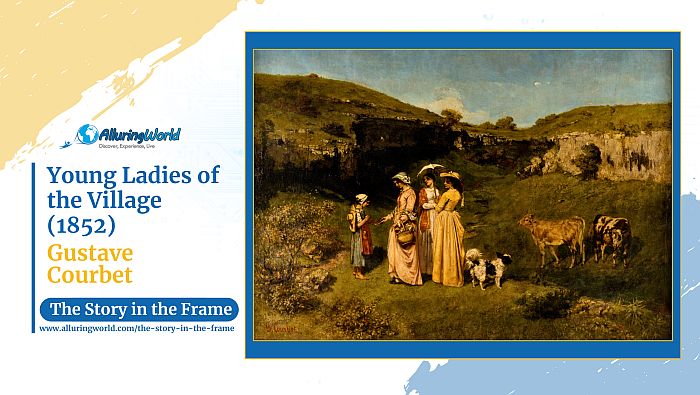
The amazing painting Young Ladies of the Village was painted in 1852 by Gustave Courbet and is a significant example of Realist painting, presenting a scene of everyday life with unidealized honesty and quiet social tension. This is a painting that reflects the work of Courbet and his rejection of academic idealization in favor of direct observation, portraying contemporary figures in a rural setting with naturalism and psychological presence.
About the Painter:
Gustave Courbet (1819–1877) was a French painter and the leading figure of the Realist movement. One of his main ideas of how to see the world is that he believed that art should represent the world as it is, and painters should focus on ordinary people and contemporary life rather than historical, mythological, or romanticized subjects. He was painting realistic paintings that brought to life people’s lives and characteristics, so we can say for certain that Courbet’s bold approach, large-scale canvases, and thick, tactile paint application challenged academic traditions and reshaped modern art.
Inspiration and Reasons Behind the Painting:
Young Ladies of the Village was inspired by Courbet’s hometown of Ornans and his interest in social relationships within rural communities. The painting subtly addresses class distinctions and social interaction because it portrays well-dressed young women who are encountering a peasant girl in a natural setting. Rather than dramatizing the scene, as other painters would have done at that time, Courbet presents the interaction with restraint, thus allowing viewers to interpret the social dynamics without overt moral commentary.
What is Depicted in the Painting:
The composition shows three young women who are dressed in fashionable clothing, and they are standing in a countryside landscape. Being the main focus of the painting, Courbet painted the ladies with a companion of a small dog that appears at the feet of the ladies, and the ladies themselves are offering charity to a barefoot peasant girl. There is also livestock in the lower right section of the composition, which truly suggests the rural landscape. The figures are rendered at nearly life-size, and this gives the scene gravity and presence. While the interaction is quiet and ambiguous, it does suggest kindness and social distance, while the surrounding landscape remains calm and unembellished.
Colors and Techniques:
Courbet employs a naturalistic palette of greens, browns, whites, and muted blues, grounding the figures firmly within the landscape. The brushwork Courbet did is direct and textured, particularly in the rendering of fabric, foliage, and earth. The light throughout the artistic masterpiece is even and unsentimental, further avoiding dramatic contrasts and reinforcing the realism of the scene. The figures are solidly modeled, emphasizing physical presence over idealized beauty.
Conclusion:
In conclusion, Young Ladies of the Village exemplifies Gustave Courbet’s Realist principles and his commitment to depicting contemporary life with honesty and complexity. Through naturalistic color, substantial forms, and understated narrative, the painting invites reflection on social relationships, class, and everyday human interaction. It remains an important work in the development of modern art, illustrating Courbet’s influence and his challenge to traditional artistic hierarchies.