
Read time ca. 7 minutes
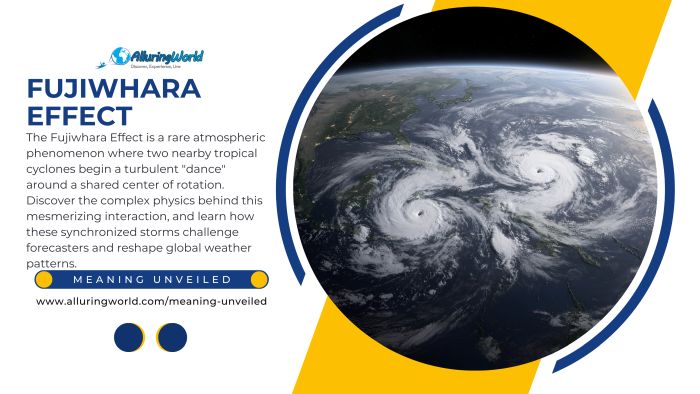
In the world of atmospheric science, there are few fascinating phenomena that are as visually dramatic as the Fujiwhara Effect. It is a rare interaction in which two storms, usually tropical cyclones, begin rotating around a shared center like partners in a turbulent dance. This very unique phenomenon is named after the Japanese meteorologist Sakuhei Fujiwhara, and it creates a wild imagination for weather enthusiasts because it reveals how dynamic, interconnected, and powerful Earth’s systems can be. When we comprehend this effect, this deepens our appreciation of the atmosphere’s complexity, and it also helps meteorologists to anticipate unusual storm behavior better.
What the Fujiwhara Effect Really Is:
At its core, the Fujiwhara Effect describes the motion that occurs when two nearby cyclonic vortices, such as tropical storms or hurricanes, draw close enough to influence each other’s paths. Instead of continuing independently, the storms begin rotating in the Northern Hemisphere counterclockwise around a midpoint between them, while they are rotating clockwise in the Southern Hemisphere.
This interaction does not guarantee that the storms will merge, but it does ensure that their original tracks will shift. For forecasters, this presents both an exciting challenge and an analytical puzzle, as the movement of one system becomes linked to the behavior of another. Even small changes in distance, intensity, or environmental conditions can produce radically different results, making every Fujiwhara scenario uniquely complex.
How Close Do Storms Need to Be?
When we see photos of the storms, they are usually close together, often suggesting a dramatic collision; however, the truth is more subtle. The Fujiwhara Effect typically occurs when two tropical systems come within roughly 1,000–1,400 km (621-870 mi) of each other. Once inside that threshold, each storm’s circulation begins tugging on the other, nudging their paths into curved or looping tracks.
The closer they come, the stronger the interaction becomes. If they move within several hundred kilometers of one another, the dance intensifies and may lead to one of two outcomes: absorption or merger. But whether this happens depends heavily on their comparative sizes and strengths.
Possible Outcomes of the Fujiwhara Interaction:
The Fujiwhara Effect can occur in multiple ways with different scenarios, but this depends on the structure and intensity of the storms that will be involved in this process. Each scenario offers insight into the mechanics of atmospheric motion, and here are four specific scenarios:
- Mutual Orbit Without Merging
When there are two storms of similar strength, they might be circling around a shared point for days, each maintaining its identity while gradually drifting apart. This is the most visually striking form of the effect and the easiest to recognize on satellite imagery.
- One Storm Dominates the Other
This scenario is when one cyclone is significantly stronger or larger, hence it can effectively steer the smaller one. In such cases, the weaker system often loops around the stronger before dissipating or being absorbed. This situation resembles a large vortex pulling a smaller one into its flow.
- Complete Merger
In rare cases, two storms combine into a single, larger system. This is a bit more feared scenario because it can create a more powerful cyclone, though mergers often disrupt internal organization temporarily. These events require precise alignment of size, timing, and atmospheric conditions.
- Disruption and Dissipation
Sometimes the interaction destabilizes one or both systems. Wind shear generated by the storms themselves can weaken their cores, leading to the rapid disintegration of one system while the other continues unaffected.
Each of these outcomes teaches scientists more about how cyclonic forces evolve and how sensitive they are to environmental changes.
ADVERTISEMENT
Why the Fujiwhara Effect Matters for Forecasting:
When forecasters are trying to tell how the storm will act accurately, it could prove to be challenging under normal circumstances, but when there is a a second nearby cyclone, it introduces additional complexity. The Fujiwhara Effect can cause abrupt deviations from predicted paths, sudden speed changes, and unexpected shifts in strength.
For emergency planners and coastal communities, a miscalculated track can be critical, which is why meteorologists are always closely monitoring twin-storm situations by using satellite imagery, computer models, and historical data. When forecasters are tracking airflow patterns and analyzing interactions between the two systems, this helps them to understand possible outcomes and issue timely warnings if necessary.
The broader significance of the effect lies in its ability to reshape weather patterns in entire regions. When storms orbit each other, their atmospheres may overlap, expanding wind fields or altering rainfall distribution. Even if the storms do not make landfall, their synchronized movement can influence ocean currents, moisture transport, and pressure patterns across large distances.
Historical Examples of the Fujiwhara Effect:
Several major cyclonic events have demonstrated the Fujiwhara Effect, allowing scientists to study how the phenomenon unfolds in real time. One notable case occurred in 1995 in the Pacific, when Hurricanes Iris and Humberto interacted as they moved across open waters. Their motions became synchronized, leading to looping tracks that deviated significantly from earlier projections.
Another famous example took place in 2017 when Typhoons Noru and Kulap interacted over the western Pacific. Due to the path they had, Noru absorbed Kulap, thus gaining additional strength soon after. This case highlighted how merging systems can shift in intensity and organization, complicating forecasting efforts.
As scientists and forecasters are using previous storms to predict how storms could behave in the future, these events, among others, continue to inform today’s understanding of storm interactions and the circumstances that cause the Fujiwhara Effect to manifest.
The Physics Behind the Dance:
Although the effect is visually mesmerizing, its explanation is firmly grounded in atmospheric physics. Cyclones are rotating columns of rising air powered by warm ocean water. As they spin, they generate large circulations that influence airflow around them. When two circulations lie within influence range, the laws of physics dictate that they begin to rotate around a shared center, and this is an outcome governed by conservation of angular momentum.
This same principle appears in other natural and physical systems, in particular within space. For example, binary stars orbit each other in a similar fashion, and even small vortices in fluids exhibit comparable behavior. Since the universality of the phenomenon can be applied to different situations, this makes the Fujiwhara Effect an essential reference across scientific fields, bridging meteorology with broader principles of rotational dynamics.
Inspiration for Sky and Storm Watchers:
The Fujiwhara Effect continues to captivate the public due to its magnificence and its remarkable imagery. Seeing two storms orbit each other, we are offered a humble reminder of the atmosphere’s power and precision, and each interaction reflects a delicate balance of forces. To put it simply, when there is too much separation, nothing happens; but when there is too much proximity, one storm collapses entirely.
Tracking such events for many weather enthusiasts becomes a way to connect more deeply with Earth’s natural systems, as they are invited to explore how storms breathe, evolve, and influence one another. This simply transforms the weather into something else, and it becomes a living system that is constantly shifting and adapting.
Conclusion:
To sum it all up, the Fujiwhara Effect is one of the most intriguing interactions in atmospheric science. When two cyclones come close enough to influence each other, they begin a coordinated movement that transforms their paths and occasionally their structure. When we try to understand this effect, we are allowing ourselves to forecast better, while at the same time making sure that we are enriching our appreciation of the complexity within Earth’s atmosphere.
Studying the Fujiwhara Effect reminds us that even powerful storms are part of a broader system of motion and balance. If you are part of the weather community and you follow weather with curiosity, this effect will offer you a meaningful glimpse into the invisible forces that shape our world, thus inviting you to look to the horizon or the satellite map with renewed wonder.